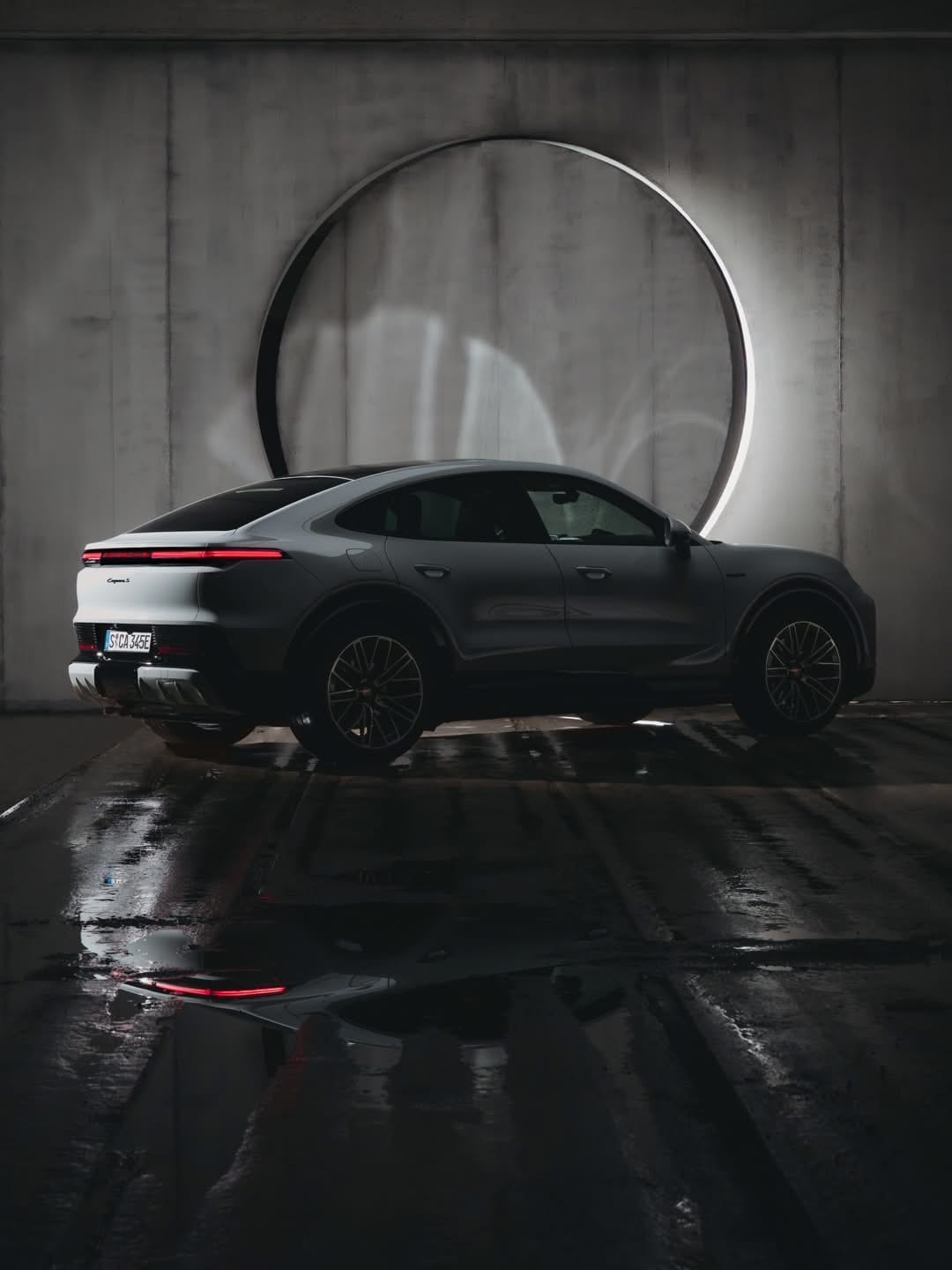

Porsche launched the 2026 Cayenne S Coupé Electric in November 2025 at $131,200 MSRP—a dual-motor luxury SUV delivering zero-emissions performance with a 3.6-second 0–60 mph sprint and customer deliveries beginning late summer 2026. The EPA range isn't confirmed yet, but ownership economics improve significantly when you factor in the $7,500 federal credit and eliminate conventional maintenance costs.
Unmistakable design meets real-world performance. With a flyline inspired by the iconic 911 and precise coupé proportions, every detail carries intent—from the athletic roofline to the sculpted haunches. Beneath the surface, Porsche's official spec lists a 3.6-second 0–60 mph with Launch Control—slightly slower than the 1,156-hp Cayenne Electric Turbo but still quicker than most SUVs on the road. The dual permanently excited synchronous motors deliver AWD torque instantly, and the front motor disconnects under partial load to extend range. Towing capacity hits 7,716 lb with the optional Off-Road package, cargo volume swells to 47.6 ft³ with the rear seats folded, and the top speed is electronically governed at 155 mph on summer tires. That's Porsche engineering—no compromises.

Ownership math tells the full story. Based on Vincentric's 2025 analysis of luxury EV SUVs, expect a five-year total cost around $110,000–$131,000 (model-dependent, 75,000 mi). Depreciation hits hard: iSeeCars' March 2026 study shows EVs average a 57.2% loss over five years—luxury models often worse—but maintenance savings offset some pain. Vincentric found 43 of 54 EVs had lower maintenance than ICE counterparts; typical luxury EV SUVs save $2,000–$4,500 over five years (no oil, transmission, or exhaust work). Insurance runs roughly $3,500–$4,500 annually per Quadrant 2025 data for premium electric SUVs, and charging at Electrify America's $0.56/kWh peak rate costs about $1,200/year for typical use. Factor in the federal credit and you're looking at true ownership costs competitive with gasoline luxury SUVs—particularly if you can charge at home and eliminate premium fuel costs entirely.
Cold weather bites, but less than you'd fear. Recurrent's November 2025 telematics data (30,000+ U.S. vehicles) shows EVs retain roughly 78% range at 32°F and 70% at 20°F—call it a 20–30% winter loss in typical freezing conditions. Argonne National Lab's September 2024 dynamometer tests showed steeper hits at 0°F (average 50% range loss), but the Cayenne's heat pump and battery-thermal management mitigate the worst. Pre-condition while plugged in—Argonne measured 9–20% energy savings at 20°F—and use seat heaters instead of blasting cabin heat. Minneapolis owners will see range dip in January, but Phoenix drivers stay near ideal year-round. That's physics, not a Porsche problem.
Gasoline had its century. The Cayenne S Coupé Electric runs on electrons, and it's landing in American driveways this summer—ready for 240 V garage outlets and everyday usability without compromise.
Frequently Asked Questions About the 2026 Porsche Cayenne S Coupé Electric
- What is the actual EPA range of the 2026 Cayenne S Coupé Electric? Porsche has not yet released confirmed EPA range figures for the Cayenne S Coupé Electric as of the article's publication. The 113 kWh gross battery pack suggests competitive range for the luxury EV SUV segment, with official numbers expected closer to customer deliveries in late summer 2026.
- Does the Cayenne S Coupé Electric qualify for the $7,500 federal tax credit? The article references the $7,500 federal credit as part of ownership calculations, suggesting eligibility. Buyers should verify current IRS guidelines and battery-sourcing requirements at purchase time, as EV tax-credit rules can change and depend on income limits and vehicle assembly location.
- How does the charging speed compare to other luxury electric SUVs? The Cayenne's 800-volt architecture enables 10–80% charging in roughly 16 minutes at compatible ultra-high-power chargers. This matches or exceeds most luxury EV SUVs, putting it among the fastest-charging vehicles in its class alongside other 800 V platforms like the Audi e-tron GT and Hyundai Ioniq 5.
- What maintenance costs can I expect compared to a gas-powered Cayenne? Based on Vincentric's luxury EV SUV analysis, expect $2,000–$4,500 in maintenance savings over five years versus gasoline models. The electric Cayenne eliminates oil changes, transmission service, exhaust system repairs, and spark-plug replacements—though brake service, tires, suspension, and battery coolant remain.
- Can the Cayenne S Coupé Electric tow, and what's the maximum capacity? Yes. With the optional Off-Road package, the Cayenne S Coupé Electric can tow up to 7,716 lb, making it suitable for boats, trailers, or travel campers. Towing will significantly reduce driving range, as with all electric vehicles.
- How much will it cost to charge the Cayenne S Coupé Electric at public stations? At Electrify America's typical peak rate of $0.56/kWh, expect roughly $1,200 annually for average use. Home charging with a Level 2 (240 V) charger will be significantly cheaper—typically $0.10–$0.15/kWh depending on local electricity rates—potentially reducing annual charging costs to $400–$600 for typical driving.