Apple has quietly laid the groundwork for its 2027 iPhone, tapping Samsung for a micro-curved polarizer-free display and testing under-display Face ID, according to supply-chain reports surfaced in late April. There's no official press release, none in Apple's U.S. Newsroom, but the supply-chain evidence is substantial enough to sort out what's real, what's technically doable, and what actually matters.
Driving the news: Industry sources say Apple is prototyping a "quad-curved" panel with Samsung's Pol-less (polarizer-free) OLED stack for the 20th-anniversary iPhone. Samsung publicly demonstrated this tech, branded Eco² OLED or OCF, at MWC25 in February 2025, claiming peak brightness of 5,000 nits under lab conditions and roughly 20 percent thinner panels. That's not marketing vapor; Samsung has the datasheets.
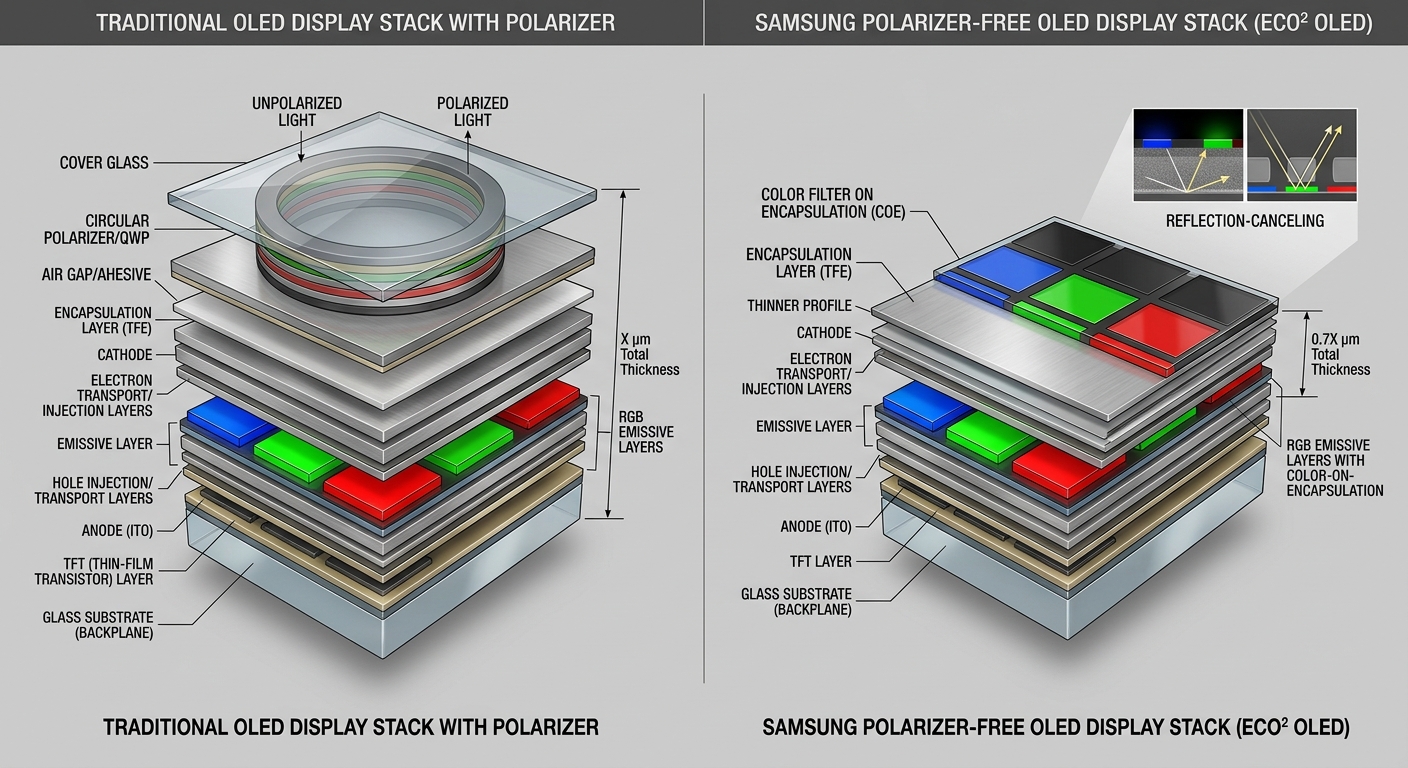
Why it matters: Dropping the polarizer lets more light through and cuts power draw. Samsung says the same brightness costs about 63 percent of the typical energy. In practice, your screen stays legible in direct sunlight without killing the battery by noon. The micro-curve adds a tactile payoff: instead of hitting a hard edge when you swipe from the side, your thumb glides over a smooth radius. Small ergonomic gain, but it adds up over hundreds of daily gestures.
The catch: Under-display Face ID remains unconfirmed. Multiple credible sources, The Information, analyst Ross Young at DSCC, Bloomberg's Mark Gurman, reported Apple is working toward it for 2026–2027 Pro models, but March 2026 supply-chain updates flagged engineering snags. Apple may ship a smaller Dynamic Island cutout rather than a fully hidden sensor array. Treat "hidden Face ID" as aspirational until Apple or a teardown proves otherwise.
By the numbers: Samsung's OCF panels are up to 0.2 mm thinner than conventional stacks; peak brightness reaches 3,000+ nits in typical use and 5,000 nits in Samsung's 10-percent-pixel test rig. U.S. supply-chain players include Universal Display (phosphorescent OLED materials), Corning (raw glass for ultra-thin covers), Applied Materials and KLA (fab equipment). Panel production stays in Korea; final assembly will be in East Asia.
What we're watching: If Apple follows the rumored staged rollout, Pro models get the new display first (fall 2027), with mainstream models in 2028. Apple's recent iOS development work has shown the company is building software hooks for advanced OLED calibration and on-device sensor tuning, which aligns with the Pol-less and under-display roadmap.
Bottom line: The tech exists and Samsung is ramping production; whether Apple ships it next year or the year after depends on yield, cost, and whether the company solves the Face ID optical challenges. Watch for official word at WWDC or the fall iPhone event, and ignore any spec that isn't backed by a datasheet or a teardown.