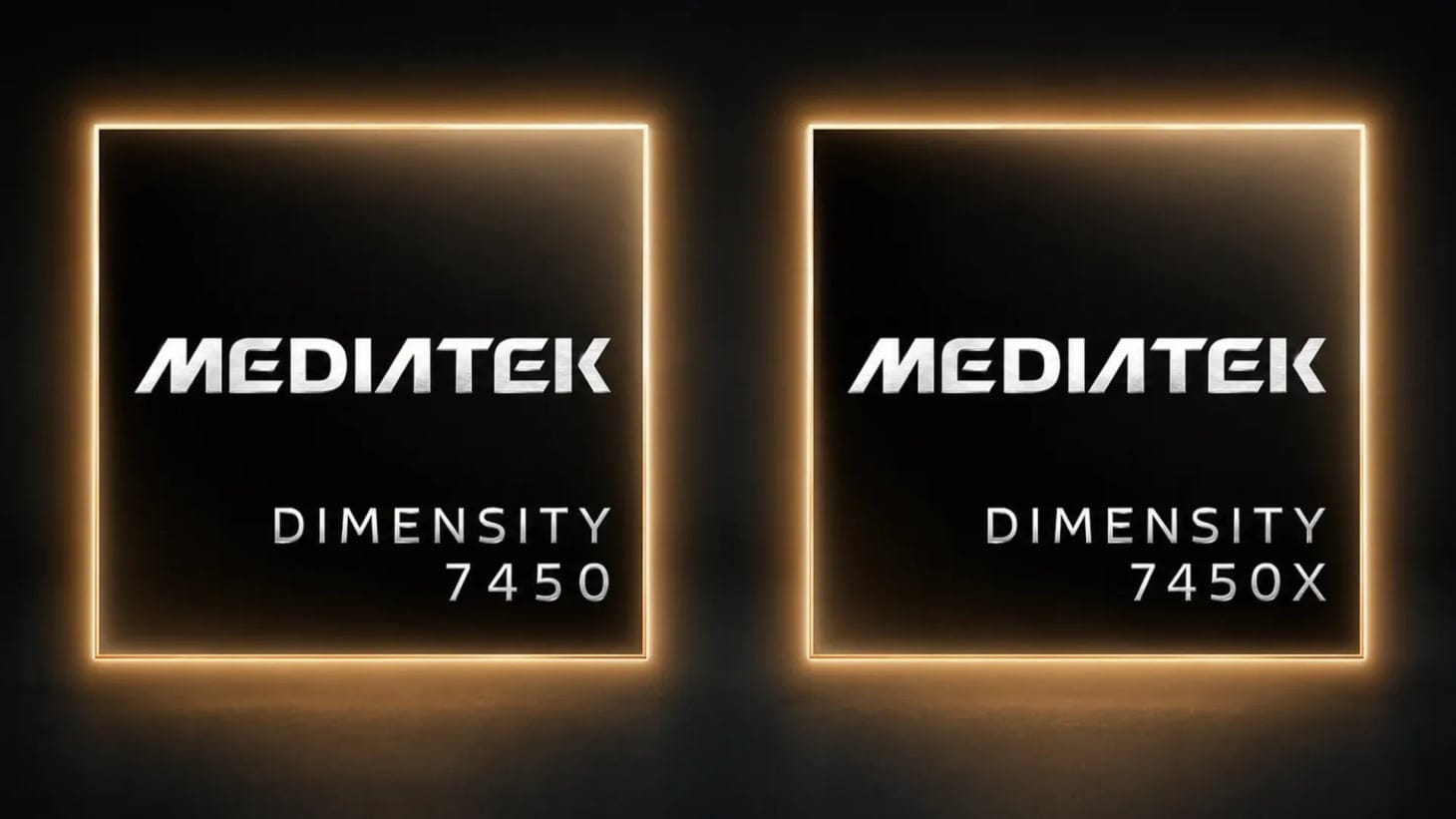

MediaTek quietly added the Dimensity 7450 and 7450X chipsets to its lineup, targeting mid-range smartphones with a 4nm process and foldable-optimized dual-display support in the 7450X version. The company designed the processors to push foldable capabilities beyond premium flagships, positioning the 7450X to power Motorola's upcoming devices and other affordable flip foldables expected later this year.
Both chips share an octa-core CPU: four Arm Cortex-A78 performance cores running up to 2.6 GHz and four Cortex-A55 efficiency cores. Graphics run on an Arm Mali-G615 MC2 GPU, and MediaTek's sixth-generation NPU tackles on-device AI with a claimed 7% performance boost over the prior generation. The Imagiq 950 ISP handles camera sensors up to 200 MP, 4K30 HDR video, and hardware noise reduction. Memory comes in LPDDR5 up to 6,400 Mbps and UFS 3.1 storage. The display pipeline drives WFHD+ panels at 120 Hz or Full HD+ at 144 Hz with 10-bit HDR.
The 7450X builds on the base 7450 with firmware and power-management tweaks for dual-screen devices. An internal foldable panel and an external cover display work together. Industry analysts say the variant keeps apps running smoothly across screens, trims power draw when only the cover is on, and adds hinge-sensor support for multi-window use. It follows MediaTek's "X" line of foldable-focused chips, which favor display-pipeline efficiency over raw compute horsepower, Counterpoint Research notes.
According to leaks from multiple tech outlets, the first smartphone to use the Dimensity 7450 chipset will be the Motorola Edge 70, which is slated for launch on April 29, 2026. The device is expected to showcase the new processor's capabilities in the mid-range smartphone segment. Additional details about U.S. availability, carrier partnerships, and pricing have not yet been officially announced by Motorola.
The Dimensity 7450 sits in MediaTek's mid-range tier alongside Qualcomm's Snapdragon 7 Gen 4 and 7s Gen 3/4 families. Qualcomm's parts enjoy broad U.S. carrier support and established mmWave modem certifications; MediaTek's recent M-series modems offer sub-6 GHz and emerging mmWave capability, though carrier integration varies by OEM. IDC and Counterpoint expect the foldable smartphone segment to grow about 20 to 30% year-over-year in 2026, driven by new form factors and Apple's anticipated entry, which could grab more than 22% of first-year foldable unit share and roughly 34% of market value. Grand View Research forecasts U.S. foldable revenue to hit $14.3 billion by 2030, up from $6.6 billion in 2024, a 12.9% compound annual growth rate.
Foldable phones have stayed premium, often topping $1,500. By packing dual-display optimization and flagship-class camera and AI power into a mid-range SoC, MediaTek lets makers offer flexible designs at lower price points. That opens up choices for U.S. shoppers who want innovation without a flagship price tag. If devices like the Edge 70 launch at competitive prices and deliver strong performance, we'll likely see more OEMs roll out mid-range smartphones and foldables throughout 2026. Success in North America could shift perception of MediaTek in a market long dominated by Qualcomm's brand equity, especially among carrier-branded devices.