
• My Feed
  • Home
  • What's Important
  • Media & Entertainment
Search

Stay Curious. Stay Wanture.

© 2026 Wanture. All rights reserved.

  • Terms of Use
  • Privacy Policy
Tech/Trends
Tech Bubbles, Explained

Why AI market chaos mirrors the minicomputer era—and what comes next

12 December 2025

—

Explainer *

Rhea Kline
banner

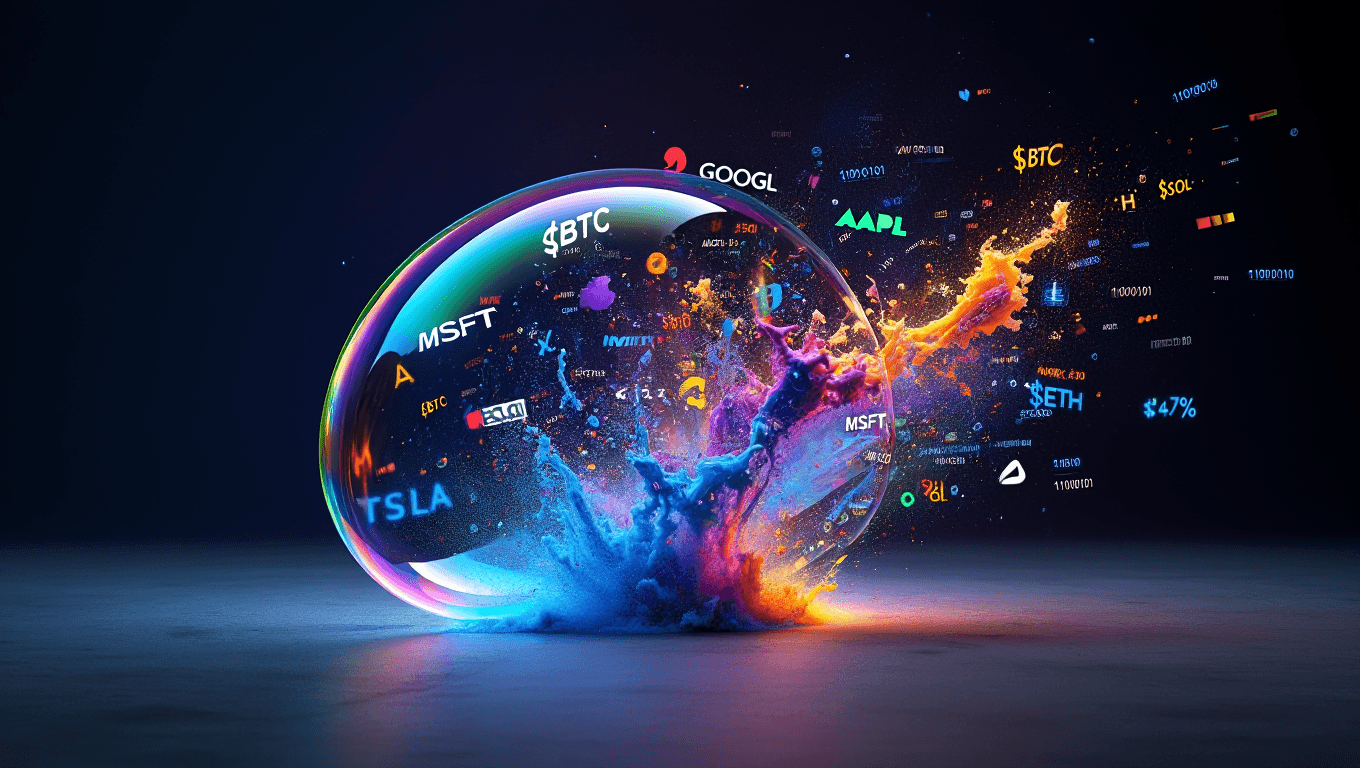
Tech bubbles aren't irrational crashes. They're sorting machines. Between the 1950s and 1970s, hundreds of minicomputer companies launched, competed, and mostly vanished—but the technology won completely. AI is following the same four-stage pattern: breakthrough, expansion, competition, shakeout. We're in stage three now. Most companies will fail. A few will dominate. The technology will succeed entirely. Understanding this cycle reveals which AI companies might survive—and why the chaos is actually progress.

image-106

Summary:

  • Tech bubble cycles are a predictable 4-stage process: breakthrough, expansion, competition, and consolidation that transforms emerging technologies.
  • AI is currently in the competition stage, with hundreds of startups competing, mirroring historical tech cycles like minicomputers in the 1960s.
  • The cycle isn't a crash but a sorting mechanism that tests approaches, eliminates weak players, and ultimately produces lasting innovation.

AI startups raised more than $50 billion in 2024. Investors call it a revolution. Skeptics call it a scam. By understanding how tech bubble cycles actually work, you'll know what happens next and which companies survive.

What It Is

A tech bubble cycle is a repeating pattern where new technology attracts massive investment, hundreds of companies compete, most fail, and a few winners emerge. It's a market phenomenon, not a sign of irrationality. Unlike financial bubbles that collapse completely, tech cycles produce real, lasting innovation. The technology succeeds even when most companies don't.

Why It Matters

Every major technology platform followed this pattern. Personal computers did it in the 1970s and 1980s. The internet did it in the 1990s and 2000s. Mobile did it in the 2000s and 2010s. Investors use the pattern to identify winners. Founders use it to time market entry. It separates hype from genuine innovation.

How It Works

Tech bubble cycles move through four stages. Each stage looks chaotic but serves a function. The minicomputer era of the 1950s through 1970s demonstrates the pattern clearly.

Stage One: The Breakthrough

A technical innovation makes something newly possible. For minicomputers, transistors replaced vacuum tubes. Computers shrank from room-sized mainframes costing millions to desk-sized machines costing thousands. Universities and mid-sized companies could access computing power for the first time.

Think of it like the first smartphone with a touchscreen that actually worked. The technology existed before. This made it practical. A breakthrough isn't entirely new. It's newly practical at scale.

According to the Computer History Museum, Digital Equipment Corporation launched in Massachusetts in 1957. The breakthrough opened a market nobody knew existed.

Stage Two: The Expansion

Capital floods in. Dozens of companies form to exploit the breakthrough. Between 1960 and 1962, the U.S. saw 1,002 IPOs (initial public offerings, when private companies sell shares to public investors) across all industries, according to financial records from the Securities and Exchange Commission. Electronics and computer companies led the surge.

This looks like mania. It's actually discovery. Nobody knows which approach will work best. The market funds many experiments simultaneously.

Think of it like a neighborhood restaurant boom. One Mexican restaurant opens and succeeds. Ten more open within a year. The market tests which locations, prices, and menus work. Most will close. Two will thrive and expand.

Stage Three: The Competition

Dozens of players fight for the same customers. Prices drop. Features multiply. Marketing intensifies. This is when observers start using the word "bubble." Too many companies. Too much capital. Not enough differentiation.

Digital Equipment Corporation launched the PDP series in the 1960s. Data General followed with the Nova. Prime Computer emerged. So did dozens of others. They competed on price, performance, software compatibility, and service.

Think of it like the NCAA March Madness basketball tournament. Sixty-eight teams enter. Each round eliminates half. The bracket looks overwhelming at first. By the finals, only the strongest remain. The competition phase optimizes who survives.

Stage Four: The Consolidation

Most companies disappear. A few grow dominant. The technology becomes infrastructure. By the late 1970s, DEC controlled most of the minicomputer market in America, according to industry analysis by the MIT Sloan School of Management. Data General survived as a smaller competitor. Most others vanished.

But the technology itself had won. Minicomputers became essential to universities, laboratories, and businesses nationwide.

This is the stage people remember as "the bubble popping." It's not destruction. It's consolidation. Only the most efficient producers remain.

Think of it like testing different pizza places in your neighborhood. You try ten. You stick with two favorites. The eight you stopped visiting didn't prove pizza was a bad idea. They proved the market was working correctly.

Real-World Examples

Example 1: Digital Equipment Corporation

DEC launched in Massachusetts in 1957. It released the PDP-1 minicomputer in 1960 for $120,000. Universities bought them for research. Companies bought them for specialized tasks. By the 1970s, DEC was America's second-largest computer company after IBM, according to corporate records archived at the Computer History Museum. Then it failed to adapt to personal computers. Compaq acquired DEC in 1998.

The lesson: First movers can dominate an entire cycle. But surviving one consolidation doesn't guarantee surviving the next disruption.

Example 2: The 1960 to 1962 IPO Surge

Between 1960 and 1962, electronics firms went public at record rates. Data from the SEC shows 269 IPOs in 1960, 435 in 1961, and 298 in 1962. Any company with "tronic" in its name could raise money. Most had little revenue. Most had no clear path to profit. Investors bought them based on the promise of the technology sector. By 1963, most had collapsed. Texas Instruments and a few others survived to define the industry.

The lesson: Speculation clusters around real innovation. The excess doesn't invalidate the innovation. It's the market's search cost for discovering what works.

Example 3: Data General

Founded in 1968 by ex-DEC engineers, Data General released the Nova in 1969 for $8,000. That was dramatically cheaper than DEC's machines. It sparked intense competition. Data General grew rapidly in the 1970s, according to business school case studies from Harvard Business School. It struggled in the 1980s as personal computers emerged. EMC acquired it in 1999.

The lesson: Lower prices expand markets fast. But price alone doesn't ensure long-term dominance. You need operational discipline and the ability to adapt to the next wave.

Common Misconceptions

Myth: High valuations prove a bubble will crash.

Reality: High valuations reflect uncertainty about transformative technology. When technology is genuinely new, nobody knows its eventual value. Markets price in many scenarios simultaneously. Some justify extreme valuations. Most don't. The pricing process works. It's just messy.

Myth: Company failures prove the technology failed.

Reality: Most companies fail in every industry. Technology markets just move faster. The minicomputer era produced dozens of failures and a handful of dominant firms. The failures didn't mean minicomputers were a bad idea. They meant the market was sorting correctly.

Myth: The shakeout is the only stage that matters.

Reality: Every stage matters. The expansion stage explores possibilities. The competition stage optimizes approaches. The shakeout stage consolidates winners. You can't skip stages. The apparent waste is actually a necessary search cost.

What This Means for AI

AI is following the same four-stage pattern right now. The breakthrough came around 2017 with transformer architectures (the technology behind ChatGPT and similar systems). The expansion started around 2020. We're now deep in the competition phase.

Hundreds of AI startups exist. Every major tech company has an AI strategy. Capital remains abundant even as skepticism rises.

One key difference: most AI companies stay private longer. The 2002 Sarbanes-Oxley Act (a law that made public offerings more expensive and complex) changed the timeline. The expansion and competition phases now happen mostly in venture capital (money invested in startups in exchange for ownership) rather than public markets. This makes the cycle less visible but equally real.

The consolidation phase is coming. Look for companies with sustainable advantages: proprietary data sets that competitors can't replicate, distribution power through existing customer relationships, deep technical expertise in specific domains, or exceptional capital efficiency. These signals matter more than hype or valuation.

Key Takeaway

Tech bubble cycles are a sorting machine, not a gambling table. They test many approaches and eliminate weak ones. Understanding the four stages helps you spot which companies will survive.

The question for AI isn't whether it's overhyped. The question is: which companies have sustainable advantages that will carry them through consolidation?

We're in stage three. Stage four is coming. That's not a crash. That's progress.

Which stage do you think reveals the most about who will win?
What is this about?

  • Explainer */
  • Rhea Kline/
  • Tech/
  • Trends
  • investment cycles/
  • technology markets/
  • artificial intelligence/
  • tech innovation cycles/
  • startup ecosystem

Feed

    Button AI Assistant Debuts, Offering Screen‑Free Voice Help

    Button AI Assistant Debuts, Offering Screen‑Free Voice Help

    Nostalgic iPod Shuffle design meets privacy‑first press‑to‑talk AI

    about 18 hours ago
    Razer Hammerhead V3 HyperSpeed Debuts with Dual‑Mode Case

    Razer Hammerhead V3 HyperSpeed Debuts with Dual‑Mode Case

    The USB‑C case also serves as a 2.4 GHz receiver, cutting dongles for PS5 and phones

    about 18 hours ago
    Apple ships 6.2 million Macs Q1 2026, M5‑MacBook Pro leads

    Apple ships 6.2 million Macs Q1 2026, M5‑MacBook Pro leads

    Apple’s share rises to 9.5%, moving it into fourth place among global PC makers

    about 18 hours ago
    Galaxy S22 Ultra can be bricked after factory reset

    Galaxy S22 Ultra can be bricked after factory reset

    US owners report IMEI‑level lock that hands control to unknown administrator Numero LLC

    about 18 hours ago
    Mouse: P.I. for Hire arrives April 16 on PC, PS5, and Xbox

    Mouse: P.I. for Hire arrives April 16 on PC, PS5, and Xbox

    Modes: 4K 60 fps quality or 120 fps performance on PS5 and Xbox Series X

    about 18 hours ago
    YouTube Rolls Out Auto Speed for Premium Users

    YouTube Rolls Out Auto Speed for Premium Users

    The AI‑driven playback boost aims to cut dead air on long videos

    1 day ago
    Blackwell Set to Capture Majority of the 2026 GPU Market

    Blackwell Set to Capture Majority of the 2026 GPU Market

    GB300/B300 GPUs Push Blackwell to 71% of Shipments; Rubin Falls to 22%

    1 day ago
    Google launches AI avatar tool for Shorts on April 9, 2026

    Google launches AI avatar tool for Shorts on April 9, 2026

    Ages 18+ can create digital replicas, with Synth ID tags and a 3‑year auto‑delete

    1 day ago
    Mac OS X 10.0 Cheetah runs on Wii

    Mac OS X 10.0 Cheetah runs on Wii

    Ports Mac OS X 10.0 Cheetah to the Wii, showing the PowerPC 750CL can run an OS

    2 days ago
    DuoBell Beats ANC: Safer Cycling with Apple AirPods Max

    DuoBell Beats ANC: Safer Cycling with Apple AirPods Max

    A 750 Hz blind‑spot lets DuoBell cut through ANC on popular headphones

    2 days ago
    Škoda DuoBell prototype unveiled on April 5, 2026

    Škoda DuoBell prototype unveiled on April 5, 2026

    750 Hz pulse and 2,000 Hz chime cut through ANC, alerting riders faster at 15 mph

    2 days ago
    SteamGPT Leak Reveals Dual‑Role AI on Steam

    SteamGPT Leak Reveals Dual‑Role AI on Steam

    Leak shows AI handling support and cheat‑detection for millions on the platform

    2 days ago
    Oppo Pad mini challenges Apple with Snapdragon 8 Gen 5

    Oppo Pad mini challenges Apple with Snapdragon 8 Gen 5

    April 21: Oppo Pad mini 8.8‑inch, Snapdragon 8 Gen 5, 5.39 mm, 279 g, 144 Hz OLED

    2 days ago
    Apple to ship 3 million foldable iPhones by end‑2026

    Apple to ship 3 million foldable iPhones by end‑2026

    Limited rollout equals 12 % of iPhone volume and rivals Samsung’s 2.4 million Galaxy Z Fold 7 sales

    2 days ago
    Apple unveils iPhone 18 Pro, iPhone 18 Pro Max, and iPhone Ultra

    Apple unveils iPhone 18 Pro, iPhone 18 Pro Max, and iPhone Ultra

    Mockups match leaked renders; 20 million Samsung panels for iPhone Ultra

    3 days ago
    Sony launches Playerbase program for Gran Turismo 7

    Sony launches Playerbase program for Gran Turismo 7

    PlayStation gamers can win a flight, facial scan, and an avatar in Gran Turismo 7

    3 days ago
    Claude Mythos Preview Beats Opus 4.6 in Cybersecurity!

    Claude Mythos Preview Beats Opus 4.6 in Cybersecurity!

    Claude Mythos Preview for five partners—pricing after a 100 million token credit

    3 days ago
    ChatGPT and AI Tools Let Solo Founders Launch Fast

    ChatGPT and AI Tools Let Solo Founders Launch Fast

    With GitHub Copilot, a founder can code, design, and deliver an MVP in days

    3 days ago
    Android 17 beta adds Notification Rules

    Android 17 beta adds Notification Rules

    New rules let users silence, block, or highlight alerts; Samsung eyes One UI 9

    4 days ago
    Utah Starts 12‑Month AI Chatbot Pilot for Psychiatric Meds

    Utah Starts 12‑Month AI Chatbot Pilot for Psychiatric Meds

    Legion Health pilot offers refills for 15 meds, easing shortages in rural Utah

    4 days ago
    Loading...
Tech/Trends

Tech Bubbles, Explained

Why AI market chaos mirrors the minicomputer era—and what comes next

December 12, 2025, 2:51 pm

Tech bubbles aren't irrational crashes. They're sorting machines. Between the 1950s and 1970s, hundreds of minicomputer companies launched, competed, and mostly vanished—but the technology won completely. AI is following the same four-stage pattern: breakthrough, expansion, competition, shakeout. We're in stage three now. Most companies will fail. A few will dominate. The technology will succeed entirely. Understanding this cycle reveals which AI companies might survive—and why the chaos is actually progress.

image-106

Summary

  • Tech bubble cycles are a predictable 4-stage process: breakthrough, expansion, competition, and consolidation that transforms emerging technologies.
  • AI is currently in the competition stage, with hundreds of startups competing, mirroring historical tech cycles like minicomputers in the 1960s.
  • The cycle isn't a crash but a sorting mechanism that tests approaches, eliminates weak players, and ultimately produces lasting innovation.

AI startups raised more than $50 billion in 2024. Investors call it a revolution. Skeptics call it a scam. By understanding how tech bubble cycles actually work, you'll know what happens next and which companies survive.

What It Is

A tech bubble cycle is a repeating pattern where new technology attracts massive investment, hundreds of companies compete, most fail, and a few winners emerge. It's a market phenomenon, not a sign of irrationality. Unlike financial bubbles that collapse completely, tech cycles produce real, lasting innovation. The technology succeeds even when most companies don't.

Why It Matters

Every major technology platform followed this pattern. Personal computers did it in the 1970s and 1980s. The internet did it in the 1990s and 2000s. Mobile did it in the 2000s and 2010s. Investors use the pattern to identify winners. Founders use it to time market entry. It separates hype from genuine innovation.

How It Works

Tech bubble cycles move through four stages. Each stage looks chaotic but serves a function. The minicomputer era of the 1950s through 1970s demonstrates the pattern clearly.

Stage One: The Breakthrough

A technical innovation makes something newly possible. For minicomputers, transistors replaced vacuum tubes. Computers shrank from room-sized mainframes costing millions to desk-sized machines costing thousands. Universities and mid-sized companies could access computing power for the first time.

Think of it like the first smartphone with a touchscreen that actually worked. The technology existed before. This made it practical. A breakthrough isn't entirely new. It's newly practical at scale.

According to the Computer History Museum, Digital Equipment Corporation launched in Massachusetts in 1957. The breakthrough opened a market nobody knew existed.

Stage Two: The Expansion

Capital floods in. Dozens of companies form to exploit the breakthrough. Between 1960 and 1962, the U.S. saw 1,002 IPOs (initial public offerings, when private companies sell shares to public investors) across all industries, according to financial records from the Securities and Exchange Commission. Electronics and computer companies led the surge.

This looks like mania. It's actually discovery. Nobody knows which approach will work best. The market funds many experiments simultaneously.

Think of it like a neighborhood restaurant boom. One Mexican restaurant opens and succeeds. Ten more open within a year. The market tests which locations, prices, and menus work. Most will close. Two will thrive and expand.

Stage Three: The Competition

Dozens of players fight for the same customers. Prices drop. Features multiply. Marketing intensifies. This is when observers start using the word "bubble." Too many companies. Too much capital. Not enough differentiation.

Digital Equipment Corporation launched the PDP series in the 1960s. Data General followed with the Nova. Prime Computer emerged. So did dozens of others. They competed on price, performance, software compatibility, and service.

Think of it like the NCAA March Madness basketball tournament. Sixty-eight teams enter. Each round eliminates half. The bracket looks overwhelming at first. By the finals, only the strongest remain. The competition phase optimizes who survives.

Stage Four: The Consolidation

Most companies disappear. A few grow dominant. The technology becomes infrastructure. By the late 1970s, DEC controlled most of the minicomputer market in America, according to industry analysis by the MIT Sloan School of Management. Data General survived as a smaller competitor. Most others vanished.

But the technology itself had won. Minicomputers became essential to universities, laboratories, and businesses nationwide.

This is the stage people remember as "the bubble popping." It's not destruction. It's consolidation. Only the most efficient producers remain.

Think of it like testing different pizza places in your neighborhood. You try ten. You stick with two favorites. The eight you stopped visiting didn't prove pizza was a bad idea. They proved the market was working correctly.

Real-World Examples

Example 1: Digital Equipment Corporation

DEC launched in Massachusetts in 1957. It released the PDP-1 minicomputer in 1960 for $120,000. Universities bought them for research. Companies bought them for specialized tasks. By the 1970s, DEC was America's second-largest computer company after IBM, according to corporate records archived at the Computer History Museum. Then it failed to adapt to personal computers. Compaq acquired DEC in 1998.

The lesson: First movers can dominate an entire cycle. But surviving one consolidation doesn't guarantee surviving the next disruption.

Example 2: The 1960 to 1962 IPO Surge

Between 1960 and 1962, electronics firms went public at record rates. Data from the SEC shows 269 IPOs in 1960, 435 in 1961, and 298 in 1962. Any company with "tronic" in its name could raise money. Most had little revenue. Most had no clear path to profit. Investors bought them based on the promise of the technology sector. By 1963, most had collapsed. Texas Instruments and a few others survived to define the industry.

The lesson: Speculation clusters around real innovation. The excess doesn't invalidate the innovation. It's the market's search cost for discovering what works.

Example 3: Data General

Founded in 1968 by ex-DEC engineers, Data General released the Nova in 1969 for $8,000. That was dramatically cheaper than DEC's machines. It sparked intense competition. Data General grew rapidly in the 1970s, according to business school case studies from Harvard Business School. It struggled in the 1980s as personal computers emerged. EMC acquired it in 1999.

The lesson: Lower prices expand markets fast. But price alone doesn't ensure long-term dominance. You need operational discipline and the ability to adapt to the next wave.

Common Misconceptions

Myth: High valuations prove a bubble will crash.

Reality: High valuations reflect uncertainty about transformative technology. When technology is genuinely new, nobody knows its eventual value. Markets price in many scenarios simultaneously. Some justify extreme valuations. Most don't. The pricing process works. It's just messy.

Myth: Company failures prove the technology failed.

Reality: Most companies fail in every industry. Technology markets just move faster. The minicomputer era produced dozens of failures and a handful of dominant firms. The failures didn't mean minicomputers were a bad idea. They meant the market was sorting correctly.

Myth: The shakeout is the only stage that matters.

Reality: Every stage matters. The expansion stage explores possibilities. The competition stage optimizes approaches. The shakeout stage consolidates winners. You can't skip stages. The apparent waste is actually a necessary search cost.

What This Means for AI

AI is following the same four-stage pattern right now. The breakthrough came around 2017 with transformer architectures (the technology behind ChatGPT and similar systems). The expansion started around 2020. We're now deep in the competition phase.

Hundreds of AI startups exist. Every major tech company has an AI strategy. Capital remains abundant even as skepticism rises.

One key difference: most AI companies stay private longer. The 2002 Sarbanes-Oxley Act (a law that made public offerings more expensive and complex) changed the timeline. The expansion and competition phases now happen mostly in venture capital (money invested in startups in exchange for ownership) rather than public markets. This makes the cycle less visible but equally real.

The consolidation phase is coming. Look for companies with sustainable advantages: proprietary data sets that competitors can't replicate, distribution power through existing customer relationships, deep technical expertise in specific domains, or exceptional capital efficiency. These signals matter more than hype or valuation.

Key Takeaway

Tech bubble cycles are a sorting machine, not a gambling table. They test many approaches and eliminate weak ones. Understanding the four stages helps you spot which companies will survive.

The question for AI isn't whether it's overhyped. The question is: which companies have sustainable advantages that will carry them through consolidation?

We're in stage three. Stage four is coming. That's not a crash. That's progress.

Which stage do you think reveals the most about who will win?

What is this about?

  • Explainer */
  • Rhea Kline/
  • Tech/
  • Trends
  • investment cycles/
  • technology markets/
  • artificial intelligence/
  • tech innovation cycles/
  • startup ecosystem

Feed

    Button AI Assistant Debuts, Offering Screen‑Free Voice Help

    Button AI Assistant Debuts, Offering Screen‑Free Voice Help

    Nostalgic iPod Shuffle design meets privacy‑first press‑to‑talk AI

    about 18 hours ago
    Razer Hammerhead V3 HyperSpeed Debuts with Dual‑Mode Case

    Razer Hammerhead V3 HyperSpeed Debuts with Dual‑Mode Case

    The USB‑C case also serves as a 2.4 GHz receiver, cutting dongles for PS5 and phones

    about 18 hours ago
    Apple ships 6.2 million Macs Q1 2026, M5‑MacBook Pro leads

    Apple ships 6.2 million Macs Q1 2026, M5‑MacBook Pro leads

    Apple’s share rises to 9.5%, moving it into fourth place among global PC makers

    about 18 hours ago
    Galaxy S22 Ultra can be bricked after factory reset

    Galaxy S22 Ultra can be bricked after factory reset

    US owners report IMEI‑level lock that hands control to unknown administrator Numero LLC

    about 18 hours ago
    Mouse: P.I. for Hire arrives April 16 on PC, PS5, and Xbox

    Mouse: P.I. for Hire arrives April 16 on PC, PS5, and Xbox

    Modes: 4K 60 fps quality or 120 fps performance on PS5 and Xbox Series X

    about 18 hours ago
    YouTube Rolls Out Auto Speed for Premium Users

    YouTube Rolls Out Auto Speed for Premium Users

    The AI‑driven playback boost aims to cut dead air on long videos

    1 day ago
    Blackwell Set to Capture Majority of the 2026 GPU Market

    Blackwell Set to Capture Majority of the 2026 GPU Market

    GB300/B300 GPUs Push Blackwell to 71% of Shipments; Rubin Falls to 22%

    1 day ago
    Google launches AI avatar tool for Shorts on April 9, 2026

    Google launches AI avatar tool for Shorts on April 9, 2026

    Ages 18+ can create digital replicas, with Synth ID tags and a 3‑year auto‑delete

    1 day ago
    Mac OS X 10.0 Cheetah runs on Wii

    Mac OS X 10.0 Cheetah runs on Wii

    Ports Mac OS X 10.0 Cheetah to the Wii, showing the PowerPC 750CL can run an OS

    2 days ago
    DuoBell Beats ANC: Safer Cycling with Apple AirPods Max

    DuoBell Beats ANC: Safer Cycling with Apple AirPods Max

    A 750 Hz blind‑spot lets DuoBell cut through ANC on popular headphones

    2 days ago
    Škoda DuoBell prototype unveiled on April 5, 2026

    Škoda DuoBell prototype unveiled on April 5, 2026

    750 Hz pulse and 2,000 Hz chime cut through ANC, alerting riders faster at 15 mph

    2 days ago
    SteamGPT Leak Reveals Dual‑Role AI on Steam

    SteamGPT Leak Reveals Dual‑Role AI on Steam

    Leak shows AI handling support and cheat‑detection for millions on the platform

    2 days ago
    Oppo Pad mini challenges Apple with Snapdragon 8 Gen 5

    Oppo Pad mini challenges Apple with Snapdragon 8 Gen 5

    April 21: Oppo Pad mini 8.8‑inch, Snapdragon 8 Gen 5, 5.39 mm, 279 g, 144 Hz OLED

    2 days ago
    Apple to ship 3 million foldable iPhones by end‑2026

    Apple to ship 3 million foldable iPhones by end‑2026

    Limited rollout equals 12 % of iPhone volume and rivals Samsung’s 2.4 million Galaxy Z Fold 7 sales

    2 days ago
    Apple unveils iPhone 18 Pro, iPhone 18 Pro Max, and iPhone Ultra

    Apple unveils iPhone 18 Pro, iPhone 18 Pro Max, and iPhone Ultra

    Mockups match leaked renders; 20 million Samsung panels for iPhone Ultra

    3 days ago
    Sony launches Playerbase program for Gran Turismo 7

    Sony launches Playerbase program for Gran Turismo 7

    PlayStation gamers can win a flight, facial scan, and an avatar in Gran Turismo 7

    3 days ago
    Claude Mythos Preview Beats Opus 4.6 in Cybersecurity!

    Claude Mythos Preview Beats Opus 4.6 in Cybersecurity!

    Claude Mythos Preview for five partners—pricing after a 100 million token credit

    3 days ago
    ChatGPT and AI Tools Let Solo Founders Launch Fast

    ChatGPT and AI Tools Let Solo Founders Launch Fast

    With GitHub Copilot, a founder can code, design, and deliver an MVP in days

    3 days ago
    Android 17 beta adds Notification Rules

    Android 17 beta adds Notification Rules

    New rules let users silence, block, or highlight alerts; Samsung eyes One UI 9

    4 days ago
    Utah Starts 12‑Month AI Chatbot Pilot for Psychiatric Meds

    Utah Starts 12‑Month AI Chatbot Pilot for Psychiatric Meds

    Legion Health pilot offers refills for 15 meds, easing shortages in rural Utah

    4 days ago
    Loading...
banner