
• My Feed
  • Home
  • What's Important
  • Media & Entertainment
Search

Stay Curious. Stay Wanture.

© 2026 Wanture. All rights reserved.

  • Terms of Use
  • Privacy Policy
Tech/Business
How a €13.2 billion chip order predicts AI growth

ASML's record bookings reveal the hidden timeline from semiconductor orders to data center capacity

28 January 2026

—

Explainer *

Aiden Roth
banner

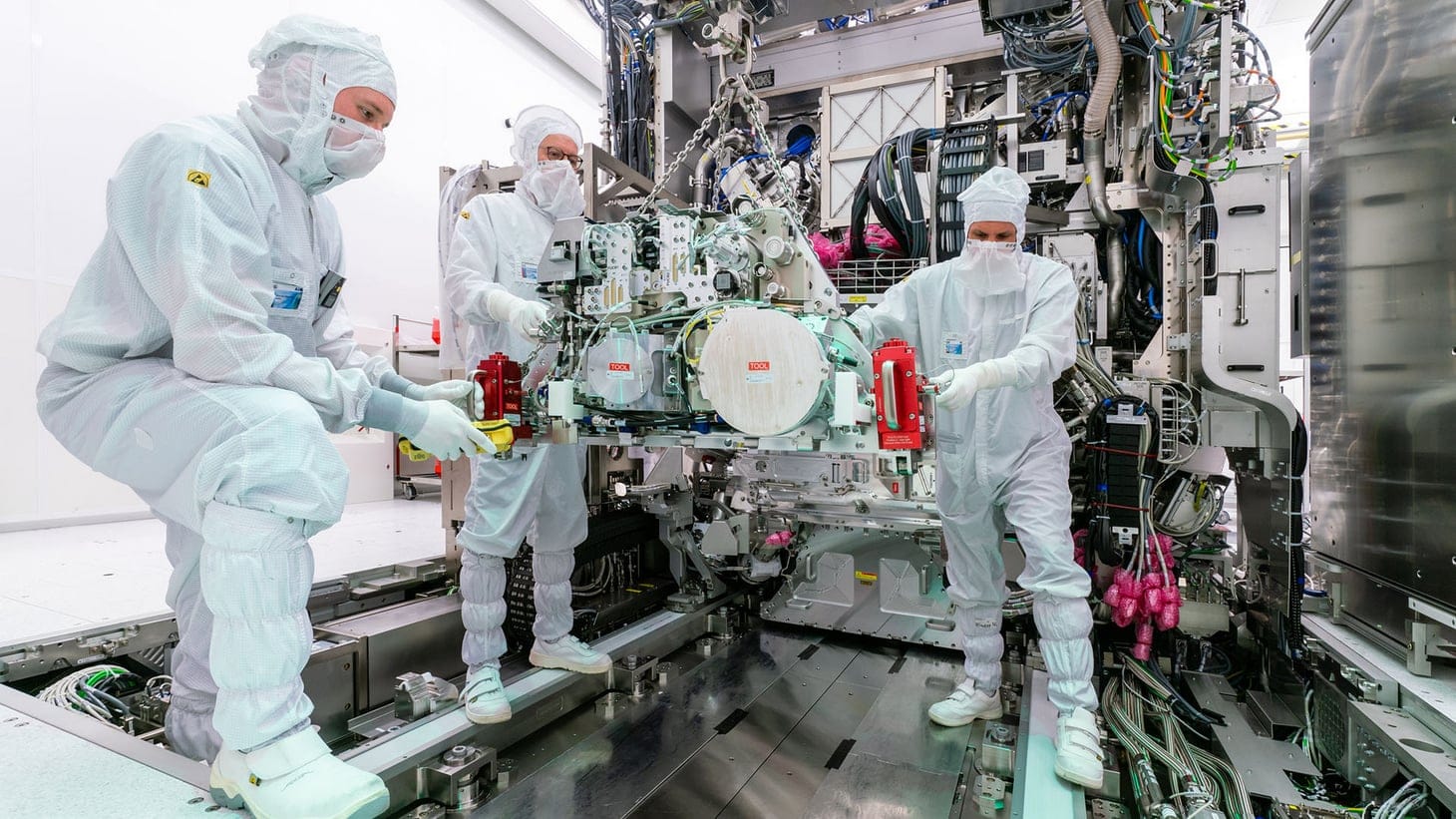
When chipmakers order extreme‑ultraviolet lithography machines, they're planning AI infrastructure two to three years ahead. ASML's €13.2 billion quarterly surge shows how equipment bookings forecast compute capacity before a single GPU ships. This explainer walks through the 24‑36 month chain from order to rack—and why tracking it matters more than headline sales.

image-173

Summary:

  • Equipment bookings act as a leading indicator: ASML’s EUV orders lock in AI‑compute capacity years before GPU sales reveal demand.
  • ASML logged €13.158 bn (≈$14.5 bn) in Q1 2025 bookings, with €7.4 bn (≈$8.1 bn) from EUV scanners costing $150‑200 m each.
  • From order to inference takes 2‑3 years; the $14 bn of bookings will power AI data‑centers around 2027, long before GPU revenue reflects the surge.

In 2022, tracking AI growth meant counting GPU shipments. By 2025, the smarter money watches something else: orders for machines that cost $200 million each and take three years to deliver. ASML just recorded $14 billion worth. These orders don't represent chips in warehouses or servers in racks. They represent compute capacity that will arrive in data centers from Virginia to Oregon sometime around 2027, long after this quarter's earnings calls fade from memory.

The gap between order and outcome matters because it reveals something GPU sales cannot: how confident chipmakers are about demand years into the future. A company placing a $200 million order today is betting on workloads that don't yet exist, funding infrastructure for AI models still in research labs.

Why equipment orders predict AI capacity better than GPU sales

Equipment bookings act as a leading indicator because the machines take years to build and deploy. When TSMC, Samsung, or Intel commits capital to an extreme ultraviolet lithography system, they initiate a timeline that stretches 24 to 36 months before a single wafer enters production. GPU sales report what shipped last quarter. Equipment orders report what chipmakers believe they will need in 2027.

ASML's first quarter 2025 filing shows €13.158 billion in new bookings, with €7.4 billion from EUV systems alone. Reuters and AP News confirmed the orders came from the three leading foundries. At roughly $150 to $200 million per EUV scanner, plus clean room upgrades and staffing investments that compound over a decade, these commitments lock in multiyear capital plans. Cancellations carry steep penalties. Order volumes this large signal conviction, not speculation.

Chipmakers ordering EUV machines is like Boeing reserving engine production capacity three years before a plane's first flight. The order doesn't guarantee the plane flies on time, but without it, the plane definitely never takes off. For AI, these machines are the engines.

The $200 million machines that no one else can build

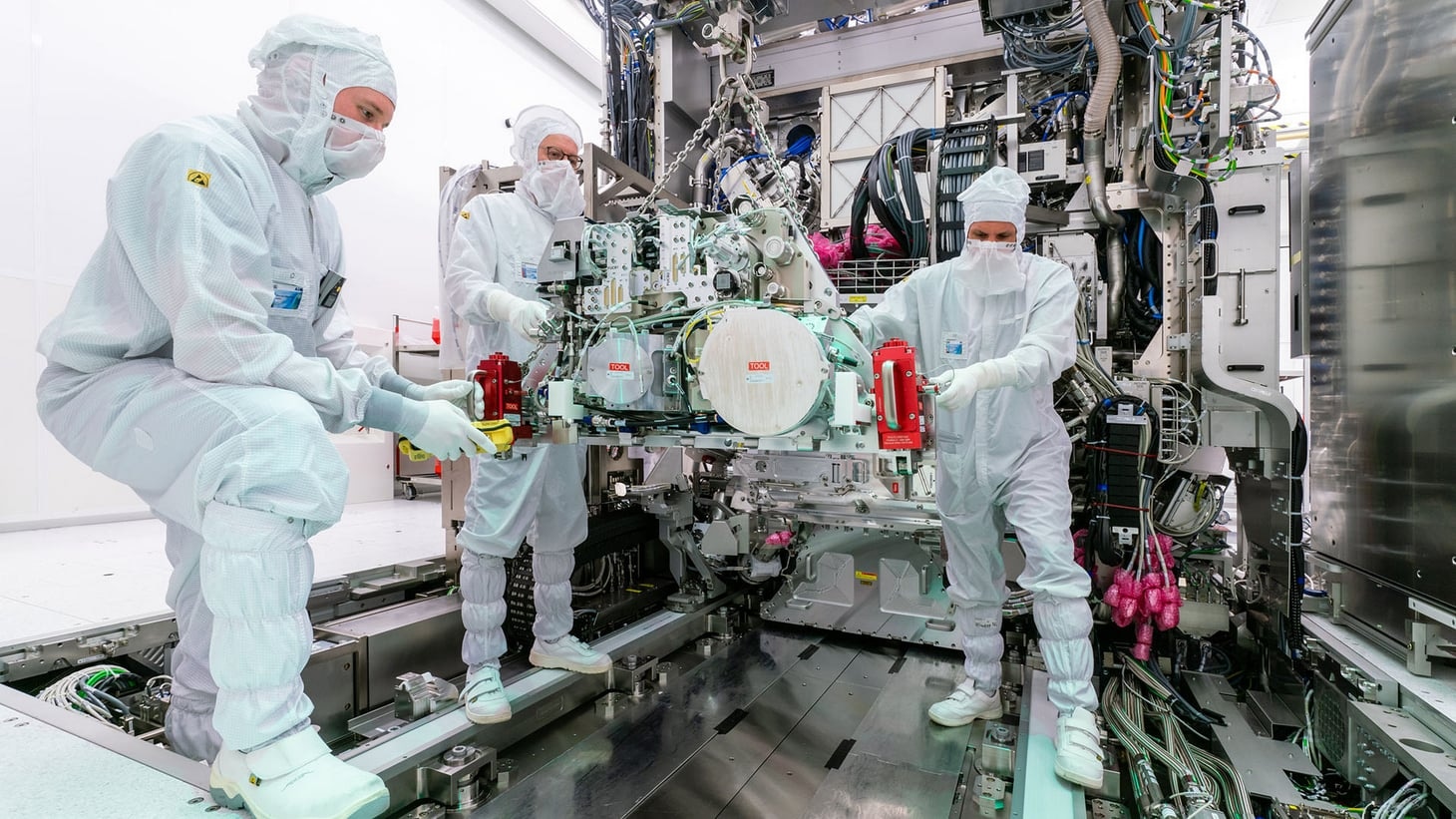
ASML's EUV machines print circuit patterns by firing extreme ultraviolet light at wavelengths of 13.5 nanometers, about one two-hundred-thousandth the width of a human hair. No other process can etch features this small. No other company makes these machines. Without them, advanced GPUs cannot exist.

The technology required decades of collaborative engineering across optics, materials science, and precision mechanics. Each system weighs approximately 400,000 pounds and contains more than 100,000 components. Mirrors must be polished to within a single atom of perfection. The light source generates plasma hotter than the surface of the sun, 50,000 times per second. This complexity explains both the monopoly and the price.

U.S. chipmakers and their foundry partners account for roughly half of ASML's customer base. The company's earnings call noted that AI workloads drove the majority of new orders, a statement CEO Christophe Fouquet reinforced:

That outlook translates into physical commitments. Foundries don't order EUV scanners on speculation. They order because hyperscalers have signed capacity agreements, because cloud providers have committed to infrastructure builds, because the math connecting model size to compute demand points in one direction.

The three year journey from invoice to inference

The timeline begins when a chipmaker signs the purchase order. ASML manufactures the scanner over 12 to 24 months, assembling subsystems built by suppliers across Europe and Asia. After delivery, the customer installs the machine in a fabrication facility engineered to eliminate vibration, control temperature to within fractions of a degree, and filter particles larger than 10 nanometers from the air. Installation and validation take another six to 12 months.

Once the system reaches high volume production, it prints wafers containing dozens of GPU dies. Those wafers ship to chip designers who package the silicon, integrate it into server boards, and deliver finished units to data center operators. End to end, the process spans two to three years. Every euro ASML recorded in Q1 2025 bookings will become operational AI capacity around 2027.

$14 billion is roughly the GDP of Vermont, committed to machines that will build chips for AI models we haven't designed yet. The scale matters because it sets a floor beneath future supply. Barring geopolitical disruption or catastrophic technical failures, this capacity will come online. The timeline is locked in.

What $14 billion in orders tells us about 2027

The surge confirms that capital is already flowing into the foundational layer of the AI stack. Investors and policymakers watch quarterly GPU revenue for signs of demand softening. That's backward-looking data. By the time GPU sales decline, the infrastructure decisions shaping 2027 have already been made. ASML's bookings show those decisions are expansionary.

The forecast is not immune to disruption. Order cancellations are possible, though expensive. Foundries could operate machines below full utilization if demand weakens. Breakthroughs in alternative chip architectures or photonic computing could reduce reliance on cutting-edge silicon. None of those scenarios seem imminent. Foundries don't absorb $200 million commitments lightly, and the concentration of orders among three players suggests coordinated confidence rather than speculative positioning.

What remains uncertain is whether this capacity will be sufficient. Model training costs are rising faster than Moore's Law can offset. If algorithmic efficiency stalls or new architectures require even denser transistor packing, the demand curve could steepen beyond what today's orders can satisfy. The equipment backlog at ASML currently extends into 2027, meaning any additional orders placed this year would likely deliver in 2028 or later.

For now, the $14 billion commitment stands as the clearest signal yet that AI infrastructure growth is funded through at least 2027. The next test comes in Q3 2025, when delivery schedules reveal whether chipmakers can absorb this capacity or if orders get pushed. Until then, the order book tells us where the money flows, years before the compute appears.

When earnings reports cite AI concerns, check ASML's bookings first. They show what billion-dollar bets look like when placed not on sentiment, but on silicon.


Topic

AI Infrastructure Investment Strategy

Nvidia, Nebius unveil AI factories using H100 and H200 GPUs

11 March 2026

Nvidia, Nebius unveil AI factories using H100 and H200 GPUs

RAM prices double as AI devours memory supply

9 December 2025

Celero raises $140M to power AI with light

18 November 2025

Celero raises $140M to power AI with light

The $80 Billion Depreciation Trap

16 November 2025

What is this about?

  • Explainer */
  • Aiden Roth/
  • Tech/
  • Business
  • semiconductor manufacturing/
  • AI innovations/
  • TSMC 2nm/
  • EV pricing/
  • EUV lithography/
  • AI compute capacity

Feed

    Button AI Assistant Debuts, Offering Screen‑Free Voice Help

    Button AI Assistant Debuts, Offering Screen‑Free Voice Help

    Nostalgic iPod Shuffle design meets privacy‑first press‑to‑talk AI

    about 7 hours ago
    Razer Hammerhead V3 HyperSpeed Debuts with Dual‑Mode Case

    Razer Hammerhead V3 HyperSpeed Debuts with Dual‑Mode Case

    The USB‑C case also serves as a 2.4 GHz receiver, cutting dongles for PS5 and phones

    about 7 hours ago
    Apple ships 6.2 million Macs Q1 2026, M5‑MacBook Pro leads

    Apple ships 6.2 million Macs Q1 2026, M5‑MacBook Pro leads

    Apple’s share rises to 9.5%, moving it into fourth place among global PC makers

    about 7 hours ago
    Galaxy S22 Ultra can be bricked after factory reset

    Galaxy S22 Ultra can be bricked after factory reset

    US owners report IMEI‑level lock that hands control to unknown administrator Numero LLC

    about 7 hours ago
    Mouse: P.I. for Hire arrives April 16 on PC, PS5, and Xbox

    Mouse: P.I. for Hire arrives April 16 on PC, PS5, and Xbox

    Modes: 4K 60 fps quality or 120 fps performance on PS5 and Xbox Series X

    about 7 hours ago
    YouTube Rolls Out Auto Speed for Premium Users

    YouTube Rolls Out Auto Speed for Premium Users

    The AI‑driven playback boost aims to cut dead air on long videos

    1 day ago
    Blackwell Set to Capture Majority of the 2026 GPU Market

    Blackwell Set to Capture Majority of the 2026 GPU Market

    GB300/B300 GPUs Push Blackwell to 71% of Shipments; Rubin Falls to 22%

    1 day ago
    Google launches AI avatar tool for Shorts on April 9, 2026

    Google launches AI avatar tool for Shorts on April 9, 2026

    Ages 18+ can create digital replicas, with Synth ID tags and a 3‑year auto‑delete

    1 day ago
    Mac OS X 10.0 Cheetah runs on Wii

    Mac OS X 10.0 Cheetah runs on Wii

    Ports Mac OS X 10.0 Cheetah to the Wii, showing the PowerPC 750CL can run an OS

    1 day ago
    DuoBell Beats ANC: Safer Cycling with Apple AirPods Max

    DuoBell Beats ANC: Safer Cycling with Apple AirPods Max

    A 750 Hz blind‑spot lets DuoBell cut through ANC on popular headphones

    1 day ago
    Škoda DuoBell prototype unveiled on April 5, 2026

    Škoda DuoBell prototype unveiled on April 5, 2026

    750 Hz pulse and 2,000 Hz chime cut through ANC, alerting riders faster at 15 mph

    1 day ago
    SteamGPT Leak Reveals Dual‑Role AI on Steam

    SteamGPT Leak Reveals Dual‑Role AI on Steam

    Leak shows AI handling support and cheat‑detection for millions on the platform

    1 day ago
    Oppo Pad mini challenges Apple with Snapdragon 8 Gen 5

    Oppo Pad mini challenges Apple with Snapdragon 8 Gen 5

    April 21: Oppo Pad mini 8.8‑inch, Snapdragon 8 Gen 5, 5.39 mm, 279 g, 144 Hz OLED

    1 day ago
    Apple to ship 3 million foldable iPhones by end‑2026

    Apple to ship 3 million foldable iPhones by end‑2026

    Limited rollout equals 12 % of iPhone volume and rivals Samsung’s 2.4 million Galaxy Z Fold 7 sales

    1 day ago
    Apple unveils iPhone 18 Pro, iPhone 18 Pro Max, and iPhone Ultra

    Apple unveils iPhone 18 Pro, iPhone 18 Pro Max, and iPhone Ultra

    Mockups match leaked renders; 20 million Samsung panels for iPhone Ultra

    2 days ago
    Sony launches Playerbase program for Gran Turismo 7

    Sony launches Playerbase program for Gran Turismo 7

    PlayStation gamers can win a flight, facial scan, and an avatar in Gran Turismo 7

    2 days ago
    Claude Mythos Preview Beats Opus 4.6 in Cybersecurity!

    Claude Mythos Preview Beats Opus 4.6 in Cybersecurity!

    Claude Mythos Preview for five partners—pricing after a 100 million token credit

    2 days ago
    ChatGPT and AI Tools Let Solo Founders Launch Fast

    ChatGPT and AI Tools Let Solo Founders Launch Fast

    With GitHub Copilot, a founder can code, design, and deliver an MVP in days

    3 days ago
    Android 17 beta adds Notification Rules

    Android 17 beta adds Notification Rules

    New rules let users silence, block, or highlight alerts; Samsung eyes One UI 9

    3 days ago
    Utah Starts 12‑Month AI Chatbot Pilot for Psychiatric Meds

    Utah Starts 12‑Month AI Chatbot Pilot for Psychiatric Meds

    Legion Health pilot offers refills for 15 meds, easing shortages in rural Utah

    3 days ago
    Loading...
Tech/Business

How a €13.2 billion chip order predicts AI growth

ASML's record bookings reveal the hidden timeline from semiconductor orders to data center capacity

January 28, 2026, 4:22 pm

When chipmakers order extreme‑ultraviolet lithography machines, they're planning AI infrastructure two to three years ahead. ASML's €13.2 billion quarterly surge shows how equipment bookings forecast compute capacity before a single GPU ships. This explainer walks through the 24‑36 month chain from order to rack—and why tracking it matters more than headline sales.

image-173

Summary

  • Equipment bookings act as a leading indicator: ASML’s EUV orders lock in AI‑compute capacity years before GPU sales reveal demand.
  • ASML logged €13.158 bn (≈$14.5 bn) in Q1 2025 bookings, with €7.4 bn (≈$8.1 bn) from EUV scanners costing $150‑200 m each.
  • From order to inference takes 2‑3 years; the $14 bn of bookings will power AI data‑centers around 2027, long before GPU revenue reflects the surge.

In 2022, tracking AI growth meant counting GPU shipments. By 2025, the smarter money watches something else: orders for machines that cost $200 million each and take three years to deliver. ASML just recorded $14 billion worth. These orders don't represent chips in warehouses or servers in racks. They represent compute capacity that will arrive in data centers from Virginia to Oregon sometime around 2027, long after this quarter's earnings calls fade from memory.

The gap between order and outcome matters because it reveals something GPU sales cannot: how confident chipmakers are about demand years into the future. A company placing a $200 million order today is betting on workloads that don't yet exist, funding infrastructure for AI models still in research labs.

Why equipment orders predict AI capacity better than GPU sales

Equipment bookings act as a leading indicator because the machines take years to build and deploy. When TSMC, Samsung, or Intel commits capital to an extreme ultraviolet lithography system, they initiate a timeline that stretches 24 to 36 months before a single wafer enters production. GPU sales report what shipped last quarter. Equipment orders report what chipmakers believe they will need in 2027.

ASML's first quarter 2025 filing shows €13.158 billion in new bookings, with €7.4 billion from EUV systems alone. Reuters and AP News confirmed the orders came from the three leading foundries. At roughly $150 to $200 million per EUV scanner, plus clean room upgrades and staffing investments that compound over a decade, these commitments lock in multiyear capital plans. Cancellations carry steep penalties. Order volumes this large signal conviction, not speculation.

Chipmakers ordering EUV machines is like Boeing reserving engine production capacity three years before a plane's first flight. The order doesn't guarantee the plane flies on time, but without it, the plane definitely never takes off. For AI, these machines are the engines.

The $200 million machines that no one else can build

ASML's EUV machines print circuit patterns by firing extreme ultraviolet light at wavelengths of 13.5 nanometers, about one two-hundred-thousandth the width of a human hair. No other process can etch features this small. No other company makes these machines. Without them, advanced GPUs cannot exist.

The technology required decades of collaborative engineering across optics, materials science, and precision mechanics. Each system weighs approximately 400,000 pounds and contains more than 100,000 components. Mirrors must be polished to within a single atom of perfection. The light source generates plasma hotter than the surface of the sun, 50,000 times per second. This complexity explains both the monopoly and the price.

U.S. chipmakers and their foundry partners account for roughly half of ASML's customer base. The company's earnings call noted that AI workloads drove the majority of new orders, a statement CEO Christophe Fouquet reinforced:

That outlook translates into physical commitments. Foundries don't order EUV scanners on speculation. They order because hyperscalers have signed capacity agreements, because cloud providers have committed to infrastructure builds, because the math connecting model size to compute demand points in one direction.

The three year journey from invoice to inference

The timeline begins when a chipmaker signs the purchase order. ASML manufactures the scanner over 12 to 24 months, assembling subsystems built by suppliers across Europe and Asia. After delivery, the customer installs the machine in a fabrication facility engineered to eliminate vibration, control temperature to within fractions of a degree, and filter particles larger than 10 nanometers from the air. Installation and validation take another six to 12 months.

Once the system reaches high volume production, it prints wafers containing dozens of GPU dies. Those wafers ship to chip designers who package the silicon, integrate it into server boards, and deliver finished units to data center operators. End to end, the process spans two to three years. Every euro ASML recorded in Q1 2025 bookings will become operational AI capacity around 2027.

$14 billion is roughly the GDP of Vermont, committed to machines that will build chips for AI models we haven't designed yet. The scale matters because it sets a floor beneath future supply. Barring geopolitical disruption or catastrophic technical failures, this capacity will come online. The timeline is locked in.

What $14 billion in orders tells us about 2027

The surge confirms that capital is already flowing into the foundational layer of the AI stack. Investors and policymakers watch quarterly GPU revenue for signs of demand softening. That's backward-looking data. By the time GPU sales decline, the infrastructure decisions shaping 2027 have already been made. ASML's bookings show those decisions are expansionary.

The forecast is not immune to disruption. Order cancellations are possible, though expensive. Foundries could operate machines below full utilization if demand weakens. Breakthroughs in alternative chip architectures or photonic computing could reduce reliance on cutting-edge silicon. None of those scenarios seem imminent. Foundries don't absorb $200 million commitments lightly, and the concentration of orders among three players suggests coordinated confidence rather than speculative positioning.

What remains uncertain is whether this capacity will be sufficient. Model training costs are rising faster than Moore's Law can offset. If algorithmic efficiency stalls or new architectures require even denser transistor packing, the demand curve could steepen beyond what today's orders can satisfy. The equipment backlog at ASML currently extends into 2027, meaning any additional orders placed this year would likely deliver in 2028 or later.

For now, the $14 billion commitment stands as the clearest signal yet that AI infrastructure growth is funded through at least 2027. The next test comes in Q3 2025, when delivery schedules reveal whether chipmakers can absorb this capacity or if orders get pushed. Until then, the order book tells us where the money flows, years before the compute appears.

When earnings reports cite AI concerns, check ASML's bookings first. They show what billion-dollar bets look like when placed not on sentiment, but on silicon.
Topic

AI Infrastructure Investment Strategy

Nvidia, Nebius unveil AI factories using H100 and H200 GPUs

11 March 2026

Nvidia, Nebius unveil AI factories using H100 and H200 GPUs

RAM prices double as AI devours memory supply

9 December 2025

Celero raises $140M to power AI with light

18 November 2025

Celero raises $140M to power AI with light

The $80 Billion Depreciation Trap

16 November 2025

What is this about?

  • Explainer */
  • Aiden Roth/
  • Tech/
  • Business
  • semiconductor manufacturing/
  • AI innovations/
  • TSMC 2nm/
  • EV pricing/
  • EUV lithography/
  • AI compute capacity

Feed

    Button AI Assistant Debuts, Offering Screen‑Free Voice Help

    Button AI Assistant Debuts, Offering Screen‑Free Voice Help

    Nostalgic iPod Shuffle design meets privacy‑first press‑to‑talk AI

    about 7 hours ago
    Razer Hammerhead V3 HyperSpeed Debuts with Dual‑Mode Case

    Razer Hammerhead V3 HyperSpeed Debuts with Dual‑Mode Case

    The USB‑C case also serves as a 2.4 GHz receiver, cutting dongles for PS5 and phones

    about 7 hours ago
    Apple ships 6.2 million Macs Q1 2026, M5‑MacBook Pro leads

    Apple ships 6.2 million Macs Q1 2026, M5‑MacBook Pro leads

    Apple’s share rises to 9.5%, moving it into fourth place among global PC makers

    about 7 hours ago
    Galaxy S22 Ultra can be bricked after factory reset

    Galaxy S22 Ultra can be bricked after factory reset

    US owners report IMEI‑level lock that hands control to unknown administrator Numero LLC

    about 7 hours ago
    Mouse: P.I. for Hire arrives April 16 on PC, PS5, and Xbox

    Mouse: P.I. for Hire arrives April 16 on PC, PS5, and Xbox

    Modes: 4K 60 fps quality or 120 fps performance on PS5 and Xbox Series X

    about 7 hours ago
    YouTube Rolls Out Auto Speed for Premium Users

    YouTube Rolls Out Auto Speed for Premium Users

    The AI‑driven playback boost aims to cut dead air on long videos

    1 day ago
    Blackwell Set to Capture Majority of the 2026 GPU Market

    Blackwell Set to Capture Majority of the 2026 GPU Market

    GB300/B300 GPUs Push Blackwell to 71% of Shipments; Rubin Falls to 22%

    1 day ago
    Google launches AI avatar tool for Shorts on April 9, 2026

    Google launches AI avatar tool for Shorts on April 9, 2026

    Ages 18+ can create digital replicas, with Synth ID tags and a 3‑year auto‑delete

    1 day ago
    Mac OS X 10.0 Cheetah runs on Wii

    Mac OS X 10.0 Cheetah runs on Wii

    Ports Mac OS X 10.0 Cheetah to the Wii, showing the PowerPC 750CL can run an OS

    1 day ago
    DuoBell Beats ANC: Safer Cycling with Apple AirPods Max

    DuoBell Beats ANC: Safer Cycling with Apple AirPods Max

    A 750 Hz blind‑spot lets DuoBell cut through ANC on popular headphones

    1 day ago
    Škoda DuoBell prototype unveiled on April 5, 2026

    Škoda DuoBell prototype unveiled on April 5, 2026

    750 Hz pulse and 2,000 Hz chime cut through ANC, alerting riders faster at 15 mph

    1 day ago
    SteamGPT Leak Reveals Dual‑Role AI on Steam

    SteamGPT Leak Reveals Dual‑Role AI on Steam

    Leak shows AI handling support and cheat‑detection for millions on the platform

    1 day ago
    Oppo Pad mini challenges Apple with Snapdragon 8 Gen 5

    Oppo Pad mini challenges Apple with Snapdragon 8 Gen 5

    April 21: Oppo Pad mini 8.8‑inch, Snapdragon 8 Gen 5, 5.39 mm, 279 g, 144 Hz OLED

    1 day ago
    Apple to ship 3 million foldable iPhones by end‑2026

    Apple to ship 3 million foldable iPhones by end‑2026

    Limited rollout equals 12 % of iPhone volume and rivals Samsung’s 2.4 million Galaxy Z Fold 7 sales

    1 day ago
    Apple unveils iPhone 18 Pro, iPhone 18 Pro Max, and iPhone Ultra

    Apple unveils iPhone 18 Pro, iPhone 18 Pro Max, and iPhone Ultra

    Mockups match leaked renders; 20 million Samsung panels for iPhone Ultra

    2 days ago
    Sony launches Playerbase program for Gran Turismo 7

    Sony launches Playerbase program for Gran Turismo 7

    PlayStation gamers can win a flight, facial scan, and an avatar in Gran Turismo 7

    2 days ago
    Claude Mythos Preview Beats Opus 4.6 in Cybersecurity!

    Claude Mythos Preview Beats Opus 4.6 in Cybersecurity!

    Claude Mythos Preview for five partners—pricing after a 100 million token credit

    2 days ago
    ChatGPT and AI Tools Let Solo Founders Launch Fast

    ChatGPT and AI Tools Let Solo Founders Launch Fast

    With GitHub Copilot, a founder can code, design, and deliver an MVP in days

    3 days ago
    Android 17 beta adds Notification Rules

    Android 17 beta adds Notification Rules

    New rules let users silence, block, or highlight alerts; Samsung eyes One UI 9

    3 days ago
    Utah Starts 12‑Month AI Chatbot Pilot for Psychiatric Meds

    Utah Starts 12‑Month AI Chatbot Pilot for Psychiatric Meds

    Legion Health pilot offers refills for 15 meds, easing shortages in rural Utah

    3 days ago
    Loading...
banner