Driving the news: Allen Institute researchers decoded mouse visual cortex activity into real‑time video with 0.57‑pixel‑level accuracy, double the precision of earlier methods, according to a study published in eLife. The team recorded calcium signals from approximately 78,000 neurons (averaging roughly 7,800 per mouse) across ten mice watching 10‑second clips, then trained an AI model to reconstruct the footage at 30 Hz.
How it works: Two‑photon imaging captured activity across primary visual cortex (V1) layers while mice viewed natural‑scene clips. The dynamic neural encoding model (Sensorium/DNEM) learned to map neuronal firing patterns to pixel intensities, generating frames that matched the original stimuli. Each trial yielded approximately 300 milliseconds of neural data per frame.
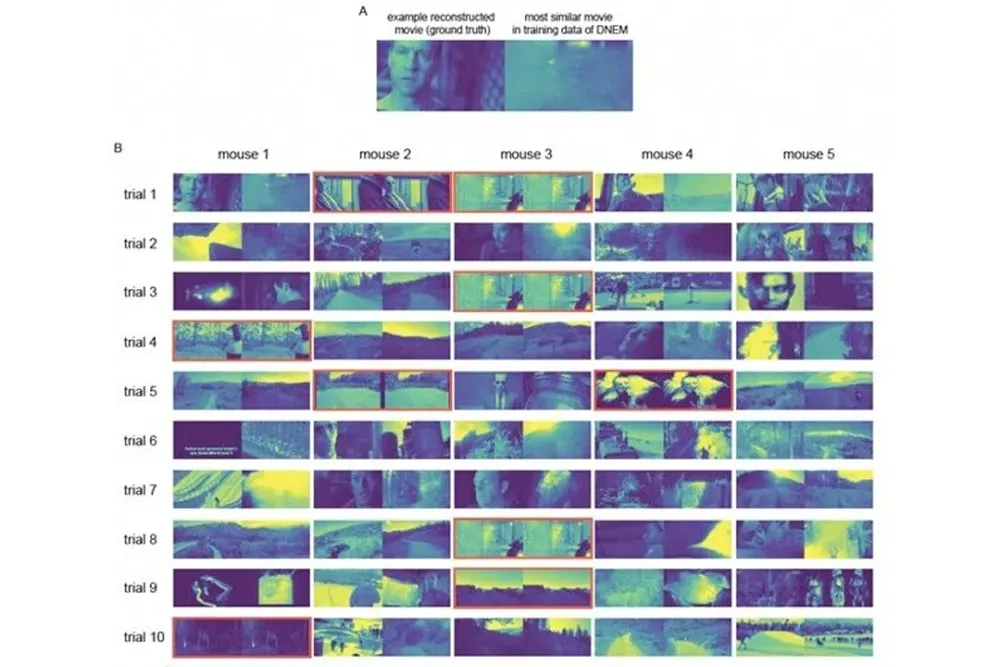
By the numbers: The model achieved a correlation of 0.57 on held‑out test clips, versus 0.27 for the previous benchmark, reflecting gains from both larger neuron samples and improved encoding algorithms.
Why it matters: The advance suggests a path toward brain‑computer interfaces for patients who cannot speak, including U.S. veterans with traumatic brain injuries, if researchers can replicate the approach in human‑compatible recordings. NIH BRAIN Initiative funding priorities already emphasize high‑resolution neural sensors for clinical translation.
The catch: Mouse V1 processes simpler visual features than human cortex; single‑trial recordings carry higher noise than trial‑averaged data.
What would strengthen the finding: Independent replication across labs, validation in non‑human primates, and demonstration that the model generalizes to imagined or recalled images—not just viewed stimuli.
What's next: The team plans cross‑species tests to confirm generalizability. Potential applications include visualizing dreams and creating neural interfaces for paralyzed individuals. Meanwhile, FDA approval pathways for neural‑decoding BCIs remain undefined; researchers and ethicists are drafting consent protocols to safeguard neural privacy before human trials begin.
The bottom line: Scientists achieved a significant leap in neural‑decoding precision, but translating mouse cortex successes to human clinical use demands higher‑resolution sensors, replicated findings, and binding privacy protections.