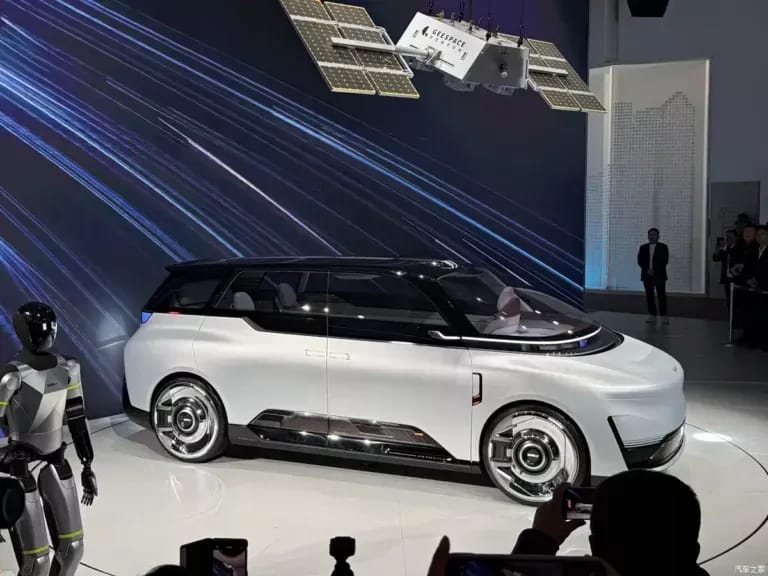

Geely Auto Group, AFARI Technology, and CaoCao Mobility unveiled the EVA Cab—China's first purpose‑built L4 robotaxi prototype—at Auto China 2026 in Beijing on April 24, 2026, with commercial deployment planned for late 2027. The prototype boasts a 196‑billion‑parameter AI stack and a 1,400 TOPS compute platform that can make perception‑to‑action decisions faster than a human driver's typical reaction time. Geely says the system can handle highway merges, unmarked rural intersections, and pedestrian crossings without a safety driver.
Why it matters: Geely is betting that end‑to‑end AI latency—not just sensor count—will decide the robotaxi race. The EVA Cab pairs a 43‑sensor array (including a 2,160‑line LiDAR with a 600 m range) with AFARI's G‑ASD L4 software stack, claiming coverage of 99% of everyday traffic scenarios in China. If the 2027 rollout holds, CaoCao Mobility will operate the country's first mass‑deployment fleet that has no steering wheel, no pedals, and no backup driver.
By the numbers: 196 billion parameters • 1,400 TOPS compute • 43 sensors • 2,160‑line LiDAR • 600 m detection range • late 2027 production target.
The U.S. context—spoiler: $0 and zero availability. No U.S. MSRP exists because Geely hasn't announced an American market entry for the EVA Cab or its Geely/Zeekr consumer brands. The company is "actively evaluating" U.S. plans, with a decision expected within the next 24–36 months, per its CES 2026 statement. For reference, importing a hypothetical $40,000 Chinese EV today would face a 2.5% base MFN tariff plus a 25% Section 301 overlay, about $3,000 in shipping, and roughly $7,000 in compliance costs—pushing the landed cost above $62,000 before dealer markup.
Charging at home would cost about $0.1755 per kWh (U.S. residential average through February 2026, EIA). Public DC fast‑charging runs roughly $0.53 per kWh in Q1 2026 (Paren industry report).
What Geely says versus what the data show: Geely claims the EVA Cab's AI "processes decisions faster than a human driver." Industry targets for autonomous perception‑to‑action latency typically aim for under 100 ms end‑to‑end, while average human reaction time sits around 1,100 ms (mean) to 2,000 ms (95th percentile) in U.S. highway design practice (FHWA). Geely hasn't disclosed measured per‑vehicle latency for the EVA Cab. Its 1,400 TOPS figure describes hardware throughput; real‑world inference latency also depends on memory bandwidth, sensor I/O, and software efficiency.
Where it works—and where it doesn't: Dense Chinese megacities with high‑definition maps, 5G coverage, and government testing permits are the sweet spot. Rural Montana gravel roads, Upper Midwest whiteouts, or any place where the nearest cell tower is ten miles away? The system would face significant challenges in these environments. Geely's 99% claim is trained on Chinese road conditions, weather patterns, and traffic behaviors. Porting that performance to American scenarios—Houston merge lanes, Boston rotaries, I‑80 crosswinds—will take years of validation.
What's next: Late 2027 series production and CaoCao Mobility's commercial rollout in China. Industry watchers will measure real‑world AI decision latency under peak traffic, fog, and edge cases no simulator caught. If Geely's numbers hold, Europe and Southeast Asia may follow. For American drivers, the timeline stays "wait and see"—but the software‑defined, electron‑powered taxi is already rolling in the world's largest auto market, and the gap between their roads and ours just widened.
Gasoline had its century. The next one runs on electrons—and it's already in your neighbor's driveway. Out here on I‑80, we're still waiting for the regulatory green light.