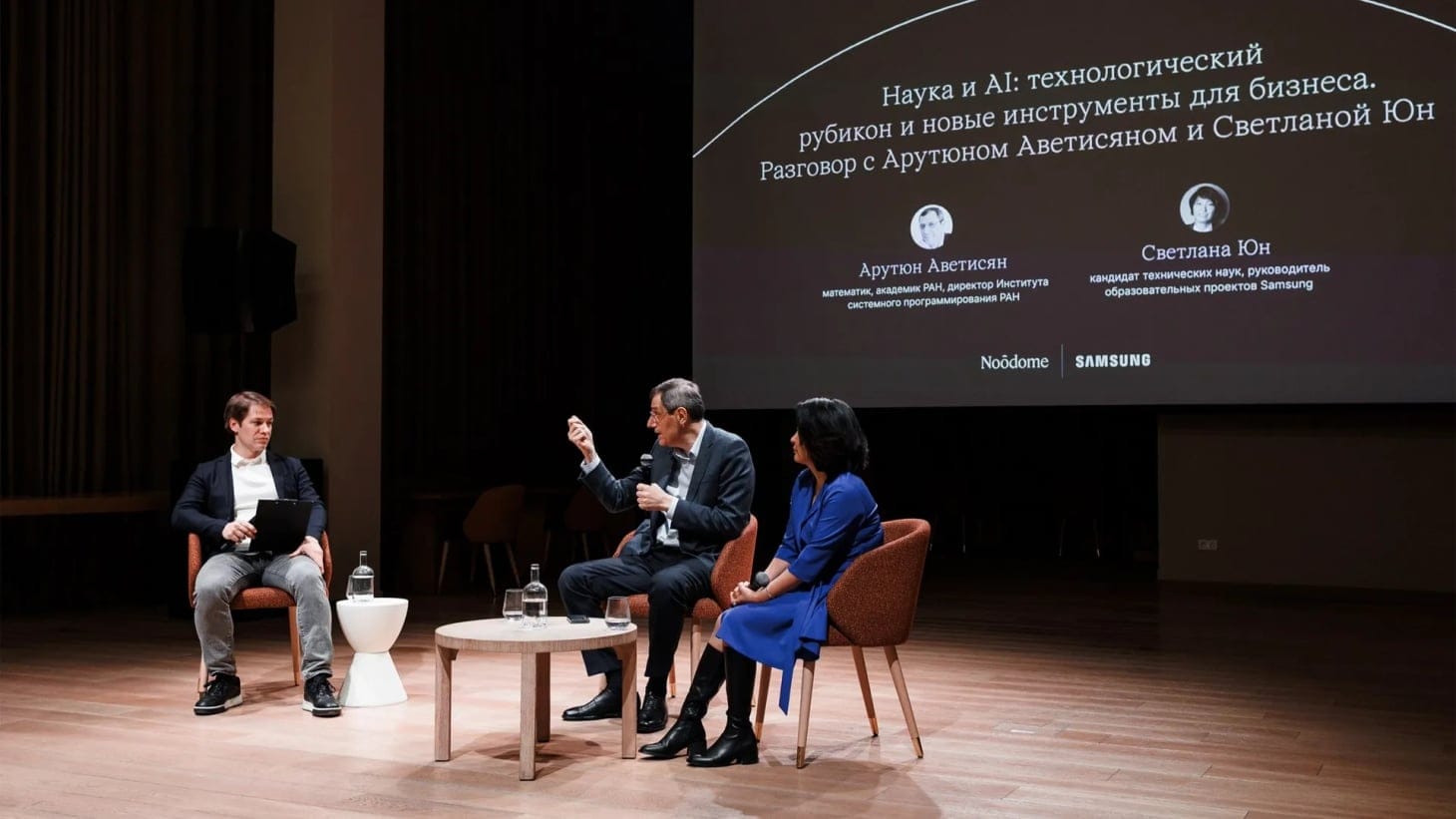

Samsung Electronics and Noôdome gathered scientists and engineers to answer a question most businesses keep circling: Can AI actually deliver measurable value, or are we just automating confusion? At a "Science and AI" expert session hosted by Samsung's Innovation Campus, mathematician Arutyun Avetisyan—member of the Russian Academy of Sciences and director of the Institute of Systems Programming—and AI researcher Svetlana Yun, Ph.D., gave an answer rooted not in marketing spin but in empirical observation. Open, lightweight AI models trained on decades of scientific research can boost productivity, cut costs, and improve quality—provided you design for trust and human oversight from the start.
The Session: Who Spoke and What They Said. Avetisyan opened with a caution rare in tech circles: AI introduces new risk vectors—cyber vulnerabilities, sociocultural drift, and the temptation to outsource judgment to systems that can't yet hold it.
He pointed to self-driving vehicles as a prime example. Fully autonomous transportation in everyday life remains impossible without a human who can intervene when needed. He framed AI not as replacement labor but as augmented capacity. Yun followed with a concrete example: faster code reviews don't just shrink timelines—they create space for more unit tests, tightening software quality without inflating line counts or technical debt.
By the Numbers: What Early Adopters Are Seeing. Pilot projects tracked by Noôdome show AI-assisted coding shaving about three days off each development sprint and cutting defect rates by roughly 15 percent. Broader adoption studies report a 2–4 percent rise in overall output, while developers say they feel 20–30 percent more efficient as routine tasks—boilerplate code, documentation, regression testing—speed up in the background. According to research cited at the session, the overwhelming majority of company leaders expect AI's new capabilities to reduce costs while increasing product value and quality. These aren't transformational gains yet, but they're consistent, measurable, and building up across teams.
The Open-Model Advantage: Why Vendor Lock-In Matters. Open models—the kind Samsung and Noôdome are advocating—sidestep a problem most enterprises only notice once it's too late: dependency. Proprietary AI platforms can optimize for one vendor's ecosystem, making it expensive or impossible to migrate, customize, or audit.
Open models, built on peer-reviewed research and community-validated datasets, offer transparency, flexibility, and the ability to retrain networks for industry-specific challenges, whether that's protein folding in biotech labs or defect prediction on manufacturing floors.
What This Means for Business Leaders. If you're evaluating AI deployment in 2026, the session's implicit roadmap is worth noting: start small, focus on workflows that are repetitive but error-prone, and audit security protocols before scaling. Samsung's Innovation Campus partnership—which now operates in more than 30 universities through "IT Academy" and "Samsung Innovation Campus" programs—also highlights an underappreciated bottleneck: talent. The most sophisticated model is useless if no one on your team knows how to steer it, interpret its errors, or explain its decisions to regulators, customers, or auditors.
"Graduates of the IT Academy courses secure internships more easily because they can showcase real-world project portfolios in interviews. When they move into business, they begin to influence the market," Yun explained.
What's Next. The session closed with a practical recommendation: pilot one routine workflow, measure the baseline, and track both efficiency and error rates over three sprints. Partner with educational initiatives that develop AI-literate talent capable of responsible oversight. And accept that the question isn't whether AI will reshape your operations—it's whether you'll shape that reshaping with intention, or let systems optimize for speed while you lose visibility into how decisions are made.
The tools are emerging. The scientific foundation exists. What remains is the business discipline to deploy AI not as magic, but as methodology—tested, measured, and accountable at every step.