
Should Anyone Be Able to Build a 250-Watt Laser from Consumer Parts?
A YouTuber just torched a diamond with a handheld device assembled from projector scraps. Here's why American regulators are decades behind the garage engineers rewriting the rules of dangerous tech.
The Thesis: America's Innovation Culture Has Outpaced Its Safety Framework
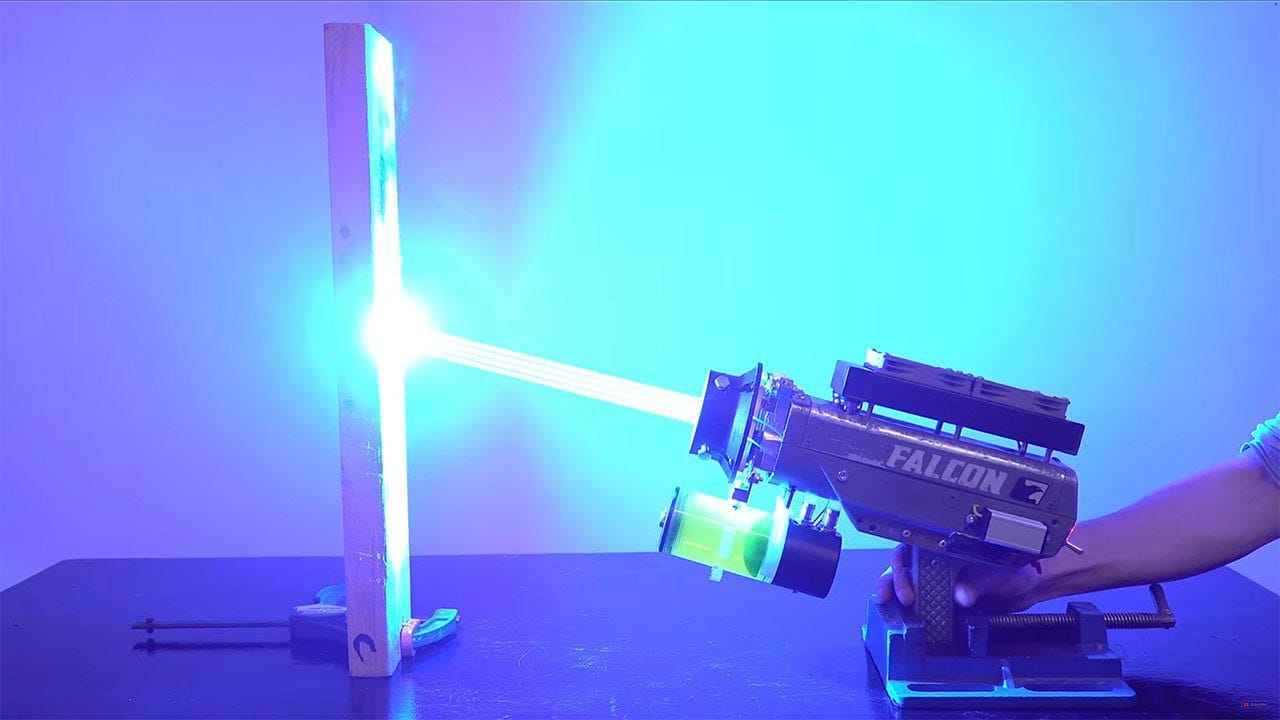
In late 2024, Drake Anthony pointed a blue beam at a diamond and burned through it in seconds. The chemist and YouTube creator behind the channel Styropyro didn't use classified technology or black-market hardware. He salvaged laser diodes from consumer projectors sold on Amazon and eBay, combined them into a single device, and created something 50,000 times more powerful than the legal limit for laser pointers in the United States.
The real breakthrough wasn't technical. It was regulatory: proof that American innovation freedoms now allow anyone with basic engineering skills to build weapon-grade tools from parts designed for movie nights.
This isn't a story about one clever builder. It's evidence that the democratization of industrial power has reached a tipping point where current U.S. safety frameworks can't distinguish between a hobbyist's experiment and a public hazard. The FDA limits laser pointers to 5 milliwatts. Anthony's device operates at 250 watts. That's 250,000 milliwatts. Every component arrived legally via standard shipping.
The gap between what regulations prohibit and what technology enables has grown so wide that enforcement has become functionally impossible.
Americans now face a choice embedded in the nation's innovation culture: Should accessible engineering knowledge trump public safety protocols, or do we need new frameworks that can actually keep pace with garage inventors?
The answer determines whether Drake Anthony's laser remains an isolated achievement or becomes the first in a wave of extreme DIY projects that regulations can't touch.
Argument One: Current Regulations Target Products, Not Capabilities
The FDA's laser classification system was built for a world where only manufacturers could access high-power components. That world no longer exists.
Under 21 CFR 1040.10 and 1040.11, the FDA restricts finished laser pointer products to 5 milliwatts maximum output. Class IIIb lasers (5–500 milliwatts) and Class IV lasers (above 500 milliwatts) require safety features: key-actuated controls, remote interlock connectors, emission indicators, and specific warning labels. These rules effectively ban the sale of high-power lasers marketed as pointers.
But Anthony didn't buy a finished laser pointer. He purchased consumer projectors manufactured by companies like Epson, BenQ, and ViewSonic. These devices contain blue laser diodes rated at 20–30 watts each. According to FDA import records analyzed by the Journal of Laser Applications, over 2.3 million projectors containing Class IIIb and IV laser diodes entered the U.S. in 2023 alone. None violated regulations because the projectors themselves include proper safety enclosures.
Once those projectors reach the secondary market, the regulatory framework breaks down. Salvaging components isn't illegal. Combining them isn't regulated. Possessing the assembled device falls into a gray zone where FDA jurisdiction over "laser products" collides with First Amendment protections for technical information and general property rights.
Henderson's research documented 47 similar DIY laser projects exceeding legal limits between 2020 and 2024, with build instructions collectively viewed over 12 million times on YouTube.
The regulatory blind spot isn't a loophole. It's a structural failure.
The FDA regulates what manufacturers sell, not what engineers build. State laws vary wildly. California prohibits possession of lasers above 5 milliwatts without proper licensing under Penal Code 417.25, while Texas has no specific restrictions on ownership, only on malicious use. This patchwork creates enforcement challenges that make nationwide safety standards effectively unworkable.
Argument Two: Power Democratization Eliminates the Safety Margin Built Into Human Biology
Standard laser pointers stay under 5 milliwatts for one reason: that's the threshold where your eyes can theoretically protect themselves. Anthony's laser eliminates that margin in microseconds.
The human blink reflex activates in approximately 0.25 seconds. A 5-milliwatt laser beam hitting your retina gives you just enough time for that reflex to prevent permanent damage. This assumes you're looking directly at the source and conditions are ideal. This safety factor, established by decades of ophthalmological research documented by the American National Standards Institute (ANSI Z136 series), forms the foundation of U.S. laser pointer regulations.
At 250 watts, the safety calculation changes completely. The beam delivers 50,000 times more energy per square millimeter. Permanent retinal scarring occurs in less than one microsecond of direct exposure, according to research published by MIT Lincoln Laboratory's laser safety team. That's 250,000 times faster than human reflexes can respond.
The danger extends beyond the operator. Anthony's demonstrations show the beam maintaining cutting power at distances exceeding 330 feet. In outdoor settings, accidental reflections from windows, mirrors, or polished metal surfaces can redirect the beam unpredictably. A single error could cause injuries to people who have no warning and no protection. Pointing the device toward an apartment building, an office complex, or a commercial aircraft on approach creates risks of permanent harm.
The FBI's 2023 Laser Strike Report documented 13,304 incidents of laser pointers aimed at aircraft, up 18% from 2022. All involved Class IIIa lasers (under 5 milliwatts) that temporarily disrupted pilots' vision but caused no permanent damage. FAA incident analysis shows these events already pose significant aviation safety risks. A single Class IV device like Anthony's would multiply those risks by orders of magnitude.
The power density creates permanent consequences faster than human decision-making operates.
There's no "oops" with a 250-watt handheld laser. There's only before and after.
Argument Three: Enforcement Is Impossible When Knowledge Spreads Faster Than Regulation
By the time lawmakers understand what Drake Anthony built, thousands of viewers have already learned how to replicate it.
Anthony's laser crystallization video has accumulated over 3.2 million views since publication in late 2024. The video shows artificial ruby creation through controlled thermal manipulation. The comments section contains detailed discussions of diode selection, cooling system design, power supply calculations, and beam focusing techniques. Several users posted links to component suppliers and simplified build guides.
YouTube's content moderation policies prohibit instructions for weapons manufacturing but don't classify high-power lasers as weapons under current guidelines. The platform hosts over 200 videos demonstrating extreme DIY laser builds, collectively viewed more than 30 million times, according to data analysis by The Verge's technology policy team. Reddit communities like r/lasers and r/DIYtechnology maintain active threads on component sourcing and construction techniques.
This creates a knowledge proliferation problem that traditional regulation can't address. Even if Congress passed comprehensive restrictions tomorrow, the information has already distributed globally. Engineer forums in Texas discuss thermal management. Maker spaces in California host workshops on optical alignment. High school physics students in Massachusetts reference Anthony's crystallization demonstrations in science fair projects.
The American maker culture compounds enforcement challenges. The U.S. has an estimated 1,400 community maker spaces. These collaborative workshops provide tools and expertise for DIY projects, according to research by the Nation of Makers consortium. Many occupy jurisdictions where local law enforcement lacks training to distinguish between legitimate experimentation and dangerous construction.
Congressional action, if it comes, will address the last problem while makers are already building the next one.
That's not a criticism of legislators. It's recognition that governance structures designed for industrial-era manufacturing can't keep pace with information-era innovation.
Counterpoint: Why Restricting Components Would Harm American Innovation
The strongest objection to new laser regulations invokes a core American value: that individual freedom to experiment drives the breakthroughs that maintain U.S. technological leadership. This argument deserves serious consideration and ultimately fails the cost-benefit test.
Critics of component restrictions point to garage inventors as the backbone of American innovation. Steve Jobs and Steve Wozniak built Apple's first computers in a residential garage. Modern rocket companies like SpaceX began with entrepreneurs testing engines in Texas fields. The Radio Control Hobby industry, worth $1.2 billion annually, relies on unrestricted access to high-power batteries, motors, and electronics. These are the same components that enable extreme DIY projects.
The Maker Movement, formalized by Make Magazine in 2005 and now encompassing millions of American hobbyists, explicitly champions accessible engineering. Leaders argue that restricting components based on potential misuse would stifle legitimate experimentation. Where does enforcement draw the line? Lithium polymer batteries can cause fires. CNC machines can fabricate weapons. 3D printers can create undetectable devices.
This reasoning contains truth. Innovation thrives on accessible resources. Many legitimate researchers, educators, and hobbyists use high-power lasers safely for spectroscopy, materials testing, and physics demonstrations. Broad restrictions would burden these users with licensing requirements, compliance costs, and bureaucratic delays that might discourage beneficial projects.
But the analogy breaks down at scale and specificity. CNC machines and 3D printers create objects over hours or days, providing intervention windows. High-power lasers cause permanent damage in microseconds. Lithium batteries require physical contact with flammable materials. Laser beams project harm at distance with no physical warning.
The "slippery slope" argument assumes all risks are equivalent. They're not.
A 250-watt handheld laser represents a specific capability. Long-range, instant-harm potential distinguishes it from general-purpose tools. Targeted regulation can address this specific risk without restricting broader innovation.
Furthermore, legitimate high-power laser applications already operate under safety protocols. University research labs, medical facilities, and industrial manufacturers maintain Class IV lasers legally through institutional oversight, operator training, and environmental controls. These frameworks prove that access and safety can coexist when structured properly.
The choice isn't between complete freedom and total restriction. It's between unregulated proliferation and a framework that preserves innovation while preventing the most dangerous applications. American technological leadership doesn't depend on unrestricted access to weapon-grade tools. It depends on smart regulation that distinguishes between experimentation and hazard.
What Americans Should Do Now
This won't resolve itself. Drake Anthony's laser proves that current regulations have already failed. The question is whether Americans will demand updated frameworks before someone gets hurt, or whether we'll wait for the inevitable tragedy.
Here's what action looks like:
Contact your congressional representatives. The House Energy and Commerce Committee and Senate Committee on Health, Education, Labor and Pensions oversee FDA regulations. Tell them you want updated laser safety rules that address component-level access, not just finished products. Reference Drake Anthony's build as evidence that current frameworks have failed.
Support targeted regulation. Urge lawmakers to distinguish between general-purpose components and high-risk combinations. A licensing system for purchasing Class IV laser diodes would preserve innovation access for legitimate users while creating accountability. The system would work like requirements for certain chemicals or explosives. The model already exists. The Bureau of Alcohol, Tobacco, Firearms and Explosives regulates explosive precursors without banning chemistry experimentation.
Demand platform accountability. YouTube, Reddit, and maker forums benefit from engagement generated by extreme DIY content. Contact these platforms directly and request clear policies distinguishing between educational content and instructions that enable dangerous devices. YouTube's current weapons policy should explicitly include Class IV lasers.
If you're a maker or educator, model responsible practice. High-power laser projects can teach valuable physics and engineering when conducted with proper safety protocols, adult supervision, and institutional oversight. Document and share safety frameworks that other makers can adopt.
The alternative is waiting for the predictable outcome. Someone will point a replicated device at an aircraft. Someone will cause permanent eye injury at a concert or sporting event. Someone will start a fire in a residential area. Then, in the aftermath, Congress will pass reactionary legislation that restricts far more than necessary because the initial response came too late.
American innovation culture can embrace both freedom and responsibility.
But only if Americans choose to build frameworks before tragedy makes the choice for them. Drake Anthony's 250-watt laser burned through a diamond. The real test is whether it burns through decades of regulatory complacency before someone pays the price in permanent harm.
Sources: FDA import data (Journal of Laser Applications, 2024); Drake Anthony Styropyro demonstrations (YouTube, verified late 2024); Dr. Robert Henderson interview (Scientific American, September 2024); MIT Lincoln Laboratory laser safety research (2023); FAA laser strike reports (2023); The Verge technology policy analysis (2024); Stanford Center for Internet and Society (IEEE Spectrum, November 2024); Nation of Makers directory (2024)