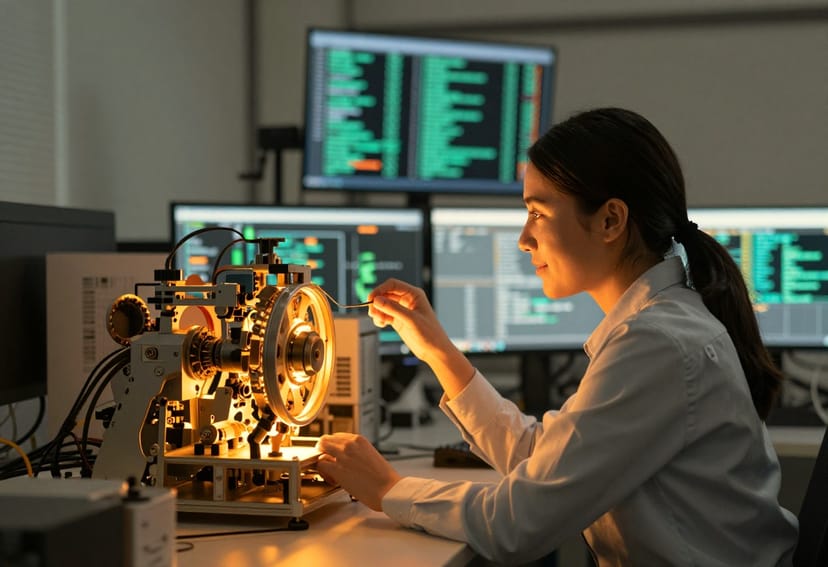

A new independent research institute launches in the United States this year, promising to accelerate scientific breakthroughs by funding researchers from idea to commercialization. Episteme takes its name from the Greek word for "knowledge" — the system of ideas that shapes how an era understands reality. Its founders believe too much promising talent remains trapped in a funding system that filters out cross-disciplinary, speculative, or difficult-to-translate ideas before they can prove their worth.
The problem is measurable. Researchers spend months writing grant proposals with success rates often below 20%. Administrative burden consumes time that could advance discovery. And when breakthroughs do emerge, the path from laboratory to real-world application remains fragmented, delaying impact by years.
Episteme proposes a third path — one inspired by history's most productive research environments, but adapted for modern science's interdisciplinary demands.
The Historical Blueprint: When Research Institutions Changed the World
Three institutions demonstrate what becomes possible when researchers receive sustained support, intellectual freedom, and cross-disciplinary collaboration.
Bell Labs, founded in 1925, produced work cited in eleven Nobel Prizes across multiple decades. On December 23, 1947, researchers there demonstrated the transistor — a discovery that became foundational to modern electronics. Later came UNIX and the C programming language in the late 1960s and early 1970s, creating major foundations of modern software.
Claude Shannon's "A Mathematical Theory of Communication" (1948) launched information theory. The pattern: sustained funding, minimal bureaucracy, and researchers from different disciplines working in close proximity.
The Institute for Advanced Study, established in 1930, welcomed 267 visiting scholars for the 2024–25 year, maintaining sustained global scholarly engagement nearly a century after its founding. Its model: provide brilliant minds with time, resources, and intellectual community — then step back.
Scholars and alumni remain prominent among major awards including the Abel Prize, Turing Award, and Breakthrough prizes in 2024–25.
Xerox PARC, active from 1970 through its donation to SRI International in April 2023, developed the Alto personal computer, Ethernet (1973), laser printer, and Smalltalk — core inventions that shaped personal computing. In 2024, PARC received IEEE Milestone recognitions for these technologies.
The lesson: when researchers can pursue ambitious ideas without immediate commercial pressure, they create technologies that define decades.
Yet these models emerged in specific historical moments. Bell Labs thrived within AT&T's regulated monopoly structure. PARC operated during an era of corporate research abundance. The Institute for Advanced Study represents pure research, not applied science.
Can their principles adapt to today's interdisciplinary challenges?
Why Traditional Scientific Funding Falls Short
The current system optimizes for predictability, not breakthrough potential.
Peer review, designed to ensure rigor, often filters out precisely the ideas that could reshape fields. Cross-disciplinary proposals fall between departmental cracks. Speculative research struggles to demonstrate "preliminary results" before receiving funding to generate those results.
Administrative requirements consume researcher time and energy.
The timeline problem compounds the impact. A researcher with a promising idea faces months writing proposals, months waiting for review, potential resubmission cycles, then institutional approval processes before work begins.
For fields like fusion energy or computational neuroscience — where accelerating progress by even a few years could have profound human impact — these delays translate to postponed breakthroughs and undiscovered cures.
Corporate labs offer an alternative, but with constraints. Research agendas align with business objectives. Timelines compress around product cycles. Intellectual property considerations shape what can be shared and when.
Academic positions provide stability but limited flexibility. Tenure-track researchers balance teaching, service, and research. Grant writing becomes a parallel career. The system rewards incremental progress over ambitious risk-taking.
How Episteme's Research Model Works
Episteme inverts the traditional funding model: it invests in researchers, not just their ideas.
The institute provides funding and operational support tailored to each researcher's needs, from initial concept through commercialization. This means laboratory setup, equipment acquisition, administrative support, and intellectual property guidance — the infrastructure that enables focus on discovery rather than logistics.
Researchers work together in a shared facility. This physical proximity matters. Bell Labs' breakthroughs emerged partly from daily interactions between physicists, engineers, and mathematicians.
PARC's innovations arose when computer scientists, cognitive psychologists, and hardware engineers shared hallways. Episteme recreates this environment deliberately.
The selection process considers both technical talent and the human being behind it. What constraints has this researcher faced? What ideas has the current system filtered out? What could they accomplish with sustained support and intellectual freedom?
Interdisciplinary Research Areas
Episteme focuses on fields where accelerated progress could have profound human impact.
Fusion technology represents one focus area. Nuclear fusion — the process that powers the sun — could provide abundant clean energy. Current approaches face engineering challenges around containing the superheated plasma (ionized gas at millions of degrees), developing materials that can withstand extreme conditions, and achieving energy efficiency where output exceeds input.
Accelerating progress by even a few years could transform global energy systems.
Computational neuroscience applies computer models to understand brain function, with applications in restoring movement and speech for people with neurological conditions. Brain-computer interfaces, neural prosthetics (artificial devices that replace or enhance nervous system function), and therapeutic interventions all depend on deeper understanding of how neural systems process information.
Advanced computing encompasses approaches that could speed discovery of life-saving treatments and novel materials. This includes quantum computing applications, machine learning for molecular design, and computational methods for predicting material properties.
The common thread: these fields sit at disciplinary intersections where traditional funding structures struggle. They require sustained investment over years, not grant cycles. And progress in each could cascade through multiple domains.
Researcher-Centered Support System
Operational support matters as much as funding.
Researchers need laboratory space, equipment, administrative assistance, legal guidance for intellectual property, and connections to commercialization pathways. Episteme provides this infrastructure, removing barriers between idea and implementation.
The model assumes that brilliant researchers, given resources and freedom, will pursue the most promising directions. This requires trust — the same trust that allowed Bell Labs researchers to explore information theory or PARC engineers to build personal computers before mass markets existed.
From Laboratory Discovery to Real-World Impact
Breakthroughs mean little if they remain in laboratories.
Episteme supports researchers through commercialization, recognizing that the path from discovery to deployment requires different skills and resources than the path to discovery itself. This might mean startup formation, licensing partnerships, or collaboration with established companies.
The institute's role evolves as projects mature. Early-stage research requires patient capital and intellectual freedom. Later stages need business development expertise, manufacturing partnerships, and regulatory navigation.
By supporting researchers across this spectrum, Episteme aims to accelerate the timeline from breakthrough to benefit.
This approach addresses a persistent gap in the innovation ecosystem. Universities excel at fundamental research but struggle with commercialization. Companies excel at product development but avoid early-stage risk. Independent research institutes can bridge this gap.
Building a Collaborative Research Community
The institute's founders spent two years speaking with hundreds of scientists and engineers worldwide to understand constraints on their work.
Common themes emerged: administrative burden, funding uncertainty, pressure for incremental results, difficulty pursuing cross-disciplinary ideas, and gaps between discovery and deployment. Episteme's structure responds to these specific pain points.
The community aspect matters. Researchers benefit from colleagues working on different problems with complementary expertise. A fusion physicist might gain insights from conversations with a computational neuroscientist.
An engineer developing new materials might collaborate with a biologist studying natural structures. These interactions don't happen by accident — they require physical proximity and institutional culture that encourages collaboration.
What This Means for Scientific Progress
Episteme represents one experiment in alternative research funding, not a complete solution to systemic challenges.
The model has limitations. It can support perhaps 15–20 researchers annually — a tiny fraction of global scientific talent. Selection processes, however thoughtful, will miss promising researchers.
And success depends on execution: Can the institute actually provide the support it promises? Will the research environment prove as productive as historical models?
Yet the experiment matters. If Episteme demonstrates that researcher-centered funding accelerates breakthroughs, other institutions might adapt similar approaches. If cross-disciplinary collaboration yields innovations that traditional structures miss, funding agencies might reconsider how they evaluate proposals.
If supporting researchers from idea to commercialization shortens the timeline from discovery to impact, the model could scale.
The broader question: How do we maximize the potential of brilliant researchers? The current system evolved to serve specific purposes — ensuring rigor, distributing resources, maintaining accountability.
But systems optimized for one set of goals may underperform on others. Episteme tests whether different optimization criteria — researcher freedom, cross-disciplinary collaboration, sustained support — can complement existing structures.
The Path Forward: What Success Looks Like
For this model to succeed, several elements must align.
Researchers considering alternative paths should evaluate whether Episteme's model fits their work. Does your research sit at disciplinary intersections? Would sustained funding without grant cycles accelerate progress? Could commercialization support help translate discoveries to impact?
Institutions and funding agencies should watch this experiment. If researcher-centered funding proves effective, what elements could adapt to existing structures? Could universities reduce administrative burden? Could grant agencies create pathways for cross-disciplinary proposals?
Could commercialization support integrate earlier in the research process?
The scientific community should demand transparency. Episteme should share metrics: How many researchers supported? What breakthroughs emerged? What timeline from idea to impact? How does productivity compare to traditional models?
Without data, the experiment teaches nothing.
Policymakers and research advocates should consider systemic implications. If alternative funding models accelerate progress in critical fields, what policy changes could support similar approaches? How might research funding evolve to balance rigor with risk-taking, accountability with freedom?
For those interested in scientific progress — whether as potential collaborators, supporters, or informed citizens — the launch of Episteme offers a window into how research funding might evolve. The institute's success or failure will provide valuable lessons about what enables breakthrough science in the 21st century.
Every minute of delay means cures undiscovered and breakthrough technologies postponed.
This urgency drives Episteme's mission. But urgency alone doesn't guarantee success. The institute must deliver on its promises: sustained funding, operational support, intellectual freedom, and pathways to impact.
Researchers must produce breakthroughs that justify the investment. And the broader scientific community must learn from both successes and failures.
The episteme — the system of ideas that shapes how an era produces knowledge — doesn't shift through announcements. It shifts through demonstrated results. Episteme the institute now faces the challenge of proving that its model can deliver what history's most productive research environments achieved: discoveries that reshape what the world sees as possible.