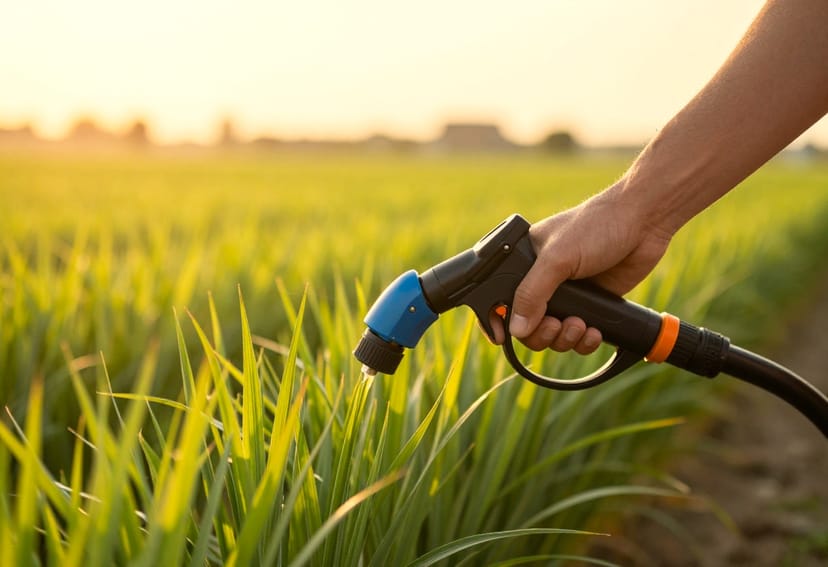

Sabanto and Verdant Robotics connect autonomous tractors with plant-level application. The integration could help producers extend field operations and target inputs more precisely, while the practical staffing and cost results will depend on the crop, equipment, and operating setup.
The companies announced the integration on June 30, 2026. Sabanto Inc., based in Ames, Iowa, and Verdant Robotics, based in Hayward, California, said Sabanto’s Autonomy System now communicates directly with Verdant’s SharpShooter precision application system. RoboticsInt'l also reported the combination as a single operational system that links autonomous vehicle control with plant-level application.
1. Navigation and application can work as one system. Sabanto’s system uses high-precision GNSS, cameras, an advanced vehicle operating system, and path-planning software to guide a tractor. SharpShooter uses Verdant’s Aim & Apply™ technology to identify individual plants and weeds in real time and apply inputs where they are needed. In practical terms, the tractor handles the route while the implement responds to what it detects in the field.
The connection runs through a CAN bus. That is the tractor’s internal communication network, which lets electronic systems exchange instructions and data. According to the companies, SharpShooter sends field information to the Sabanto Autonomy System during navigation. The combined system can then direct changes in tractor speed and implement height under the operating conditions supported by the integration.
2. The potential benefit is less blanket application. Applying inputs only where the system detects a target may reduce unnecessary product use compared with treating an entire field uniformly. The companies describe this as plant-level precision. However, the available information does not provide independent measurements of input savings, detection rates, application accuracy, or total operating costs, so producers should treat those outcomes as potential benefits rather than established results.
3. The setup is designed for existing equipment. Sabanto’s retrofit approach is intended to work across a wide range of tractor makes and models. That could give producers a way to add autonomous capability without replacing an entire fleet. Exact compatibility, installation requirements, and performance limits should be confirmed for each tractor and implement combination.
4. Field use may reduce the need for an operator in the cab. The companies say the integrated system can run field work without an operator sitting in the cab. That does not by itself establish that every part of a job is unattended. Producers should confirm how a specific deployment handles startup, refilling, calibration, field edges, obstacles, maintenance, emergency intervention, and any required remote or on-site supervision.
Commercial testing gives the announcement a practical reference point. The integration is being used in commercial operations in several crop markets, including sod production at Bethel Farms. The companies describe the combined system as reliable in demanding conditions, but the available material does not provide a conventional comparison, acreage-per-hour figures, staffing data, or a measured cost reduction.
5. The next question is whether the economics fit your operation. Sabanto announced an oversubscribed Series B financing on July 14, 2026, saying the funding will help scale its autonomous technology for row-crop farming. That announcement does not establish when the integrated Sabanto and SharpShooter setup will be broadly available. For now, producers can evaluate the opportunity by comparing the expected retrofit and operating costs with their current labor, application, supervision, and equipment expenses.
A sensible first step is a site-specific assessment. Ask both companies for compatible equipment lists, supervision requirements, field-validation data, and results from a crop and application method similar to yours. If the system can cover more of your application window without compromising safety or accuracy, it may offer a practical way to ease staffing pressure and make input use more targeted.