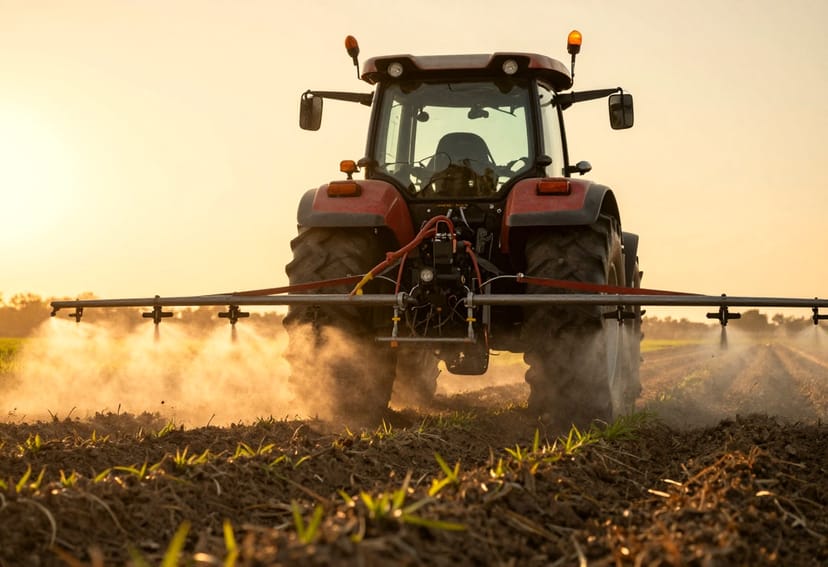

Swiss company Ecorobotix is launching the ARA595 Ultra-High Precision (UHP) Sprayer in the United States. The machine uses AI to target crop protection treatments plant by plant, helping irrigation-based farms pursue more precise applications and potentially lower chemical use. (source)
1. The U.S. launch is aimed at a specific irrigation setup. Ecorobotix published its U.S. launch announcement on June 30, 2026. The ARA595 is designed for 80-inch irrigation beds with side sprinklers, a configuration the company says is common in California and Arizona. It will be manufactured and assembled in Lyons, Kansas, giving U.S. buyers a domestic production and supply point.
2. The machine is built for high-throughput fieldwork. The company says the first units will be available to ship by the end of July. The ARA595 has a 19.7-foot working width, a driving speed of up to 4.5 mph, and coverage of up to 10 acres per hour. Pipe guides help it navigate side-sprinkler infrastructure during operation.
3. The biggest potential savings need careful verification. Ecorobotix says its Plant-by-Plant AI™ can reduce input costs by up to 95% by treating only the plants that need attention. That figure should be treated as a company-reported upper limit, not a guaranteed result. The available information does not specify the baseline application rate, crop, weed pressure, herbicide, field size, number of trials, comparison method, or whether the percentage refers to product volume, total spending, or both.
4. Precision does not replace pesticide safeguards. The ARA595 offers a 2.4 × 2.4-inch spot-spray resolution, but resolution alone is not a blanket assurance that non-selective herbicides will be safe for every crop or condition. Before using such products, growers should request crop-safety and drift-control data covering the tested crops, nozzle and pressure settings, operating speed, weather limits, buffer requirements, and failure rate. They must also follow United States Environmental Protection Agency pesticide labels and applicable state requirements.
5. The software supports more than 30 crop algorithms. The system includes capabilities such as lettuce thinning, crop-specific targeting, and adjustable safety zones. The available product information does not specify what those zones detect or restrict, so they should be treated as machine settings that complement, rather than replace, human supervision, emergency procedures, pesticide re-entry intervals, and worker-protection rules.
When this becomes a buying decision. If your operation uses 80-inch beds and side sprinklers in California, Arizona, or a similar setup, the ARA595 may fit your existing layout. Build the business case with conservative, middle, and upper-bound savings scenarios rather than relying on the 95% figure alone. Include the purchase or lease price, financing, labor, training, software or algorithm fees, maintenance, batteries or fuel, calibration, herbicide costs, crop-loss risk, downtime, insurance, and resale value.
For growers who can match the machine to their irrigation infrastructure, the potential upside is more targeted treatment, lower chemical use, and more efficient field management. Confirm the machine's fit, request the supporting trial data, and compare the full ownership cost before planning a late-July deployment. Read more: Sabanto and Verdant Robotics integrate autonomous systems. Here is how you can run fields without a cab operator.