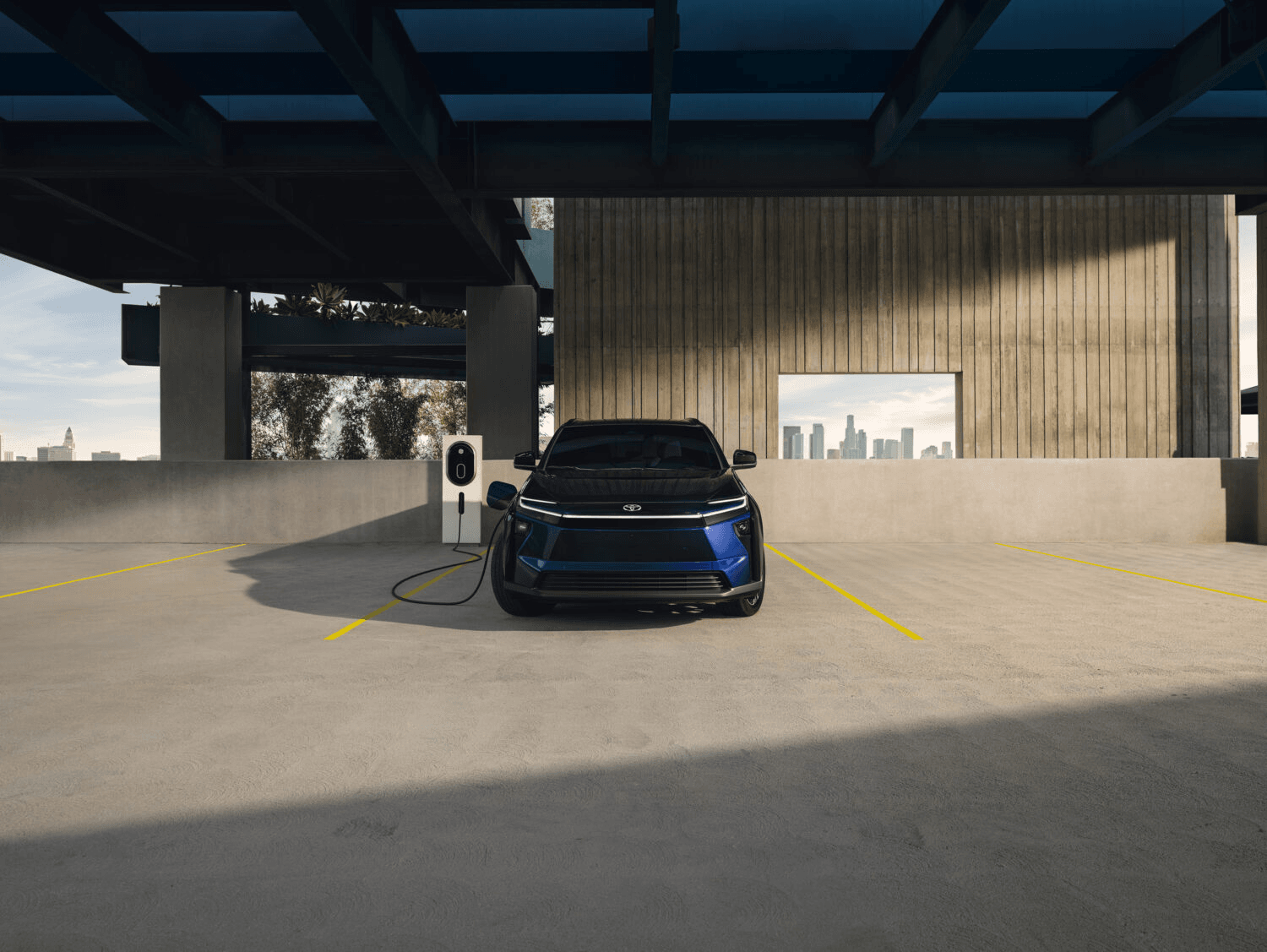

At $18,000, the U.S. EV shopping list is brutally short. The Nissan Leaf starts around $29,600. Everything else climbs from there—Chevy Equinox EV at $34,995, Tesla Model 3 at $36,990. And that's in a market where federal incentives have become increasingly complex and restrictive.

Take that same $18,000 to a showroom in Shanghai, though, and the doors open to Toyota's just-launched bZ5—a compact electric crossover with 268 hp, LiDAR, and a 10-speaker JBL system. Picture walking the lot: the salesperson hands you the keys, you slide into a cabin that smells like new leather and soft-touch plastics, and the 15.6-inch touchscreen lights up with a price that makes you check the exchange rate twice.
It's the kind of vehicle that makes you wonder what century we're living in, and which side of the Pacific got the better deal.

The Coffee-Break Charge That Adds 200 Miles
Every bZ5 uses a front-mounted electric motor: 200 kW (268 hp), 243 lb-ft of torque. The 90 kW DC fast-charging system takes the battery from 30 to 80 percent in 27 minutes.
Imagine an Electrify America station outside Austin on a Saturday morning. You plug in, walk inside for coffee—the good kind, not gas-station sludge—check your phone, maybe scroll through messages. Twenty-seven minutes later you're at 80 percent, and the screen shows $15.68 charged at $0.56/kWh peak rate. You do the math: that's roughly 200 miles for the price of a large pizza. The cable clicks out, coils back into the stall, and you're gone before your coffee gets cold.

The battery tech comes from BYD's Blade LFP (lithium iron phosphate) packs—proven, safe, durable chemistry that's cheaper than the nickel-cobalt mixes in most vehicles sold here. The 550-badged models carry a 65.28 kWh pack good for 342 miles of CLTC-rated range. The 630 Pro steps up to 73.98 kWh and 392 miles.
CLTC is China's test cycle—generous, optimistic, and about as real-world as a windless day in Death Valley. Expect those numbers to drop 20–25 percent in mixed driving, more in cold weather. Still, 270–310 miles of actual range in a $20,000 crossover would rewrite the U.S. EV market overnight.
Four Trims, All Priced Like Used Sedans
Toyota didn't pull the usual trick of a cheap base model and a $15,000 jump to anything usable. The range is tight and rational:
Trim | Price (USD) | Battery | CLTC Range | Key Features |
|---|---|---|---|---|
550 Joy | $18,100 | 65.28 kWh | 342 mi | Base model, 15.6" screen |
550 Pro | $19,400 | 65.28 kWh | 342 mi | Enhanced features |
550 Pro Smart | $22,200 | 65.28 kWh | 342 mi | LiDAR, advanced driver assist |
630 Pro | $22,200 | 73.98 kWh | 392 mi | Bigger battery, LiDAR, JBL audio |

The top trim—with the bigger battery, LiDAR, and JBL audio—costs $22,200. The 10-speaker JBL setup is standard. There's a digital gauge cluster behind the wheel. The Navigation on Autopilot system uses 33 sensors. The styling is clean, modern, and doesn't scream "budget compromise" from across the parking lot.
For context: in the U.S., $18,000 buys a subcompact Nissan Versa or maybe a leftover 2024 Mitsubishi Mirage gathering dust. The cheapest new EV—the Nissan Leaf—starts at $29,600 before destination charges. The bZ5 undercuts that by $11,500 and adds a size class, more range, and features that would cost extra on anything sold here.
The Phoenix Family That Could Drive This Tomorrow (If Only)
Picture a Phoenix morning in late October. You slide into the driver's seat at 6:45 a.m., the cabin silent except for the soft chime of the startup sequence. 268 hp waits under your right foot, and the battery shows 342 miles—more than enough for the 18-mile commute to work, the 12-mile detour to drop the kids at soccer practice, and the evening grocery run.

The kids' gear fills the back—cleats, shin guards, two water bottles, a forgotten sweatshirt. The cargo area swallows it all without complaint. You merge onto the 101, and the electric motor pushes you into the flow of traffic with the kind of smooth, instant torque that makes internal combustion feel like it's thinking too hard.
The JBL speakers are playing something the algorithm picked—sounds good, feels expensive, costs nothing extra on this trim. The air conditioning hums quietly, fighting the 95°F heat that's already building outside. The battery percentage ticks down slowly. By the time you pull into the driveway that evening, it still shows 68 percent.
You plug into the 240V outlet in the garage, and by morning it's back to 100 percent. Cost: $4.20 at Arizona's average $0.14/kWh residential rate. You haven't thought about a gas station in three weeks.
The bZ5 measures 188.2 inches long, 73.5 inches wide, 59.4 inches tall, with a 113.4-inch wheelbase. That makes it noticeably larger than the U.S.-market bZ4X, which stretches 184.6 inches long on a 112.2-inch wheelbase. The extra length translates to more rear-seat legroom and cargo space—the kind of practical volume families actually use for grocery runs and weekend trips.
The Math That Makes You Check the Exchange Rate Twice
In China, the Tesla Model Y starts at 263,500 yuan ($37,000) despite being built locally in Shanghai. That's double the price of a bZ5 630 Pro. You could buy two fully loaded bZ5s—one for daily commuting, one for weekend trips—and still have $8,000 left over.

Here's the U.S. reality, out-the-door pricing included:
Vehicle | Starting Price | Range | Price Premium vs. bZ5 |
|---|---|---|---|
Nissan Leaf S | $29,600 | 149 mi | +$11,500 (63% more) |
Chevy Equinox EV | $34,995 | 319 mi | +$16,895 (93% more) |
Tesla Model 3 | $36,990 | 272 mi | +$18,890 (104% more) |
Toyota bZ5 (China) | $18,100 | 342 mi (CLTC) | Baseline |
The cheapest EV you can buy in America costs 63 percent more than the bZ5 and offers less than half the range. The Tesla Model 3—often cited as the "affordable" EV—costs more than double.
Why This Gap Exists (And Why It Won't Close Soon)
The price disparity isn't magic. It's manufacturing scale, supply chain integration, battery chemistry choices, and government policy working in concert.
China's EV supply chain is vertically integrated in ways the U.S. can't match. BYD manufactures its own batteries, motors, and semiconductors. CATL supplies half the world's EV batteries from factories within trucking distance of assembly plants. Rare earth processing happens domestically. The result: lower costs, faster iteration, and pricing flexibility that would be impossible with imported components.
The LFP batteries in the bZ5 cost roughly 30 percent less per kWh than the nickel-cobalt chemistries favored in U.S. vehicles. They're heavier and slightly less energy-dense, but they're safer, longer-lasting, and don't require cobalt—a metal with complex supply chains and ethical concerns.
Government support matters too. China's EV subsidies have shifted from direct consumer rebates to manufacturing incentives, R&D funding, and charging infrastructure. The result is a hyper-competitive market where automakers must innovate and price aggressively to survive. Over 100 EV brands compete in China; in the U.S., fewer than a dozen have meaningful market share.
U.S. tariffs on Chinese-made EVs—currently 27.5 percent and potentially rising—make importing vehicles like the bZ5 economically unviable. Even if Toyota wanted to sell this vehicle here, the math wouldn't work. A $18,100 vehicle becomes $23,085 after tariffs, before shipping, before meeting U.S. safety and emissions standards, before dealer markup.
What This Means for American Buyers
The bZ5 won't arrive in U.S. showrooms. Toyota's American lineup focuses on the bZ4X, a vehicle that starts at $42,000—more than double the bZ5's price—with less interior space and comparable range.
But the bZ5's existence matters because it reveals what's possible when manufacturing scale, supply chain efficiency, and competitive pressure align. It shows that $20,000 EVs with 300+ miles of range aren't science fiction—they're reality, just not here.
For American buyers, the message is clear: the global EV market is moving faster and cheaper than what's available domestically. Whether that gap closes depends on battery manufacturing capacity, supply chain development, and policy decisions that are still years away from implementation.
In the meantime, that $18,000 in your savings account buys a Nissan Versa in Denver or a well-equipped electric crossover in Shanghai. The exchange rate is the same. The vehicles aren't even close.