
Logo
Decide better.Live better.
My feedToday
Logo
Decide better.Live better.
My feedToday
Logo
My feedToday

Stay Curious. Stay Wanture.

© 2026 Wanture. All rights reserved.

  • Terms of Use
  • Privacy Policy
Logo
Decide better.Live better.
My feedTodayTechScienceHealthMobilityMindProductivityHomeExperiencesLongevity
Logo
Decide better.Live better.
My feedTodayTechScienceHealthMobilityMindProductivityHomeExperiencesLongevity
Logo
My feedTodayTechScienceHealthMobilityMindProductivityHomeExperiencesLongevity

Two Electric Locomotives That Never Plug In

Fortescue's Infinity Train hauls iron ore 385 miles on gravity alone — no charging stations, no diesel, just regenerative braking

Two Electric Locomotives That Never Plug In

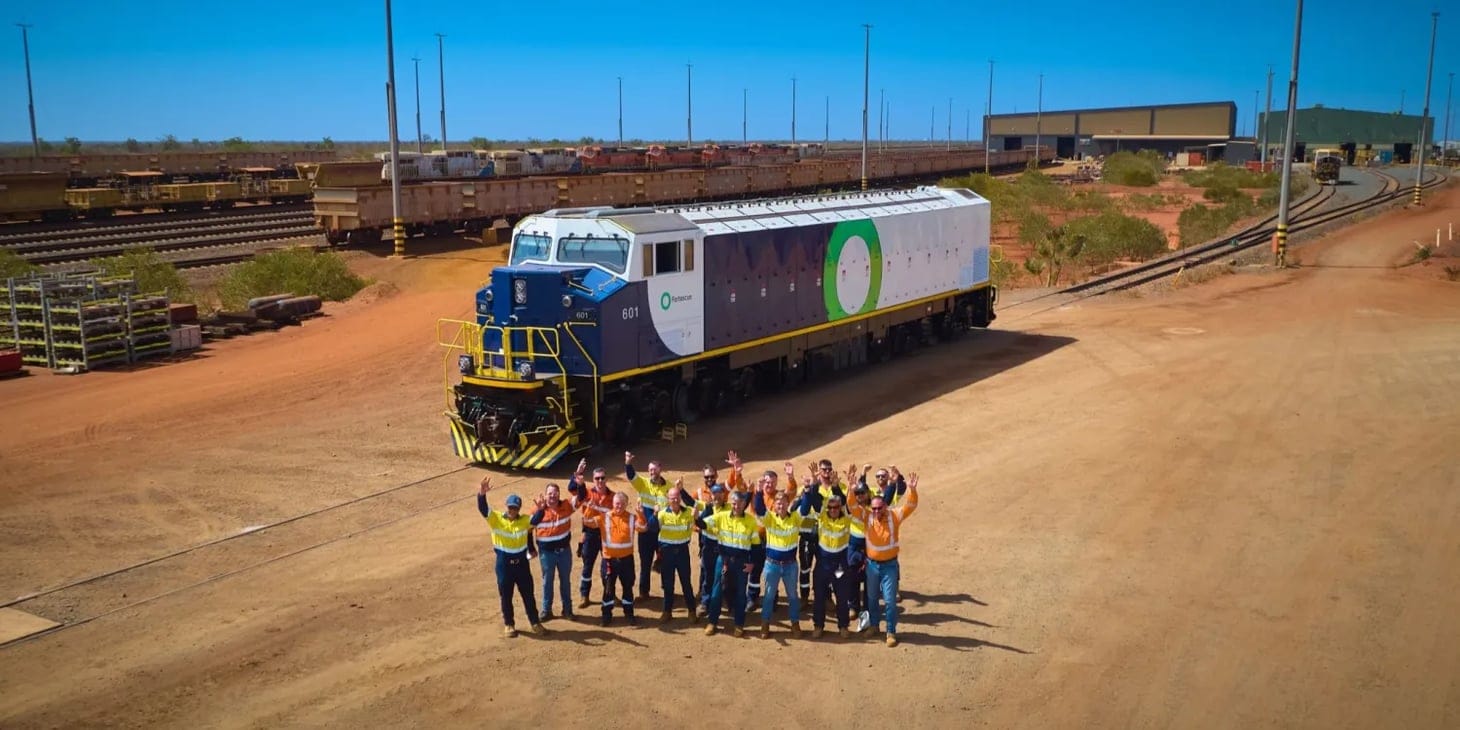
Fortescue's battery-electric locomotives in Western Australia prove perpetual-motion rail is real. Two trains hauling 259-ton ore loads across 385 miles charge themselves through regenerative braking on downhill runs. 14.5 MWh battery packs. Zero external charging infrastructure. 21.7 million gallons of diesel eliminated annually. This isn't a test — it's commercial mining operations running on electrons and gravity right now.

15 December 2025

—

Explainer

Ethan Whitaker
banner

Summary:

  • Two battery-electric locomotives in Western Australia haul 385 miles of iron ore, generating electricity through gravity and regenerative braking.
  • Fortescue's Infinity Train eliminates 220,520 metric tons of CO₂ annually by replacing diesel with a self-charging battery system powered by downhill loaded trains.
  • The technology works only on routes with significant elevation change, potentially transforming mining and freight transport across routes like Wyoming's coal and Minnesota's iron ore lines.

Two locomotives in Western Australia haul iron ore 385 miles. They run on batteries. They never plug in. This is how gravity powers electric trains.

What It Is

A regenerative heavy-haul train is a battery-electric locomotive that recharges itself through operation. It belongs to the category of energy-recovery transport systems. Unlike battery trains that need charging stations, these trains generate more electricity going downhill loaded than they consume going uphill empty. The weight of cargo becomes the fuel.

Why It Matters

Heavy-haul rail consumes diesel at industrial scale. Fortescue's mining operations in Australia burn 21.7 million gallons annually just for rail. Switching to regenerative electric eliminates 235,200 metric tons of CO₂. That equals removing 51,400 cars from roads for one year.

The economics shift hard. Diesel costs money. It requires supply chains. It needs maintenance infrastructure. Battery-electric eliminates fuel procurement. It reduces maintenance. Electric motors have fewer moving parts than diesel engines. It simplifies logistics.

For mining operations in remote regions where diesel delivery is expensive and weather-dependent, self-sustaining electric trains change the cost structure entirely.

How It Works

The Energy Recovery Loop

The train generates more energy downhill loaded than it uses uphill empty.

The train hauls ore downhill. Gravity pulls it. Brakes slow it down. But these aren't normal brakes that waste energy as heat. They're regenerative brakes that capture motion and convert it to electricity. The battery stores it.

The train then climbs back empty. It uses less energy going up empty than it gained going down loaded.

Think of it like this. Push a shopping cart full of heavy groceries down a steep parking garage ramp. Gravity pulls the cart downhill. You brake to control speed. Now imagine those brakes captured that energy and stored it in a battery. That stored energy then powers the cart back up the ramp when it's empty and light.

The Infinity Train does exactly that at industrial scale. The ore's weight becomes the fuel.

Battery Pack Design

A 14.5 MWh battery stores the recovered energy.

MWh stands for megawatt-hour. It measures energy storage. One megawatt-hour powers 1,000 average homes for one hour. The Infinity Train's 14.5 MWh battery equals 145 Ford F-150 Lightning batteries. Or enough to power a small neighborhood for a day.

The battery is modular. Crews can replace sections. The train stays operational. This matters for mining operations where downtime costs millions per day.

The pack survives Pilbara conditions. Summer temperatures hit 120°F. Red dust infiltrates everything. Vibration from heavy-haul operations is constant. Thermal management systems keep cells within optimal temperature ranges.

The battery charges. It discharges. It charges again. For years.

Route Requirements

The route must have more downhill loaded travel than uphill empty travel.

Not every rail route works. The physics require specific elevation profiles. Iron ore mines in Australia's Pilbara region sit at elevation. The rail route to the coast drops through terrain that creates a natural energy advantage. Loaded trains descend. Empty trains climb back.

The 385-mile route between mine and port was designed for heavy-haul iron ore transport decades before electric trains existed. The existing route profile happens to create ideal conditions for regenerative systems. Elevation change between mine sites and Port Hedland provides consistent downhill loaded runs.

U.S. examples exist. Wyoming coal trains could run Powder River Basin mines down to eastern rail yards. Minnesota iron ore operations move taconite from Mesabi Range mines toward Duluth and Lake Superior. Appalachian coal routes drop from mountaintop mines to valley processing facilities.

Any route where loaded weight travels downhill more than uphill can potentially close the energy loop.

The system works because total energy recovered over a full cycle exceeds total energy consumed. Not every segment generates surplus energy. Level terrain consumes battery power. Uphill sections drain it faster. The route profile determines whether the math closes.

Energy Management Systems

Sophisticated software tracks every kilowatt-hour in real time.

The system monitors state of charge. It optimizes regenerative braking efficiency. It balances energy recovery with propulsion demands.

The software predicts energy needs based on route profile. It tells the crew whether the train will complete the cycle with charge to spare or arrive at the depot needing a top-up.

In commercial operations, Fortescue's two locomotives complete multiple round trips per week hauling iron ore to Port Hedland for export. These are revenue-generating operations under full production load. Not controlled demonstrations. Not test tracks. Real mining.

Real-World Examples

Fortescue Pilbara Operations

Fortescue deployed two Infinity Train locomotives simultaneously in December 2024. Built in partnership with Caterpillar's Progress Rail division, each carries the 14.5 MWh battery pack. They operate on Fortescue's private heavy-haul rail network in Western Australia's Pilbara region right now.

Simultaneous deployment at scale signals confidence. This isn't a pilot program waiting for validation.

The 21.7 million gallons of diesel eliminated annually represents approximately 11 percent of Fortescue's direct emissions. For a mining company, that's primarily mobile equipment and on-site power generation. An 11 percent reduction from switching two trains shows how diesel-intensive rail operations are. It also suggests the potential impact if the concept scales across the full locomotive fleet.

Building charging stations across 385 miles of remote rail line would cost tens of millions. The Infinity Train eliminates that capital requirement entirely.

Potential U.S. Applications

The concept could extend to American mining and freight operations. Wyoming's Powder River Basin produces 40 percent of U.S. coal. Trains haul it from elevation down to eastern markets. That's a regenerative-ready profile.

Minnesota's Iron Range ships taconite pellets from Mesabi Range mines toward Duluth. Loaded trains descend toward Lake Superior. Empty trains climb back. The elevation drop could power the return trip.

Cost comparison matters. Diesel at $3.50 per gallon costs roughly $0.10 per kWh equivalent when burned in a locomotive. Electricity at $0.12 per kWh purchased from the grid is competitive. Electricity generated by the train itself through regenerative braking costs nothing.

The economics improve every time diesel prices spike.

Beyond Mining

Urban delivery routes with hilly terrain could work. Quarry operations with consistent downhill loaded runs. Ski resort shuttle systems. Any application where loaded weight travels downhill can potentially recover enough energy to close the loop.

The physics are the same. Only the scale changes.

Common Misconceptions

Myth: This is perpetual motion.

Reality: Not perpetual motion. The ore's gravitational potential energy powers the system. Gravity does work pulling loaded ore downhill. That work converts to electricity. Remove the ore and the train stops working. The energy comes from somewhere. It comes from elevation change.

Myth: Works on any rail route.

Reality: Requires specific elevation profile. More downhill loaded travel than uphill empty travel. Flat routes don't generate surplus energy. Routes where loaded trains climb and empty trains descend don't work at all. They require external charging or diesel. The route profile determines everything.

Myth: The battery lasts forever.

Reality: Batteries degrade. Charge cycles wear them down. The modular design allows replacement of degraded sections. Fortescue's operational data over coming years will show real-world battery lifespan in harsh mining conditions. Early indications suggest 10 to 15 years of useful life with proper thermal management.

What This Means for American Rail

Regenerative heavy-haul trains work when gravity does the heavy lifting. The physics are simple. The weight you haul downhill powers the climb back up. This makes battery-electric rail viable without charging infrastructure for routes with the right elevation profile.

Fortescue's Infinity Train proves the technology works at commercial scale. The next question is how many American rail routes have similar profiles. The answer is probably more than the industry expects.

Coal. Iron ore. Aggregate. Timber. Grain from mountain states. Any commodity that moves from higher elevation to lower elevation for processing or shipping.

The breakthrough isn't just environmental. It's economic. No fuel cost. Lower maintenance. Simplified logistics. For mining and freight operations watching diesel prices, that changes the calculus on fleet electrification entirely.

Gasoline had its century. In the Pilbara desert and potentially across American mining corridors, the next one runs on gravity, regenerative braking, and the weight of cargo headed downhill to port.


What is this about?

  • Explainer/
  • Ethan Whitaker/
  • Mobility/
  • Electrics/
  • battery-electric trains/
  • zero-emission transport/
  • mining decarbonization/
  • regenerative energy/
  • sustainable logistics

Feed

    ..

    ..

    ..

    Auden Wheelockabout 10 hours ago
    Apple Breaks Autumn Cadence: iPhone 18 Pro and iPhone Ultra

    Apple Breaks Autumn Cadence: iPhone 18 Pro and iPhone Ultra

    Plan purchases around September’s standard lineup or wait for Q4 hardware

    Ben Ramosabout 13 hours ago
    Apple Watch Ultra 4 could track blood pressure trends

    Apple Watch Ultra 4 could track blood pressure trends

    A potential hardware redesign with 8 sensors aims to move from simple alerts to direct cardiovascular measurement

    Ben Ramos4 days ago

    Your earbuds could become a secure digital key via your heartbeat

    AccLock uses standard accelerometers to verify identity without needing premium optical heart trackers

    Ben Ramos5 days ago
    Memory chip shortages could end by 2027

    Memory chip shortages could end by 2027

    Aggressive Chinese production expansions from YMTC and CXMT may lower hardware costs sooner than the 2030 consensus

    Ben Ramos5 days ago
    Hisense Explorer X1 Pro brings 120-inch cinema to your living room

    Hisense Explorer X1 Pro brings 120-inch cinema to your living room

    A new tri-color laser engine offers 110% BT.2020 color gamut, though US availability remains unannounced

    Logan Price6 days ago
    Onyx Boox Poke 7 series brings paper-like clarity to your library

    Onyx Boox Poke 7 series brings paper-like clarity to your library

    New 300 ppi displays and 2 TB expandable storage offer a sharper, larger reading experience

    Ben Ramos6 days ago
    SpaceX IPO: A historic bet on the space economy

    SpaceX IPO: A historic bet on the space economy

    With 2025 revenue hitting $18.6 billion, the Nasdaq debut tests market appetite for Elon Musk

    Jasmine Wu6 days ago
    Figma AI agents turn manual design into high-level direction

    Figma AI agents turn manual design into high-level direction

    New intent-based tools allow designers to build layouts using natural language instead of clicking and dragging

    Evelyn Park6 days ago
    NanoClaw's sandbox stops AI agents from compromising your OS

    NanoClaw's sandbox stops AI agents from compromising your OS

    NanoCo secures $12 million to scale its isolated architecture for enterprise AI deployment

    Marcus Dillard6 days ago
    Loading...

Two Electric Locomotives That Never Plug In

Fortescue's Infinity Train hauls iron ore 385 miles on gravity alone — no charging stations, no diesel, just regenerative braking

December 15, 2025, 6:16 pm

Fortescue's battery-electric locomotives in Western Australia prove perpetual-motion rail is real. Two trains hauling 259-ton ore loads across 385 miles charge themselves through regenerative braking on downhill runs. 14.5 MWh battery packs. Zero external charging infrastructure. 21.7 million gallons of diesel eliminated annually. This isn't a test — it's commercial mining operations running on electrons and gravity right now.

Two Electric Locomotives That Never Plug In

Summary

  • Two battery-electric locomotives in Western Australia haul 385 miles of iron ore, generating electricity through gravity and regenerative braking.
  • Fortescue's Infinity Train eliminates 220,520 metric tons of CO₂ annually by replacing diesel with a self-charging battery system powered by downhill loaded trains.
  • The technology works only on routes with significant elevation change, potentially transforming mining and freight transport across routes like Wyoming's coal and Minnesota's iron ore lines.

Two locomotives in Western Australia haul iron ore 385 miles. They run on batteries. They never plug in. This is how gravity powers electric trains.

What It Is

A regenerative heavy-haul train is a battery-electric locomotive that recharges itself through operation. It belongs to the category of energy-recovery transport systems. Unlike battery trains that need charging stations, these trains generate more electricity going downhill loaded than they consume going uphill empty. The weight of cargo becomes the fuel.

Why It Matters

Heavy-haul rail consumes diesel at industrial scale. Fortescue's mining operations in Australia burn 21.7 million gallons annually just for rail. Switching to regenerative electric eliminates 235,200 metric tons of CO₂. That equals removing 51,400 cars from roads for one year.

The economics shift hard. Diesel costs money. It requires supply chains. It needs maintenance infrastructure. Battery-electric eliminates fuel procurement. It reduces maintenance. Electric motors have fewer moving parts than diesel engines. It simplifies logistics.

For mining operations in remote regions where diesel delivery is expensive and weather-dependent, self-sustaining electric trains change the cost structure entirely.

How It Works

The Energy Recovery Loop

The train generates more energy downhill loaded than it uses uphill empty.

The train hauls ore downhill. Gravity pulls it. Brakes slow it down. But these aren't normal brakes that waste energy as heat. They're regenerative brakes that capture motion and convert it to electricity. The battery stores it.

The train then climbs back empty. It uses less energy going up empty than it gained going down loaded.

Think of it like this. Push a shopping cart full of heavy groceries down a steep parking garage ramp. Gravity pulls the cart downhill. You brake to control speed. Now imagine those brakes captured that energy and stored it in a battery. That stored energy then powers the cart back up the ramp when it's empty and light.

The Infinity Train does exactly that at industrial scale. The ore's weight becomes the fuel.

Battery Pack Design

A 14.5 MWh battery stores the recovered energy.

MWh stands for megawatt-hour. It measures energy storage. One megawatt-hour powers 1,000 average homes for one hour. The Infinity Train's 14.5 MWh battery equals 145 Ford F-150 Lightning batteries. Or enough to power a small neighborhood for a day.

The battery is modular. Crews can replace sections. The train stays operational. This matters for mining operations where downtime costs millions per day.

The pack survives Pilbara conditions. Summer temperatures hit 120°F. Red dust infiltrates everything. Vibration from heavy-haul operations is constant. Thermal management systems keep cells within optimal temperature ranges.

The battery charges. It discharges. It charges again. For years.

Route Requirements

The route must have more downhill loaded travel than uphill empty travel.

Not every rail route works. The physics require specific elevation profiles. Iron ore mines in Australia's Pilbara region sit at elevation. The rail route to the coast drops through terrain that creates a natural energy advantage. Loaded trains descend. Empty trains climb back.

The 385-mile route between mine and port was designed for heavy-haul iron ore transport decades before electric trains existed. The existing route profile happens to create ideal conditions for regenerative systems. Elevation change between mine sites and Port Hedland provides consistent downhill loaded runs.

U.S. examples exist. Wyoming coal trains could run Powder River Basin mines down to eastern rail yards. Minnesota iron ore operations move taconite from Mesabi Range mines toward Duluth and Lake Superior. Appalachian coal routes drop from mountaintop mines to valley processing facilities.

Any route where loaded weight travels downhill more than uphill can potentially close the energy loop.

The system works because total energy recovered over a full cycle exceeds total energy consumed. Not every segment generates surplus energy. Level terrain consumes battery power. Uphill sections drain it faster. The route profile determines whether the math closes.

Energy Management Systems

Sophisticated software tracks every kilowatt-hour in real time.

The system monitors state of charge. It optimizes regenerative braking efficiency. It balances energy recovery with propulsion demands.

The software predicts energy needs based on route profile. It tells the crew whether the train will complete the cycle with charge to spare or arrive at the depot needing a top-up.

In commercial operations, Fortescue's two locomotives complete multiple round trips per week hauling iron ore to Port Hedland for export. These are revenue-generating operations under full production load. Not controlled demonstrations. Not test tracks. Real mining.

Real-World Examples

Fortescue Pilbara Operations

Fortescue deployed two Infinity Train locomotives simultaneously in December 2024. Built in partnership with Caterpillar's Progress Rail division, each carries the 14.5 MWh battery pack. They operate on Fortescue's private heavy-haul rail network in Western Australia's Pilbara region right now.

Simultaneous deployment at scale signals confidence. This isn't a pilot program waiting for validation.

The 21.7 million gallons of diesel eliminated annually represents approximately 11 percent of Fortescue's direct emissions. For a mining company, that's primarily mobile equipment and on-site power generation. An 11 percent reduction from switching two trains shows how diesel-intensive rail operations are. It also suggests the potential impact if the concept scales across the full locomotive fleet.

Building charging stations across 385 miles of remote rail line would cost tens of millions. The Infinity Train eliminates that capital requirement entirely.

Potential U.S. Applications

The concept could extend to American mining and freight operations. Wyoming's Powder River Basin produces 40 percent of U.S. coal. Trains haul it from elevation down to eastern markets. That's a regenerative-ready profile.

Minnesota's Iron Range ships taconite pellets from Mesabi Range mines toward Duluth. Loaded trains descend toward Lake Superior. Empty trains climb back. The elevation drop could power the return trip.

Cost comparison matters. Diesel at $3.50 per gallon costs roughly $0.10 per kWh equivalent when burned in a locomotive. Electricity at $0.12 per kWh purchased from the grid is competitive. Electricity generated by the train itself through regenerative braking costs nothing.

The economics improve every time diesel prices spike.

Beyond Mining

Urban delivery routes with hilly terrain could work. Quarry operations with consistent downhill loaded runs. Ski resort shuttle systems. Any application where loaded weight travels downhill can potentially recover enough energy to close the loop.

The physics are the same. Only the scale changes.

Common Misconceptions

Myth: This is perpetual motion.

Reality: Not perpetual motion. The ore's gravitational potential energy powers the system. Gravity does work pulling loaded ore downhill. That work converts to electricity. Remove the ore and the train stops working. The energy comes from somewhere. It comes from elevation change.

Myth: Works on any rail route.

Reality: Requires specific elevation profile. More downhill loaded travel than uphill empty travel. Flat routes don't generate surplus energy. Routes where loaded trains climb and empty trains descend don't work at all. They require external charging or diesel. The route profile determines everything.

Myth: The battery lasts forever.

Reality: Batteries degrade. Charge cycles wear them down. The modular design allows replacement of degraded sections. Fortescue's operational data over coming years will show real-world battery lifespan in harsh mining conditions. Early indications suggest 10 to 15 years of useful life with proper thermal management.

What This Means for American Rail

Regenerative heavy-haul trains work when gravity does the heavy lifting. The physics are simple. The weight you haul downhill powers the climb back up. This makes battery-electric rail viable without charging infrastructure for routes with the right elevation profile.

Fortescue's Infinity Train proves the technology works at commercial scale. The next question is how many American rail routes have similar profiles. The answer is probably more than the industry expects.

Coal. Iron ore. Aggregate. Timber. Grain from mountain states. Any commodity that moves from higher elevation to lower elevation for processing or shipping.

The breakthrough isn't just environmental. It's economic. No fuel cost. Lower maintenance. Simplified logistics. For mining and freight operations watching diesel prices, that changes the calculus on fleet electrification entirely.

Gasoline had its century. In the Pilbara desert and potentially across American mining corridors, the next one runs on gravity, regenerative braking, and the weight of cargo headed downhill to port.
What is this about?

  • Explainer/
  • Ethan Whitaker/
  • Mobility/
  • Electrics/
  • battery-electric trains/
  • zero-emission transport/
  • mining decarbonization/
  • regenerative energy/
  • sustainable logistics

Feed

    ..

    ..

    ..

    Auden Wheelockabout 10 hours ago
    Apple Breaks Autumn Cadence: iPhone 18 Pro and iPhone Ultra

    Apple Breaks Autumn Cadence: iPhone 18 Pro and iPhone Ultra

    Plan purchases around September’s standard lineup or wait for Q4 hardware

    Ben Ramosabout 13 hours ago
    Apple Watch Ultra 4 could track blood pressure trends

    Apple Watch Ultra 4 could track blood pressure trends

    A potential hardware redesign with 8 sensors aims to move from simple alerts to direct cardiovascular measurement

    Ben Ramos4 days ago

    Your earbuds could become a secure digital key via your heartbeat

    AccLock uses standard accelerometers to verify identity without needing premium optical heart trackers

    Ben Ramos5 days ago
    Memory chip shortages could end by 2027

    Memory chip shortages could end by 2027

    Aggressive Chinese production expansions from YMTC and CXMT may lower hardware costs sooner than the 2030 consensus

    Ben Ramos5 days ago
    Hisense Explorer X1 Pro brings 120-inch cinema to your living room

    Hisense Explorer X1 Pro brings 120-inch cinema to your living room

    A new tri-color laser engine offers 110% BT.2020 color gamut, though US availability remains unannounced

    Logan Price6 days ago
    Onyx Boox Poke 7 series brings paper-like clarity to your library

    Onyx Boox Poke 7 series brings paper-like clarity to your library

    New 300 ppi displays and 2 TB expandable storage offer a sharper, larger reading experience

    Ben Ramos6 days ago
    SpaceX IPO: A historic bet on the space economy

    SpaceX IPO: A historic bet on the space economy

    With 2025 revenue hitting $18.6 billion, the Nasdaq debut tests market appetite for Elon Musk

    Jasmine Wu6 days ago
    Figma AI agents turn manual design into high-level direction

    Figma AI agents turn manual design into high-level direction

    New intent-based tools allow designers to build layouts using natural language instead of clicking and dragging

    Evelyn Park6 days ago
    NanoClaw's sandbox stops AI agents from compromising your OS

    NanoClaw's sandbox stops AI agents from compromising your OS

    NanoCo secures $12 million to scale its isolated architecture for enterprise AI deployment

    Marcus Dillard6 days ago
    Loading...
Home
Home
Search
Search
banner