
Logo
Decide better.Live better.
My feedToday
Logo
Decide better.Live better.
My feedToday
Logo
My feedToday

Stay Curious. Stay Wanture.

© 2026 Wanture. All rights reserved.

  • Terms of Use
  • Privacy Policy
Logo
Decide better.Live better.
My feedTodayTechScienceHealthMobilityMindProductivityHomeExperiencesLongevity
Logo
Decide better.Live better.
My feedTodayTechScienceHealthMobilityMindProductivityHomeExperiencesLongevity
Logo
My feedTodayTechScienceHealthMobilityMindProductivityHomeExperiencesLongevity

Dubai's tunnel projects exist only on paper

Two concepts, zero construction, and billions in questions

Dubai's tunnel projects exist only on paper

URB's 58-mile climate-controlled pedestrian tunnel and The Boring Company's 11-mile vehicle Loop have generated headlines, but neither has government funding, construction permits, or a start date. One's a design concept from 2023. The other's a February 2025 MoU for a feasibility study. This is what actually exists versus what's been announced.

16 December 2025

—

Explainer

Ethan Whitaker
banner

Summary:

  • Dubai proposes 58-mile underground pedestrian tunnel network called THE LOOP, offering climate-controlled walkways that make moving around possible during 113°F summers.
  • Tunnel infrastructure relies on solar power, thick insulation, and underground placement to maintain a consistent 72°F, with independent cooling zones and energy from Mohammed bin Rashid Solar Park.
  • Project challenges include massive infrastructure costs ($11.6–$29 billion), high car ownership rates, and convincing residents to walk underground instead of driving in air-conditioned vehicles.

113°F Phoenix summers. 120°F Kuwait City afternoons. 105°F Dubai nine months a year. Walking isn't just uncomfortable—it's dangerous.

Heat stroke begins at 30 minutes outdoors. Elderly residents stay inside from May to October. Kids miss park visits. Commuters drive 2 miles because sidewalks feel like convection ovens.

What if pedestrians went underground?

Climate-controlled tunnels solve extreme heat the same way metros solve traffic—move people where conditions are controlled.

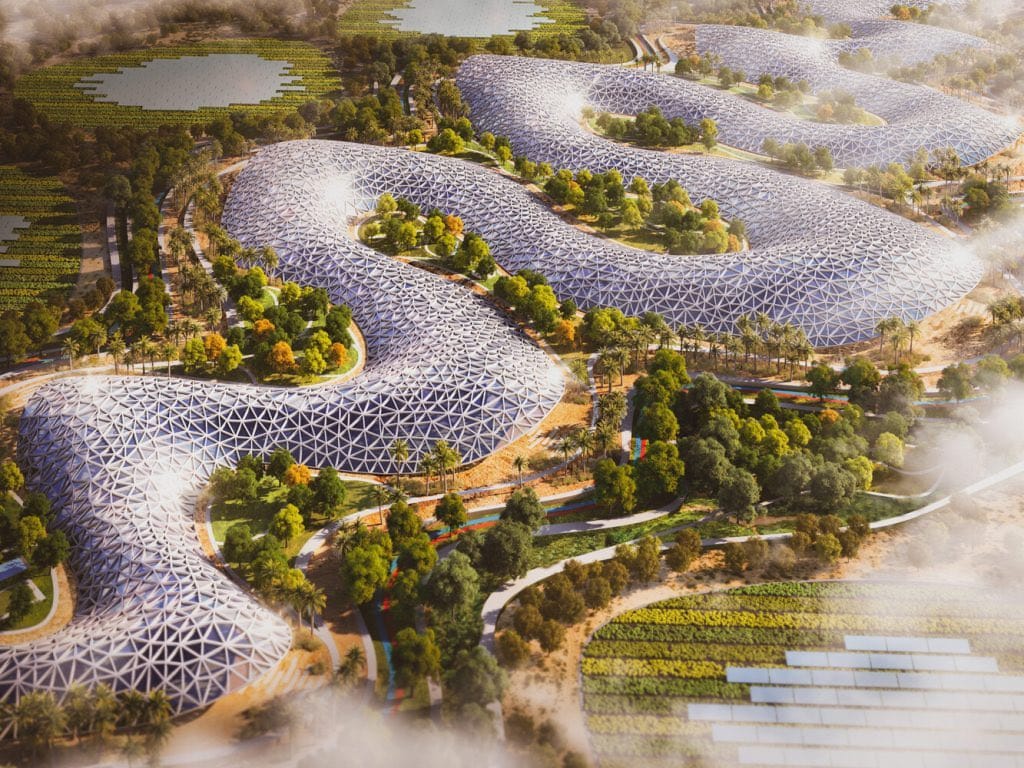
URB, a Dubai-based urban design firm, published a concept design in February 2023 called "THE LOOP." 58 miles of pedestrian and bicycle infrastructure. Temperature inside: 72°F. Temperature outside: 113°F. The gap between indoors and outdoors: survival versus comfort.

How climate control works at tunnel scale

Keeping 58 miles at 72°F when the surface hits 113°F requires four integrated systems: insulation, zoned HVAC, renewable energy, and thermal mass.

Start with the tunnel itself. Concrete walls 16–24 inches thick, lined with R-30 insulation foam—the same spec used in walk-in freezers. Underground placement at 33–49 feet depth adds natural thermal buffering. Soil temperature at that depth stays near 75°F year-round, even when the surface bakes at 113°F. The earth does half the work before HVAC turns on.

Zoned cooling divides 58 miles into 9-mile segments, each with independent air handling units. Fail one zone, 49 miles stay operational. Air exchange happens every 8 minutes—slower than metro tunnels because pedestrians generate less heat than packed train cars. Cooling load per linear foot: approximately 3.7 kW, comparable to climate-controlling a small retail shop.

Energy comes from integration with Dubai's Mohammed bin Rashid Al Maktoum Solar Park, which will generate 5,000 MW by 2030. Dedicating 120 MW—2.4% of total capacity—would power continuous tunnel operation.

URB's renderings show kinetic floor tiles generating electricity from foot traffic. Realistic contribution: 4–8 watts per footstep. A walker generates enough power for one LED every 50 steps. The solar park carries the real load.

Dubai Metro already proves the concept. The Red and Green lines maintain 75°F inside trains and stations while surface temperatures exceed 113°F. Passengers step from furnace to freezer in seconds. THE LOOP scales that proven technology horizontally across neighborhoods instead of vertically through station entrances.

Climate-controlled tunnels let people walk comfortably when surface temperatures hit 113°F. Dubai's proposed 58-mile Loop shows how extreme-heat cities could make walking viable year-round.

When walking becomes faster than driving

A 20-minute city means residents reach work, groceries, parks, and services within 20 minutes by foot or bike.

It works in Barcelona and Paris because those cities built mixed-use neighborhoods over decades. Dubai's challenge: density distribution. Downtown Dubai and Marina pack tight. Industrial zones and villa communities sprawl across tens of miles.

THE LOOP proposes solving this with underground shortcuts.

A walker covering 3.1 mph completes 2.5 miles in 48 minutes at a comfortable 72°F. Same trip by car: 15 minutes in traffic plus 10 minutes finding parking plus $20 daily parking fee. By metro: 25 minutes with two transfers. The tunnel becomes fastest option for distances under 3 miles if the destination sits near a tunnel exit.

Office commuters gain most. Someone living in Dubai Marina walks to Business Bay in 50 minutes, saves $400/month in parking, skips traffic, gets cardio. Families use tunnels for weekend park visits—kids burn energy without heat exhaustion risk. Cyclists gain 58 miles of protected route uninterrupted by traffic.

The concept assumes people will choose to walk 3 miles underground rather than drive 3 miles in air-conditioned cars. That assumption requires testing. But Montreal offers proof.

What Montreal's underground city teaches Dubai

Montreal's 20-mile underground pedestrian network moves 500,000 people daily because winter temperatures drop to −4°F and the city concentrated retail, offices, and transit hubs underground.

Pedestrians aren't just passing through—they're shopping, eating, working. 120 access points connect metro stations, office towers, universities, shopping centers, and residential buildings. Surface walking in January can kill. Underground stays 68°F.

Dubai inverts the problem. Surface is 113°F. Underground is 72°F. Same solution, opposite temperature.

Where the analogy breaks: Montreal built RESO over 60 years, layering infrastructure as buildings went up. Developers competed to connect properties to the network because underground access increased real estate value. THE LOOP would need the same commercial integration—tunnel exits leading to offices, gyms, cafes, grocery stores. Otherwise it's just 58 miles connecting parking lots.

Hong Kong's Central–Mid-Levels escalator system moves 55,000 people daily up 443 feet across half a mile. It works because it solves a specific topographic problem: steep hillsides between dense housing and sea-level offices. Dubai's challenge is horizontal sprawl in flat terrain. The solution isn't just tunnels—it's redesigning neighborhoods so destinations cluster within walking distance. THE LOOP could complement that. It can't replace it.

Where the energy bill rivals a small power plant

Maintaining 72°F across 58 miles requires continuous baseline consumption of approximately 120 MW—equivalent to powering 40,000 homes.

For context: a single air conditioning unit for a small retail space consumes 3.5 kW. Scaling to 305,000 feet of tunnel at 3.7 kW per linear foot builds that load.

Cost estimates haven't been published. Standard underground construction for complex urban tunnels with full outfitting: $200–500 million per mile depending on depth and geology. 58 miles could range from $11.6 billion to $29 billion.

Dubai Metro Phase 1—47 miles elevated and underground—cost $7.6 billion in 2009. THE LOOP's climate control, pedestrian amenities, and integrated green spaces push costs higher.

Operating costs depend on energy source. Grid electricity at commercial rates: $15–20 million annually. Solar integration from Mohammed bin Rashid Solar Park reduces that to infrastructure maintenance and backup power. Dubai's metro proves feasibility—continuous climate control at scale is expensive but operational.

What stands between vision and construction

URB's THE LOOP exists as design concept. No government funding confirmed. No construction timeline announced. Dubai's Roads and Transport Authority has not formally endorsed the project.

Separately, on February 13, 2025, RTA signed a memorandum of understanding with The Boring Company for a different project: a 10.5-mile vehicle tunnel study. That's a framework for discussion, not construction.

Two tunnel concepts. Two companies. Zero miles under construction as of December 2025.

Both face the same challenge: proving underground pedestrian infrastructure can shift enough trips away from cars to justify cost. Dubai's car ownership rate—540 vehicles per 1,000 people—ranks among the world's highest. Changing that requires more than tunnels. It requires zoning reform, parking policy changes, and street-level improvements that make walking appealing even without going underground.

Climate-controlled tunnels work when cities build them as integrated systems with concentrated destinations, proven energy sources, and decades-long commitment. Dubai has the solar capacity, the engineering expertise, and the density in core districts. What it doesn't have yet: the decision to build.

The concept demonstrates that human-centered mobility can overcome extreme heat. The question isn't whether it's possible. Montreal answered that 60 years ago. The question is whether Dubai commits the infrastructure budget to make 113°F summers feel like 72°F autumn—58 miles at a time.


What is this about?

  • Explainer/
  • Ethan Whitaker/
  • Mobility/
  • Cars/
  • urban mobility/
  • climate-adaptive design/
  • Dubai infrastructure/
  • pedestrian infrastructure/
  • climate resilience

Feed

    Apple Plans 15 New Devices for Late 2026

    Apple Plans 15 New Devices for Late 2026

    Foldable iPhone Ultra and smart hub await personalized Siri launch

    Ben Ramosabout 7 hours ago
    Apple Watch Ultra 4 could track blood pressure trends

    Apple Watch Ultra 4 could track blood pressure trends

    A potential hardware redesign with 8 sensors aims to move from simple alerts to direct cardiovascular measurement

    Ben Ramos3 days ago

    Your earbuds could become a secure digital key via your heartbeat

    AccLock uses standard accelerometers to verify identity without needing premium optical heart trackers

    Ben Ramos4 days ago
    Memory chip shortages could end by 2027

    Memory chip shortages could end by 2027

    Aggressive Chinese production expansions from YMTC and CXMT may lower hardware costs sooner than the 2030 consensus

    Ben Ramos4 days ago
    Hisense Explorer X1 Pro brings 120-inch cinema to your living room

    Hisense Explorer X1 Pro brings 120-inch cinema to your living room

    A new tri-color laser engine offers 110% BT.2020 color gamut, though US availability remains unannounced

    Logan Price4 days ago
    Onyx Boox Poke 7 series brings paper-like clarity to your library

    Onyx Boox Poke 7 series brings paper-like clarity to your library

    New 300 ppi displays and 2 TB expandable storage offer a sharper, larger reading experience

    Ben Ramos4 days ago
    SpaceX IPO: A historic bet on the space economy

    SpaceX IPO: A historic bet on the space economy

    With 2025 revenue hitting $18.6 billion, the Nasdaq debut tests market appetite for Elon Musk

    Jasmine Wu5 days ago
    Figma AI agents turn manual design into high-level direction

    Figma AI agents turn manual design into high-level direction

    New intent-based tools allow designers to build layouts using natural language instead of clicking and dragging

    Evelyn Park5 days ago
    NanoClaw's sandbox stops AI agents from compromising your OS

    NanoClaw's sandbox stops AI agents from compromising your OS

    NanoCo secures $12 million to scale its isolated architecture for enterprise AI deployment

    Marcus Dillard5 days ago

    Microsoft's new Surface lineup is for businesses, not consumers

    Wait for Snapdragon X2 models this summer if you aren't buying for an enterprise fleet

    Carter Brooks5 days ago
    Loading...

Dubai's tunnel projects exist only on paper

Two concepts, zero construction, and billions in questions

December 16, 2025, 10:14 pm

URB's 58-mile climate-controlled pedestrian tunnel and The Boring Company's 11-mile vehicle Loop have generated headlines, but neither has government funding, construction permits, or a start date. One's a design concept from 2023. The other's a February 2025 MoU for a feasibility study. This is what actually exists versus what's been announced.

Dubai's tunnel projects exist only on paper

Summary

  • Dubai proposes 58-mile underground pedestrian tunnel network called THE LOOP, offering climate-controlled walkways that make moving around possible during 113°F summers.
  • Tunnel infrastructure relies on solar power, thick insulation, and underground placement to maintain a consistent 72°F, with independent cooling zones and energy from Mohammed bin Rashid Solar Park.
  • Project challenges include massive infrastructure costs ($11.6–$29 billion), high car ownership rates, and convincing residents to walk underground instead of driving in air-conditioned vehicles.

113°F Phoenix summers. 120°F Kuwait City afternoons. 105°F Dubai nine months a year. Walking isn't just uncomfortable—it's dangerous.

Heat stroke begins at 30 minutes outdoors. Elderly residents stay inside from May to October. Kids miss park visits. Commuters drive 2 miles because sidewalks feel like convection ovens.

What if pedestrians went underground?

Climate-controlled tunnels solve extreme heat the same way metros solve traffic—move people where conditions are controlled.

URB, a Dubai-based urban design firm, published a concept design in February 2023 called "THE LOOP." 58 miles of pedestrian and bicycle infrastructure. Temperature inside: 72°F. Temperature outside: 113°F. The gap between indoors and outdoors: survival versus comfort.

How climate control works at tunnel scale

Keeping 58 miles at 72°F when the surface hits 113°F requires four integrated systems: insulation, zoned HVAC, renewable energy, and thermal mass.

Start with the tunnel itself. Concrete walls 16–24 inches thick, lined with R-30 insulation foam—the same spec used in walk-in freezers. Underground placement at 33–49 feet depth adds natural thermal buffering. Soil temperature at that depth stays near 75°F year-round, even when the surface bakes at 113°F. The earth does half the work before HVAC turns on.

Zoned cooling divides 58 miles into 9-mile segments, each with independent air handling units. Fail one zone, 49 miles stay operational. Air exchange happens every 8 minutes—slower than metro tunnels because pedestrians generate less heat than packed train cars. Cooling load per linear foot: approximately 3.7 kW, comparable to climate-controlling a small retail shop.

Energy comes from integration with Dubai's Mohammed bin Rashid Al Maktoum Solar Park, which will generate 5,000 MW by 2030. Dedicating 120 MW—2.4% of total capacity—would power continuous tunnel operation.

URB's renderings show kinetic floor tiles generating electricity from foot traffic. Realistic contribution: 4–8 watts per footstep. A walker generates enough power for one LED every 50 steps. The solar park carries the real load.

Dubai Metro already proves the concept. The Red and Green lines maintain 75°F inside trains and stations while surface temperatures exceed 113°F. Passengers step from furnace to freezer in seconds. THE LOOP scales that proven technology horizontally across neighborhoods instead of vertically through station entrances.

Climate-controlled tunnels let people walk comfortably when surface temperatures hit 113°F. Dubai's proposed 58-mile Loop shows how extreme-heat cities could make walking viable year-round.

When walking becomes faster than driving

A 20-minute city means residents reach work, groceries, parks, and services within 20 minutes by foot or bike.

It works in Barcelona and Paris because those cities built mixed-use neighborhoods over decades. Dubai's challenge: density distribution. Downtown Dubai and Marina pack tight. Industrial zones and villa communities sprawl across tens of miles.

THE LOOP proposes solving this with underground shortcuts.

A walker covering 3.1 mph completes 2.5 miles in 48 minutes at a comfortable 72°F. Same trip by car: 15 minutes in traffic plus 10 minutes finding parking plus $20 daily parking fee. By metro: 25 minutes with two transfers. The tunnel becomes fastest option for distances under 3 miles if the destination sits near a tunnel exit.

Office commuters gain most. Someone living in Dubai Marina walks to Business Bay in 50 minutes, saves $400/month in parking, skips traffic, gets cardio. Families use tunnels for weekend park visits—kids burn energy without heat exhaustion risk. Cyclists gain 58 miles of protected route uninterrupted by traffic.

The concept assumes people will choose to walk 3 miles underground rather than drive 3 miles in air-conditioned cars. That assumption requires testing. But Montreal offers proof.

What Montreal's underground city teaches Dubai

Montreal's 20-mile underground pedestrian network moves 500,000 people daily because winter temperatures drop to −4°F and the city concentrated retail, offices, and transit hubs underground.

Pedestrians aren't just passing through—they're shopping, eating, working. 120 access points connect metro stations, office towers, universities, shopping centers, and residential buildings. Surface walking in January can kill. Underground stays 68°F.

Dubai inverts the problem. Surface is 113°F. Underground is 72°F. Same solution, opposite temperature.

Where the analogy breaks: Montreal built RESO over 60 years, layering infrastructure as buildings went up. Developers competed to connect properties to the network because underground access increased real estate value. THE LOOP would need the same commercial integration—tunnel exits leading to offices, gyms, cafes, grocery stores. Otherwise it's just 58 miles connecting parking lots.

Hong Kong's Central–Mid-Levels escalator system moves 55,000 people daily up 443 feet across half a mile. It works because it solves a specific topographic problem: steep hillsides between dense housing and sea-level offices. Dubai's challenge is horizontal sprawl in flat terrain. The solution isn't just tunnels—it's redesigning neighborhoods so destinations cluster within walking distance. THE LOOP could complement that. It can't replace it.

Where the energy bill rivals a small power plant

Maintaining 72°F across 58 miles requires continuous baseline consumption of approximately 120 MW—equivalent to powering 40,000 homes.

For context: a single air conditioning unit for a small retail space consumes 3.5 kW. Scaling to 305,000 feet of tunnel at 3.7 kW per linear foot builds that load.

Cost estimates haven't been published. Standard underground construction for complex urban tunnels with full outfitting: $200–500 million per mile depending on depth and geology. 58 miles could range from $11.6 billion to $29 billion.

Dubai Metro Phase 1—47 miles elevated and underground—cost $7.6 billion in 2009. THE LOOP's climate control, pedestrian amenities, and integrated green spaces push costs higher.

Operating costs depend on energy source. Grid electricity at commercial rates: $15–20 million annually. Solar integration from Mohammed bin Rashid Solar Park reduces that to infrastructure maintenance and backup power. Dubai's metro proves feasibility—continuous climate control at scale is expensive but operational.

What stands between vision and construction

URB's THE LOOP exists as design concept. No government funding confirmed. No construction timeline announced. Dubai's Roads and Transport Authority has not formally endorsed the project.

Separately, on February 13, 2025, RTA signed a memorandum of understanding with The Boring Company for a different project: a 10.5-mile vehicle tunnel study. That's a framework for discussion, not construction.

Two tunnel concepts. Two companies. Zero miles under construction as of December 2025.

Both face the same challenge: proving underground pedestrian infrastructure can shift enough trips away from cars to justify cost. Dubai's car ownership rate—540 vehicles per 1,000 people—ranks among the world's highest. Changing that requires more than tunnels. It requires zoning reform, parking policy changes, and street-level improvements that make walking appealing even without going underground.

Climate-controlled tunnels work when cities build them as integrated systems with concentrated destinations, proven energy sources, and decades-long commitment. Dubai has the solar capacity, the engineering expertise, and the density in core districts. What it doesn't have yet: the decision to build.

The concept demonstrates that human-centered mobility can overcome extreme heat. The question isn't whether it's possible. Montreal answered that 60 years ago. The question is whether Dubai commits the infrastructure budget to make 113°F summers feel like 72°F autumn—58 miles at a time.

What is this about?

  • Explainer/
  • Ethan Whitaker/
  • Mobility/
  • Cars/
  • urban mobility/
  • climate-adaptive design/
  • Dubai infrastructure/
  • pedestrian infrastructure/
  • climate resilience

Feed

    Apple Plans 15 New Devices for Late 2026

    Apple Plans 15 New Devices for Late 2026

    Foldable iPhone Ultra and smart hub await personalized Siri launch

    Ben Ramosabout 7 hours ago
    Apple Watch Ultra 4 could track blood pressure trends

    Apple Watch Ultra 4 could track blood pressure trends

    A potential hardware redesign with 8 sensors aims to move from simple alerts to direct cardiovascular measurement

    Ben Ramos3 days ago

    Your earbuds could become a secure digital key via your heartbeat

    AccLock uses standard accelerometers to verify identity without needing premium optical heart trackers

    Ben Ramos4 days ago
    Memory chip shortages could end by 2027

    Memory chip shortages could end by 2027

    Aggressive Chinese production expansions from YMTC and CXMT may lower hardware costs sooner than the 2030 consensus

    Ben Ramos4 days ago
    Hisense Explorer X1 Pro brings 120-inch cinema to your living room

    Hisense Explorer X1 Pro brings 120-inch cinema to your living room

    A new tri-color laser engine offers 110% BT.2020 color gamut, though US availability remains unannounced

    Logan Price4 days ago
    Onyx Boox Poke 7 series brings paper-like clarity to your library

    Onyx Boox Poke 7 series brings paper-like clarity to your library

    New 300 ppi displays and 2 TB expandable storage offer a sharper, larger reading experience

    Ben Ramos4 days ago
    SpaceX IPO: A historic bet on the space economy

    SpaceX IPO: A historic bet on the space economy

    With 2025 revenue hitting $18.6 billion, the Nasdaq debut tests market appetite for Elon Musk

    Jasmine Wu5 days ago
    Figma AI agents turn manual design into high-level direction

    Figma AI agents turn manual design into high-level direction

    New intent-based tools allow designers to build layouts using natural language instead of clicking and dragging

    Evelyn Park5 days ago
    NanoClaw's sandbox stops AI agents from compromising your OS

    NanoClaw's sandbox stops AI agents from compromising your OS

    NanoCo secures $12 million to scale its isolated architecture for enterprise AI deployment

    Marcus Dillard5 days ago

    Microsoft's new Surface lineup is for businesses, not consumers

    Wait for Snapdragon X2 models this summer if you aren't buying for an enterprise fleet

    Carter Brooks5 days ago
    Loading...
Home
Home
Search
Search
banner