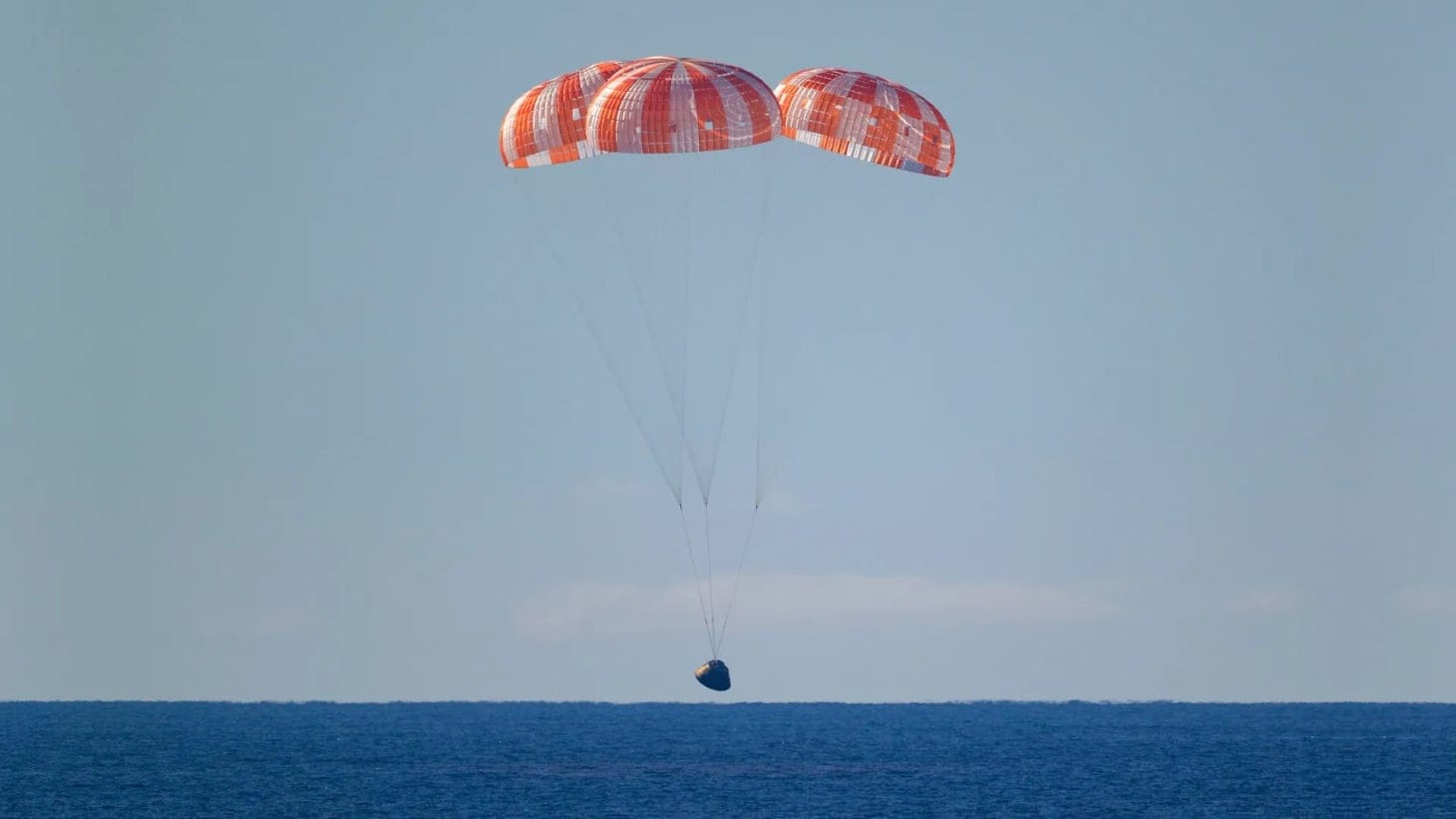

On the morning of April 11, 2026, NASA's Artemis-2 crew completed humanity's first crewed journey beyond low-Earth orbit in more than half a century. Four astronauts splashed down in the Pacific Ocean off the coast of San Diego, closing a nine-day mission that traced a looping arc around the Moon—and proved that the hardware designed to return us there can bring us home again.
The capsule hit the water at 3:00 a.m. Pacific Time, racing through Earth's atmosphere at approximately 11 kilometers per second. Reentry temperatures climbed beyond 2,760 degrees Celsius as the heat shield—one of the mission's most critical elements—absorbed the kinetic energy of orbital velocity. Two drogue parachutes stabilized the descent, followed by three main parachutes that eased the crew to a controlled splashdown. Recovery teams aboard the USS John P. Murtha reached the capsule within minutes.
Artemis-2 is the first crewed lunar mission since Apollo 17 in December 1972. The crew traveled 406,765 kilometers from Earth—the farthest distance any human-rated spacecraft has ever journeyed. Along the way, they captured images of the Moon's far side during a rare solar eclipse, offering perspectives that expand both our photographic catalog of the lunar surface and our understanding of cislunar space.
This was not a landing. It was a test—of systems, of endurance, of the engineering that will underpin the next decade of deep-space exploration. The mission validated the capsule's heat shield, communications architecture, and life-support infrastructure under conditions that cannot be replicated on Earth.
Agency officials described the mission as a critical milestone toward sustainable lunar exploration. They emphasized the flawless performance of the parachute system and the precision of the recovery operation. NASA reported minor anomalies in the onboard email client and waste-management hardware, but neither affected crew safety or mission objectives.
Mission duration: April 2–11, 2026 (nine days)
Reentry velocity: approximately 11 km/s
Maximum distance from Earth: 406,765 km
Parachute deployment: 2 drogue, 3 main
Splashdown location: Pacific Ocean, off San Diego
Every mission is a question posed to the universe. Artemis-2 asked whether we could return to the Moon not as visitors on a deadline, but as engineers building infrastructure for the long term. The answer, it appears, is yes—but with caveats written in small print across thermal tiles and toilet plumbing.
Space exploration has always been humanity's longest-running experiment in resilience. What we learn from nine days in deep space will echo through the decades of habitats, landers, and lunar bases that follow.
NASA is now turning its attention to Artemis-3, the mission that will attempt to land astronauts on the lunar surface for the first time in more than half a century. If Artemis-2 was the rehearsal, Artemis-3 will be the opening act of a new era—one where the Moon is not a destination, but a proving ground for everything that lies beyond it.