
• My Feed
  • Home
  • What's Important
  • Media & Entertainment
Search

Stay Curious. Stay Wanture.

© 2026 Wanture. All rights reserved.

  • Terms of Use
  • Privacy Policy
Tech/Software
Spotify’s Prompted Playlist Lets You Direct Your Soundtrack

How Spotify’s AI turns prompts into custom playlists, reshaping music discovery

12 December 2025

—

Explainer

Leo Navarro
banner

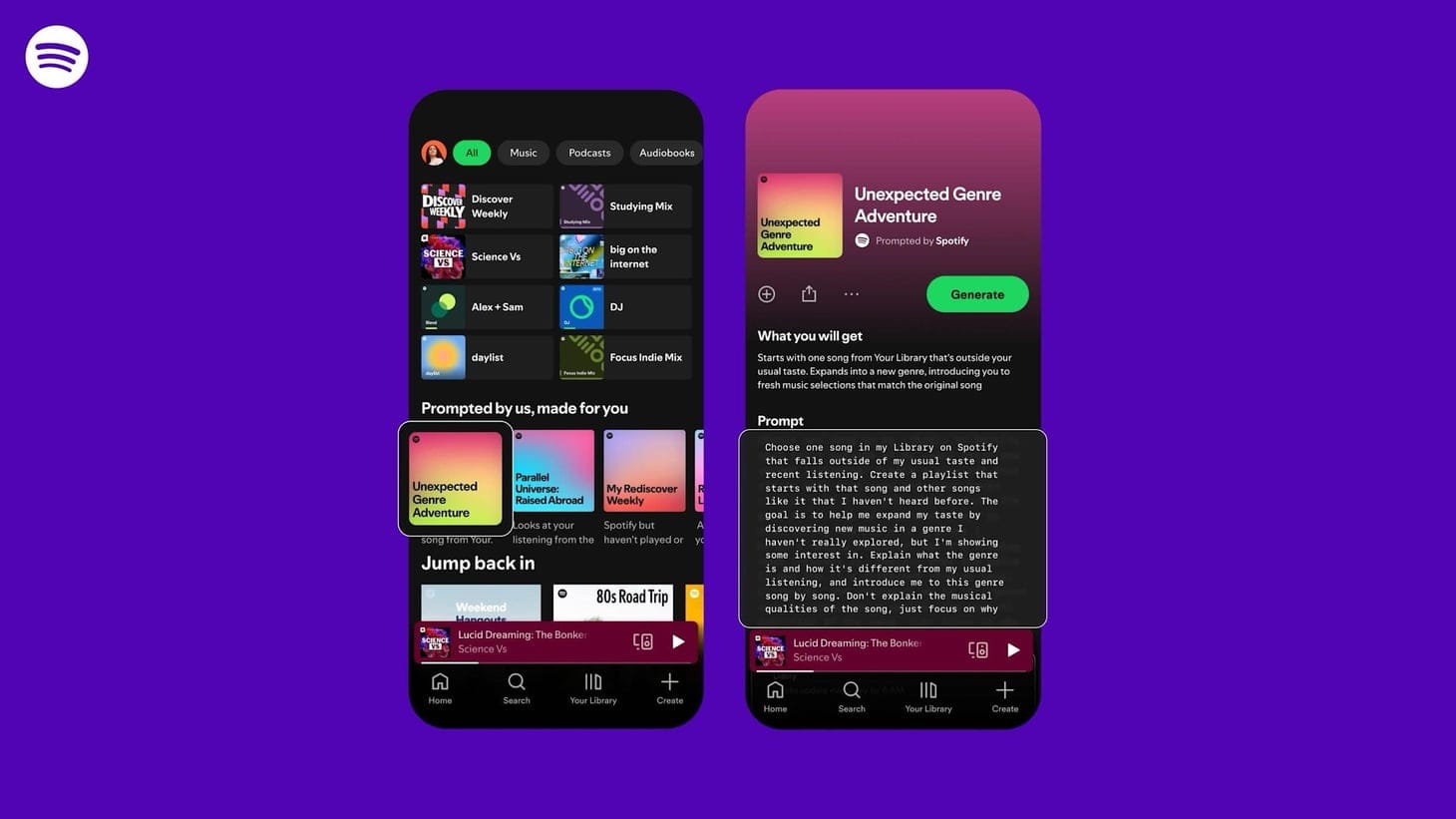
Spotify’s Prompted Playlist lets Premium users type natural‑language requests that the AI matches against their entire listening history, then explains each song’s selection. The explainer shows how the feature works, why the added transparency matters, and how it shifts music curation from passive prediction to active user direction.

image-96

Summary:

  • Prompted Playlist lets you type a request, scans your full Spotify history, builds a custom playlist and shows a brief reason for each track.
  • Prompted Playlist launched beta in New Zealand on Dec 11 2025, expanded to the US/Canada on Jan 22 2026; it’s mobile‑only, English‑only, with usage limits.
  • Prompted Playlist moves music discovery from opaque predictions to user‑driven prompts, offering transparency—a industry’s shift to user‑controlled feeds.

Most music algorithms choose for you. Spotify's Prompted Playlist makes you choose what the algorithm searches for. The difference is subtle but fundamental.

When you open the app now, you no longer wait for Discover Weekly to arrive or hope that Daily Mix reads your mood correctly. You type instructions. The system responds by building a custom playlist from every song you've ever played, then tells you exactly why it picked each track. You gain control, and you also gain responsibility.

Think of it this way: traditional recommendation systems are like hiring a personal assistant who picks your outfits each morning based on what you wore last month. Prompted Playlist is like hiring a research librarian. They won't choose for you. They'll find exactly what you ask for, using resources you didn't know how to access. The librarian knows your history, though. They remember which books you've checked out, which authors you revisit, which genres dominate your reading habits. That memory shapes every search.

This is how Spotify transforms your listening history into a conversational database. The feature launched in New Zealand on December 11, 2025 as a beta test for Premium subscribers, with expansion to additional markets including the United States planned as the beta progresses. It remains mobile only, English only, with usage limits during beta testing.

When you type what you want instead of waiting for predictions

The mechanism starts with language. Navigate to the Prompted Playlist section and type a request. "Upbeat indie rock for coding without distracting lyrics." "Deep cuts from artists I already love." "Melancholic jazz that sounds like a rainy Tuesday." The system processes your prompt against your complete listening history. It identifies patterns in tempo, instrumentation, mood, and era. It assembles a playlist.

Each song arrives with a brief explanation. "Added because you've played similar tempo tracks during evening sessions." "Matches your preference for analog production in folk music." The algorithm opens its reasoning.

This differs from search in one critical way. A search bar returns results that match keywords. Prompted Playlist returns results that match keywords filtered through your behavioral data. Type "driving music" and a generic search surfaces high-energy rock. Prompted Playlist examines what you actually stream during commutes and builds from there.

The system scans every song you've played since account creation. It knows which genres you revisit, which decades dominate your replays, and which tempos correlate with morning versus evening sessions. A prompt like "focus music" generates lo-fi beats for one person and ambient classical for another based purely on historical preferences.

Consider a specific example. Type "songs that help me think without making me feel rushed." The system might return a playlist of mid-tempo instrumental tracks in D minor because your history shows you replay that key signature during weekend mornings. It explains: "Selected for consistent 85 to 95 BPM range matching your most-played contemplative music." You learn something about your own taste you hadn't articulated.

The feature also maintains living playlists. Set a refresh interval, either daily or weekly. The collection evolves as your listening habits shift. The AI doesn't create a static snapshot. It updates recommendations while staying within the boundaries you defined in your original prompt.

The algorithm opens its reasoning

Algorithmic recommendations have always suffered from a trust problem. Discover Weekly might surface a perfect track or completely miss your mood. You never knew why. The system made choices. You accepted or skipped them. No dialogue existed.

Transparency transforms that one-way street into a feedback loop. When Prompted Playlist tells you why it selected a track, you're not just consuming recommendations. You're learning how the algorithm interprets your taste. If it chose a song "because you stream orchestral hip-hop during workouts," you gain insight into patterns you hadn't articulated.

That knowledge lets you refine future prompts with more precision. You become better at articulating what you want. The process becomes collaborative rather than passive.

This mirrors a broader shift across platforms. Meta introduced user-controlled algorithmic feeds. TikTok added transparency tools showing why videos appear on For You pages. The pattern is clear. Tech companies are moving from "trust us, the algorithm knows best" to "here's how it works, now steer it yourself."

Spotify anticipated that crafting effective prompts would require practice. The feature includes an Ideas tab that suggests prompt structures and examples. "Songs that sound like summer road trips." "Artists I've never heard who sound like my top three favorites." These starting points teach users how specificity and metaphor work within the system.

Early adopters will experiment with detail levels. Does "sad songs" work better than "songs in minor keys with slow tempos and introspective lyrics"? How does the system interpret subjective descriptions versus technical music-theory terms? Users will learn through iteration, discovering which language produces better matches.

Prediction versus instruction

Traditional recommendation systems optimize for one metric: keeping you listening. They prioritize engagement over exploration. They reinforce existing preferences because prediction algorithms learn from past behavior and extrapolate forward. This creates the filter-bubble problem. Algorithms that predict your next song tend to narrow your listening over time.

Prompted Playlist inverts that logic. You define the goal. The algorithm serves it. Want to explore Brazilian jazz from the 1960s that matches your affinity for complex rhythms? Describe it. The AI searches your history for compatible patterns. Looking for workout music that avoids aggressive energy? Issue that instruction. The system responds.

The difference is intentionality. You're not receiving predictions. You're issuing instructions.

Compare this to Spotify's existing features. Discover Weekly arrives automatically with selections based on collaborative filtering. Daily Mix creates genre-based stations from your most-played music. Release Radar surfaces new tracks from artists you follow. All three operate on prediction. Prompted Playlist operates on articulation.

Here's another concrete example. Type "music that sounds like my favorite albums but from artists I haven't discovered yet." The system might return tracks from independent artists whose production style matches your most-replayed records from the past year. The explanation reads: "Shares layered vocal harmonies and reverb techniques with albums you've streamed more than ten times." You're not asking the algorithm to guess. You're asking it to search according to criteria you specify.

This dual capability—executing your request while remembering your behavioral history—makes the feature more powerful than pure search, but less autonomous than pure recommendation. You gain control and invest active engagement. For some users, that's welcome agency. For others, it's additional effort. The quality of output depends entirely on the quality of input.

This feature marks a turning point. Music streaming is moving past the era of invisible algorithms. The future isn't smarter prediction. It's better tools for articulating what you already know you want, even if you've never had the language to express it until now.

So what should you do with this understanding? Start simple. Type a mood or activity. See what the system returns. Read the explanations. Notice which patterns from your history the algorithm identifies. Then refine. Add detail. Use metaphor. Test whether technical language or subjective description produces better results. The system learns your listening history passively. You'll need to learn its language actively. That's the trade. The algorithm won't guess anymore. But it will search anywhere you point it.

Topic

Algorithmic Content Personalization

How Multimodal Embeddings Boost Video Recommendations

6 March 2026

How Social Media Recommendation Engines Shape Your Feed

13 February 2026

What is this about?

  • Explainer/
  • Leo Navarro/
  • Tech/
  • Software

Feed

    iPhone 18 Pro to Launch iOS 27 Camera with f/1.5‑f/2.8 Aperture

    iOS 27 adds a “Siri” visual‑AI mode as Apple readies iPhone 18 Pro for fall

    Carter Brooks3 days ago

    Therapist vs Counselor: Which Fits Your Needs?

    Licenses, Training Hours, and Treatment Options Compared (2024‑2025 Data)

    Caleb Brooks3 days ago

    Ask YouTube Launches March 15, 2026 for Premium Users

    On March 15, 2026, YouTube introduced Ask YouTube, an AI‑driven chat that lets U.S. Premium subscribers ask questions and receive synthesized video‑based answers. The tool promises a conversational search experience, yet early tests revealed factual slips, such as a wrong claim about the Steam controller’s joysticks, highlighting the need for users to verify information before acting.

    Ask YouTube Launches March 15, 2026 for Premium Users
    Carter Brooks5 days ago

    Samsung unveils Galaxy Z Fold 8 Wide with magnets

    Leaked images released by insider Sonny Dixon reveal Samsung’s upcoming Galaxy Z Fold 8 lineup, including a new Z Fold 8 Wide with integrated chassis magnets and a simplified two-camera rear array. The wide model aims to lower costs while keeping tablet-size screens, targeting buyers priced out of premium foldables ahead of an August 2026 launch.

    Samsung unveils Galaxy Z Fold 8 Wide with magnets
    Carter Brooks5 days ago

    Samsung launches Jinju smart glasses in 2026

    Samsung’s first smart glasses, code‑named Jinju, debut in 2026 as a voice‑assistant and photo‑capture device. They use a Qualcomm Snapdragon AR1 chip, Sony IMX681 12MP camera, 155 mAh battery, and bone‑conduction speakers, with no display. The battery lasts a few hours; sustained tasks may throttle. Samsung will unveil Jinju in 2026, targeting the Russian market where Meta glasses are unavailable.

    Samsung launches Jinju smart glasses in 2026
    Priya Desai5 days ago

    Sony Adds 30‑Day Online Checks for PlayStation 4 & PS5

    Starting April 2026, Sony’s PlayStation 4 and PS5 will require each digital title purchased after March 2026 to verify its license with Sony’s servers at least once every 30 days. Missing the online ping renders the game unplayable until the console reconnects, while disc copies and pre‑March downloads remain unaffected. Users should plan a monthly check to keep libraries active.

    Sony Adds 30‑Day Online Checks for PlayStation 4 & PS5
    Carter Brooks5 days ago

    Boost Your Healthspan: 1‑MET Gains Cut Mortality by 11–17%

    Why a 5–7 MET boost (16–25 ml·kg⁻¹·min⁻¹) narrows smoker‑level death risk

    Sarah Lindgren5 days ago

    Geely unveils 196‑billion‑parameter EVA Cab L4 robotaxi

    At Auto China 2026, Geely, AFARI and CaoCao introduced the EVA Cab, a purpose‑built L4 robotaxi with a 196‑billion‑parameter AI stack and a 1,400 TOPS compute platform. The 43‑sensor suite, featuring a 2,160‑line LiDAR with 600 m range, claims 99% scenario coverage and aims for series production in late 2027, while U.S. entry remains uncertain.

    Geely unveils 196‑billion‑parameter EVA Cab L4 robotaxi
    Ethan Whitaker6 days ago

    MediaTek launches Dimensity 7450X for mid‑range foldables

    MediaTek unveiled the Dimensity 7450 and 7450X on April 27, 2026, for mid‑range phones. They feature an octa‑core CPU (Cortex‑A78 up to 2.6 GHz + Cortex‑A55), Mali‑G615 MC2 GPU, sixth‑gen NPU with 7 % AI gain, and an Imagiq 950 ISP supporting up to 200 MP cameras. The 7450X adds dual‑display optimization and flagship‑class camera and AI capabilities, debuting in Motorola’s Razr 70 on April 29, 2026.

    MediaTek launches Dimensity 7450X for mid‑range foldables
    Priya Desai6 days ago

    Cat Gatekeeper Chrome Extension Launches on April 27, 2026

    Cat Gatekeeper, a free Chrome extension released on April 27, 2026, overlays a cartoon cat on selected sites—Facebook, X, Reddit, YouTube, Threads, and Bluesky—once a user‑set timer expires. The tab remains blocked until the user resets it. Developer @konekone2026 describes it as a light‑hearted productivity cue that avoids shame‑based blocking. A Firefox version is planned.

    Cat Gatekeeper Chrome Extension Launches on April 27, 2026
    Carter Brooks6 days ago
    Loading...
Tech/Software

Spotify’s Prompted Playlist Lets You Direct Your Soundtrack

How Spotify’s AI turns prompts into custom playlists, reshaping music discovery

December 12, 2025, 2:20 pm

Spotify’s Prompted Playlist lets Premium users type natural‑language requests that the AI matches against their entire listening history, then explains each song’s selection. The explainer shows how the feature works, why the added transparency matters, and how it shifts music curation from passive prediction to active user direction.

image-96

Summary

  • Prompted Playlist lets you type a request, scans your full Spotify history, builds a custom playlist and shows a brief reason for each track.
  • Prompted Playlist launched beta in New Zealand on Dec 11 2025, expanded to the US/Canada on Jan 22 2026; it’s mobile‑only, English‑only, with usage limits.
  • Prompted Playlist moves music discovery from opaque predictions to user‑driven prompts, offering transparency—a industry’s shift to user‑controlled feeds.

Most music algorithms choose for you. Spotify's Prompted Playlist makes you choose what the algorithm searches for. The difference is subtle but fundamental.

When you open the app now, you no longer wait for Discover Weekly to arrive or hope that Daily Mix reads your mood correctly. You type instructions. The system responds by building a custom playlist from every song you've ever played, then tells you exactly why it picked each track. You gain control, and you also gain responsibility.

Think of it this way: traditional recommendation systems are like hiring a personal assistant who picks your outfits each morning based on what you wore last month. Prompted Playlist is like hiring a research librarian. They won't choose for you. They'll find exactly what you ask for, using resources you didn't know how to access. The librarian knows your history, though. They remember which books you've checked out, which authors you revisit, which genres dominate your reading habits. That memory shapes every search.

This is how Spotify transforms your listening history into a conversational database. The feature launched in New Zealand on December 11, 2025 as a beta test for Premium subscribers, with expansion to additional markets including the United States planned as the beta progresses. It remains mobile only, English only, with usage limits during beta testing.

When you type what you want instead of waiting for predictions

The mechanism starts with language. Navigate to the Prompted Playlist section and type a request. "Upbeat indie rock for coding without distracting lyrics." "Deep cuts from artists I already love." "Melancholic jazz that sounds like a rainy Tuesday." The system processes your prompt against your complete listening history. It identifies patterns in tempo, instrumentation, mood, and era. It assembles a playlist.

Each song arrives with a brief explanation. "Added because you've played similar tempo tracks during evening sessions." "Matches your preference for analog production in folk music." The algorithm opens its reasoning.

This differs from search in one critical way. A search bar returns results that match keywords. Prompted Playlist returns results that match keywords filtered through your behavioral data. Type "driving music" and a generic search surfaces high-energy rock. Prompted Playlist examines what you actually stream during commutes and builds from there.

The system scans every song you've played since account creation. It knows which genres you revisit, which decades dominate your replays, and which tempos correlate with morning versus evening sessions. A prompt like "focus music" generates lo-fi beats for one person and ambient classical for another based purely on historical preferences.

Consider a specific example. Type "songs that help me think without making me feel rushed." The system might return a playlist of mid-tempo instrumental tracks in D minor because your history shows you replay that key signature during weekend mornings. It explains: "Selected for consistent 85 to 95 BPM range matching your most-played contemplative music." You learn something about your own taste you hadn't articulated.

The feature also maintains living playlists. Set a refresh interval, either daily or weekly. The collection evolves as your listening habits shift. The AI doesn't create a static snapshot. It updates recommendations while staying within the boundaries you defined in your original prompt.

The algorithm opens its reasoning

Algorithmic recommendations have always suffered from a trust problem. Discover Weekly might surface a perfect track or completely miss your mood. You never knew why. The system made choices. You accepted or skipped them. No dialogue existed.

Transparency transforms that one-way street into a feedback loop. When Prompted Playlist tells you why it selected a track, you're not just consuming recommendations. You're learning how the algorithm interprets your taste. If it chose a song "because you stream orchestral hip-hop during workouts," you gain insight into patterns you hadn't articulated.

That knowledge lets you refine future prompts with more precision. You become better at articulating what you want. The process becomes collaborative rather than passive.

This mirrors a broader shift across platforms. Meta introduced user-controlled algorithmic feeds. TikTok added transparency tools showing why videos appear on For You pages. The pattern is clear. Tech companies are moving from "trust us, the algorithm knows best" to "here's how it works, now steer it yourself."

Spotify anticipated that crafting effective prompts would require practice. The feature includes an Ideas tab that suggests prompt structures and examples. "Songs that sound like summer road trips." "Artists I've never heard who sound like my top three favorites." These starting points teach users how specificity and metaphor work within the system.

Early adopters will experiment with detail levels. Does "sad songs" work better than "songs in minor keys with slow tempos and introspective lyrics"? How does the system interpret subjective descriptions versus technical music-theory terms? Users will learn through iteration, discovering which language produces better matches.

Prediction versus instruction

Traditional recommendation systems optimize for one metric: keeping you listening. They prioritize engagement over exploration. They reinforce existing preferences because prediction algorithms learn from past behavior and extrapolate forward. This creates the filter-bubble problem. Algorithms that predict your next song tend to narrow your listening over time.

Prompted Playlist inverts that logic. You define the goal. The algorithm serves it. Want to explore Brazilian jazz from the 1960s that matches your affinity for complex rhythms? Describe it. The AI searches your history for compatible patterns. Looking for workout music that avoids aggressive energy? Issue that instruction. The system responds.

The difference is intentionality. You're not receiving predictions. You're issuing instructions.

Compare this to Spotify's existing features. Discover Weekly arrives automatically with selections based on collaborative filtering. Daily Mix creates genre-based stations from your most-played music. Release Radar surfaces new tracks from artists you follow. All three operate on prediction. Prompted Playlist operates on articulation.

Here's another concrete example. Type "music that sounds like my favorite albums but from artists I haven't discovered yet." The system might return tracks from independent artists whose production style matches your most-replayed records from the past year. The explanation reads: "Shares layered vocal harmonies and reverb techniques with albums you've streamed more than ten times." You're not asking the algorithm to guess. You're asking it to search according to criteria you specify.

This dual capability—executing your request while remembering your behavioral history—makes the feature more powerful than pure search, but less autonomous than pure recommendation. You gain control and invest active engagement. For some users, that's welcome agency. For others, it's additional effort. The quality of output depends entirely on the quality of input.

This feature marks a turning point. Music streaming is moving past the era of invisible algorithms. The future isn't smarter prediction. It's better tools for articulating what you already know you want, even if you've never had the language to express it until now.

So what should you do with this understanding? Start simple. Type a mood or activity. See what the system returns. Read the explanations. Notice which patterns from your history the algorithm identifies. Then refine. Add detail. Use metaphor. Test whether technical language or subjective description produces better results. The system learns your listening history passively. You'll need to learn its language actively. That's the trade. The algorithm won't guess anymore. But it will search anywhere you point it.

Topic

Algorithmic Content Personalization

How Multimodal Embeddings Boost Video Recommendations

6 March 2026

How Social Media Recommendation Engines Shape Your Feed

13 February 2026

What is this about?

  • Explainer/
  • Leo Navarro/
  • Tech/
  • Software

Feed

    iPhone 18 Pro to Launch iOS 27 Camera with f/1.5‑f/2.8 Aperture

    iOS 27 adds a “Siri” visual‑AI mode as Apple readies iPhone 18 Pro for fall

    Carter Brooks3 days ago

    Therapist vs Counselor: Which Fits Your Needs?

    Licenses, Training Hours, and Treatment Options Compared (2024‑2025 Data)

    Caleb Brooks3 days ago

    Ask YouTube Launches March 15, 2026 for Premium Users

    On March 15, 2026, YouTube introduced Ask YouTube, an AI‑driven chat that lets U.S. Premium subscribers ask questions and receive synthesized video‑based answers. The tool promises a conversational search experience, yet early tests revealed factual slips, such as a wrong claim about the Steam controller’s joysticks, highlighting the need for users to verify information before acting.

    Ask YouTube Launches March 15, 2026 for Premium Users
    Carter Brooks5 days ago

    Samsung unveils Galaxy Z Fold 8 Wide with magnets

    Leaked images released by insider Sonny Dixon reveal Samsung’s upcoming Galaxy Z Fold 8 lineup, including a new Z Fold 8 Wide with integrated chassis magnets and a simplified two-camera rear array. The wide model aims to lower costs while keeping tablet-size screens, targeting buyers priced out of premium foldables ahead of an August 2026 launch.

    Samsung unveils Galaxy Z Fold 8 Wide with magnets
    Carter Brooks5 days ago

    Samsung launches Jinju smart glasses in 2026

    Samsung’s first smart glasses, code‑named Jinju, debut in 2026 as a voice‑assistant and photo‑capture device. They use a Qualcomm Snapdragon AR1 chip, Sony IMX681 12MP camera, 155 mAh battery, and bone‑conduction speakers, with no display. The battery lasts a few hours; sustained tasks may throttle. Samsung will unveil Jinju in 2026, targeting the Russian market where Meta glasses are unavailable.

    Samsung launches Jinju smart glasses in 2026
    Priya Desai5 days ago

    Sony Adds 30‑Day Online Checks for PlayStation 4 & PS5

    Starting April 2026, Sony’s PlayStation 4 and PS5 will require each digital title purchased after March 2026 to verify its license with Sony’s servers at least once every 30 days. Missing the online ping renders the game unplayable until the console reconnects, while disc copies and pre‑March downloads remain unaffected. Users should plan a monthly check to keep libraries active.

    Sony Adds 30‑Day Online Checks for PlayStation 4 & PS5
    Carter Brooks5 days ago

    Boost Your Healthspan: 1‑MET Gains Cut Mortality by 11–17%

    Why a 5–7 MET boost (16–25 ml·kg⁻¹·min⁻¹) narrows smoker‑level death risk

    Sarah Lindgren5 days ago

    Geely unveils 196‑billion‑parameter EVA Cab L4 robotaxi

    At Auto China 2026, Geely, AFARI and CaoCao introduced the EVA Cab, a purpose‑built L4 robotaxi with a 196‑billion‑parameter AI stack and a 1,400 TOPS compute platform. The 43‑sensor suite, featuring a 2,160‑line LiDAR with 600 m range, claims 99% scenario coverage and aims for series production in late 2027, while U.S. entry remains uncertain.

    Geely unveils 196‑billion‑parameter EVA Cab L4 robotaxi
    Ethan Whitaker6 days ago

    MediaTek launches Dimensity 7450X for mid‑range foldables

    MediaTek unveiled the Dimensity 7450 and 7450X on April 27, 2026, for mid‑range phones. They feature an octa‑core CPU (Cortex‑A78 up to 2.6 GHz + Cortex‑A55), Mali‑G615 MC2 GPU, sixth‑gen NPU with 7 % AI gain, and an Imagiq 950 ISP supporting up to 200 MP cameras. The 7450X adds dual‑display optimization and flagship‑class camera and AI capabilities, debuting in Motorola’s Razr 70 on April 29, 2026.

    MediaTek launches Dimensity 7450X for mid‑range foldables
    Priya Desai6 days ago

    Cat Gatekeeper Chrome Extension Launches on April 27, 2026

    Cat Gatekeeper, a free Chrome extension released on April 27, 2026, overlays a cartoon cat on selected sites—Facebook, X, Reddit, YouTube, Threads, and Bluesky—once a user‑set timer expires. The tab remains blocked until the user resets it. Developer @konekone2026 describes it as a light‑hearted productivity cue that avoids shame‑based blocking. A Firefox version is planned.

    Cat Gatekeeper Chrome Extension Launches on April 27, 2026
    Carter Brooks6 days ago
    Loading...
banner