
• My Feed
  • Home
  • What's Important
  • Media & Entertainment
Search

Stay Curious. Stay Wanture.

© 2026 Wanture. All rights reserved.

  • Terms of Use
  • Privacy Policy
Tech/Software
Google and Microsoft launch no-code AI app builders

7 November 2025

—

News

Ben Ramos

Google and Microsoft just released AI-powered app builders that let anyone create tools, dashboards, and automations without writing code—a direct challenge to OpenAI and Anthropic's head start in the no-code AI space.

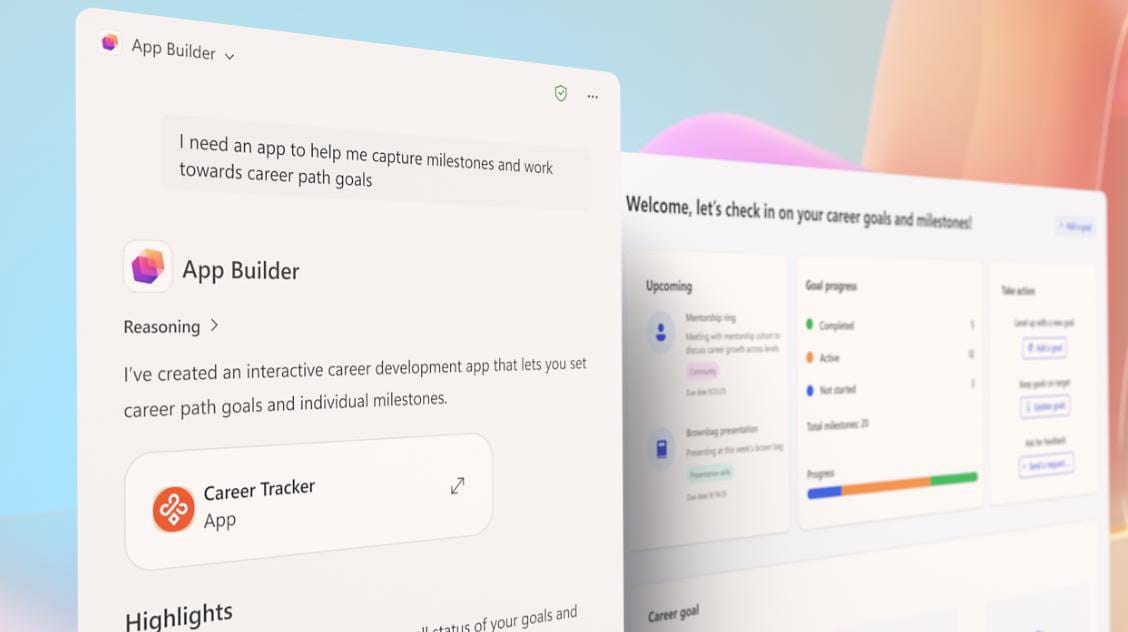
Google dropped its App Builder inside AI Studio this week. Microsoft followed with two tools baked into Copilot for Microsoft 365: App Builder for creating calculators and dashboards, and Workflows for automating tasks like email sequences and calendar reminders.

Both companies are betting millions of existing users will start building instead of just browsing.

Why it matters: The barrier to entry for app creation is collapsing—if you can describe a tool clearly, you can build it.

What's new: Google's App Builder turns plain English into working apps—you type "build me a budget tracker," and it generates the interface, logic, and functionality in seconds.

The tool lives inside AI Studio and connects directly to Gemini, Google's conversational AI model. It includes image generation capabilities, voice synthesis for audio outputs, and text-based editing.

A hypothetical example: imagine a freelance designer in Portland needing a client invoice tracker. Instead of hiring a developer or wrestling with spreadsheets, they describe the tool in a sentence. The builder handles the rest—fields, calculations, even email notifications when payments are due.

Zoom in: Microsoft split its approach into two products: App Builder creates standalone tools like lead trackers or project dashboards, while Workflows automates repetitive tasks across Microsoft 365 apps.

Both plug into Outlook, Teams, and Excel—where work already happens.

Workflows handles tasks like sending weekly team updates, scheduling reminders based on calendar events, or pulling data from emails into spreadsheets. App Builder focuses on creating interactive tools—think expense calculators, feedback forms, or inventory dashboards.

Both use natural language prompts instead of drag-and-drop interfaces.

By the numbers: Microsoft Power Platform, the ecosystem these tools extend, reported 56 million monthly active users in 2025 according to company data.

ChatGPT reached 500 million weekly active users by March 2025, per OpenAI's public statements.

OpenAI hit $10 billion in annualized revenue by June, while Anthropic reached roughly $3 billion annualized, according to reports from The Information and Bloomberg.

The no-code AI platform market sits between $4.1 and $6.7 billion in 2025, according to industry estimates.

The big picture: Google and Microsoft are playing catch-up. OpenAI and Anthropic already let users build custom GPTs (personalized AI assistants) and projects without coding—features that launched months before Google and Microsoft's tools.

The difference now: Google and Microsoft are embedding these builders where millions already work. Google Workspace has over 3 billion users. Microsoft 365 serves more than 400 million.

The question isn't whether people want no-code tools—it's whether they'll use them where they already spend eight hours a day.

Between the lines: No-code platforms like Bubble, Webflow, and Zapier have existed for years, but AI changes the interaction—you're describing what you want instead of assembling it piece by piece.

That shift matters for specific groups: startups testing MVPs (minimum viable products—early versions of a product used to test ideas) without hiring developers, marketers building landing pages or lead magnets in minutes, analysts creating dashboards without learning SQL (a database query language), and product managers prototyping features in hours instead of weeks.

Consider a small business owner in Austin running a pet supply shop. They need a loyalty program tracker but can't afford custom software. With these tools, they describe the system—points per purchase, rewards at certain thresholds, email notifications—and the builder generates it. No developer. No monthly SaaS subscription. Just a working tool.

Worth noting: Microsoft earned recognition as a leader in the 2025 Forrester Wave for Low-Code Platforms for Professional Developers, according to Forrester Research.

Google's betting on Gemini's conversational strength and its Workspace distribution. Both are embedding AI builders into daily workflows—not as separate apps, but as native features.

What's next: The shift isn't whether no-code AI tools will go mainstream. It's how fast adoption happens, and which industries move first.

Teachers building quiz generators. Event planners automating RSVPs. Nonprofit coordinators tracking donations. The use cases multiply when the friction disappears.

What happens when building becomes as common as browsing?

Mobile Bottom Test Banner

What is this about?

  • News/
  • Ben Ramos/
  • Tech/
  • Software

Feed

    Casely issues second E33A recall in April 2026

    Casely issues second E33A recall in April 2026

    Up to 429,000 units made between March 2022 and Sept 2024 may overheat, prompting an urgent CPSC warning

    Carter Brooksabout 9 hours ago
    Meta hikes Quest 3S 128 GB, 256 GB, and Quest 3 512 GB prices

    Meta hikes Quest 3S 128 GB, 256 GB, and Quest 3 512 GB prices

    Price rise effective April 19, 2026, cites memory‑chip cost pressures

    Carter Brooksabout 9 hours ago
    Surface Laptop 8 OLED to debut this summer

    Surface Laptop 8 OLED to debut this summer

    Top‑tier models will feature OLED; Intel units arrive in May, and Snapdragon later

    Carter Brooksabout 9 hours ago
    Pixel 11 Leaks Pixel Glow Notification LEDs

    Pixel 11 Leaks Pixel Glow Notification LEDs

    Android 17 beta code shows Pixel 11 will add back‑panel lighting for alerts

    Carter Brooks1 day ago
    Apple adds camera shortcuts to iOS 27

    Apple adds camera shortcuts to iOS 27

    iOS 27 shortcuts turn photos into nutrition logs, contacts, and ticket scans

    Carter Brooks1 day ago
    Intel AI Quiet Plus Debuts on April 15, 2026

    Intel AI Quiet Plus Debuts on April 15, 2026

    Core Ultra 200HX Plus NPU caps noise at 43 dBA, retains 92% performance

    Priya Desai1 day ago
    Redmi Buds 8 Launches with 50 dB ANC and 11 mm Driver

    Redmi Buds 8 Launches with 50 dB ANC and 11 mm Driver

    Xiaomi Rolls Out Budget Earbuds in China on April 22, with 4 kHz ANC

    Carter Brooks1 day ago
    AMD re‑releases Ryzen 7 5800X3D for Q2 2026

    AMD re‑releases Ryzen 7 5800X3D for Q2 2026

    AMD offers performance to AM4 builders, extending platform life

    Priya Desai1 day ago
    OpenAI’s Codex gets gpt‑image‑1.5 and 90+ plugins

    OpenAI’s Codex gets gpt‑image‑1.5 and 90+ plugins

    The April 15, 2026 update adds autonomous screen control and a built‑in browser

    Ben Ramos1 day ago
    Apple to debut OLED iPad Air in 2027

    Apple to debut OLED iPad Air in 2027

    Affordable OLED display aims to revamp mid-range tablets

    Carter Brooks2 days ago
    Capcom orders GrizzoUK to delete 1,004 videos

    Capcom orders GrizzoUK to delete 1,004 videos

    Cease‑and‑desist nukes his Resident Evil: Requiem and Street Fighter mods, warning creators

    Ben Ramos2 days ago
    Allbirds' Pivot Fuels 600% Stock Surge

    Allbirds' Pivot Fuels 600% Stock Surge

    Marcus Dillard2 days ago
    DaVinci Resolve Beta Adds Photo Editor

    DaVinci Resolve Beta Adds Photo Editor

    Photo Manager lets creators edit RAW images inside the video timeline

    Ben Ramos3 days ago
    2026 Porsche 911 GT3 S/C Roadster Unveiled in Stuttgart

    2026 Porsche 911 GT3 S/C Roadster Unveiled in Stuttgart

    Base price $275,000; 4.0‑L flat‑six delivers 510 hp and 3.9 s 0‑60

    Ethan Whitaker3 days ago
    Trump Mobile unveils T1 phone with 6.78‑inch 120 Hz display

    Trump Mobile unveils T1 phone with 6.78‑inch 120 Hz display

    6.78‑inch AMOLED, Snapdragon 7‑series, 512 GB storage, triple‑camera specs

    Carter Brooks3 days ago
    Sony InZone M10S II launches with 540 Hz OLED gaming monitor

    Sony InZone M10S II launches with 540 Hz OLED gaming monitor

    27‑inch WOLED with 2,560 × 1,440 at 540 Hz, 0.02‑ms response and 1,500,000:1 contrast

    Carter Brooks3 days ago
    Google launches Windows app with Alt+Space search shortcut

    Google launches Windows app with Alt+Space search shortcut

    The new Google app adds AI and Lens search, but AI mode works only in English

    Carter Brooks3 days ago
    Samsung raises prices on Galaxy Z Flip 7, S25 FE, S25 Edge

    Samsung raises prices on Galaxy Z Flip 7, S25 FE, S25 Edge

    April 12 hikes push flagship devices above $1,200, raising concerns

    Carter Brooks4 days ago
    Pragmata on PC (RTX3080) & Consoles: A Deep Dive

    Pragmata on PC (RTX3080) & Consoles: A Deep Dive

    Jordan McAllister5 days ago
    Roblox rolls out age‑gated tiers in June

    Roblox rolls out age‑gated tiers in June

    Three new account types—Kids, Select, and Standard—AI scans and parental approval

    Jordan McAllister5 days ago
    Loading...
Recommended for you
Subscription

Get daily briefings and deep dives without missing important updates.

Popular reads

See the most discussed stories and editor picks from this week.

Internal promo

Explore our featured projects, interviews, and special collections.

Tech/Software

Google and Microsoft launch no-code AI app builders

7 November 2025

—

News

Ben Ramos

Google and Microsoft just released AI-powered app builders that let anyone create tools, dashboards, and automations without writing code—a direct challenge to OpenAI and Anthropic's head start in the no-code AI space.

Google dropped its App Builder inside AI Studio this week. Microsoft followed with two tools baked into Copilot for Microsoft 365: App Builder for creating calculators and dashboards, and Workflows for automating tasks like email sequences and calendar reminders.

Both companies are betting millions of existing users will start building instead of just browsing.

Why it matters: The barrier to entry for app creation is collapsing—if you can describe a tool clearly, you can build it.

What's new: Google's App Builder turns plain English into working apps—you type "build me a budget tracker," and it generates the interface, logic, and functionality in seconds.

The tool lives inside AI Studio and connects directly to Gemini, Google's conversational AI model. It includes image generation capabilities, voice synthesis for audio outputs, and text-based editing.

A hypothetical example: imagine a freelance designer in Portland needing a client invoice tracker. Instead of hiring a developer or wrestling with spreadsheets, they describe the tool in a sentence. The builder handles the rest—fields, calculations, even email notifications when payments are due.

Zoom in: Microsoft split its approach into two products: App Builder creates standalone tools like lead trackers or project dashboards, while Workflows automates repetitive tasks across Microsoft 365 apps.

Both plug into Outlook, Teams, and Excel—where work already happens.

Workflows handles tasks like sending weekly team updates, scheduling reminders based on calendar events, or pulling data from emails into spreadsheets. App Builder focuses on creating interactive tools—think expense calculators, feedback forms, or inventory dashboards.

Both use natural language prompts instead of drag-and-drop interfaces.

By the numbers: Microsoft Power Platform, the ecosystem these tools extend, reported 56 million monthly active users in 2025 according to company data.

ChatGPT reached 500 million weekly active users by March 2025, per OpenAI's public statements.

OpenAI hit $10 billion in annualized revenue by June, while Anthropic reached roughly $3 billion annualized, according to reports from The Information and Bloomberg.

The no-code AI platform market sits between $4.1 and $6.7 billion in 2025, according to industry estimates.

The big picture: Google and Microsoft are playing catch-up. OpenAI and Anthropic already let users build custom GPTs (personalized AI assistants) and projects without coding—features that launched months before Google and Microsoft's tools.

The difference now: Google and Microsoft are embedding these builders where millions already work. Google Workspace has over 3 billion users. Microsoft 365 serves more than 400 million.

The question isn't whether people want no-code tools—it's whether they'll use them where they already spend eight hours a day.

Between the lines: No-code platforms like Bubble, Webflow, and Zapier have existed for years, but AI changes the interaction—you're describing what you want instead of assembling it piece by piece.

That shift matters for specific groups: startups testing MVPs (minimum viable products—early versions of a product used to test ideas) without hiring developers, marketers building landing pages or lead magnets in minutes, analysts creating dashboards without learning SQL (a database query language), and product managers prototyping features in hours instead of weeks.

Consider a small business owner in Austin running a pet supply shop. They need a loyalty program tracker but can't afford custom software. With these tools, they describe the system—points per purchase, rewards at certain thresholds, email notifications—and the builder generates it. No developer. No monthly SaaS subscription. Just a working tool.

Worth noting: Microsoft earned recognition as a leader in the 2025 Forrester Wave for Low-Code Platforms for Professional Developers, according to Forrester Research.

Google's betting on Gemini's conversational strength and its Workspace distribution. Both are embedding AI builders into daily workflows—not as separate apps, but as native features.

What's next: The shift isn't whether no-code AI tools will go mainstream. It's how fast adoption happens, and which industries move first.

Teachers building quiz generators. Event planners automating RSVPs. Nonprofit coordinators tracking donations. The use cases multiply when the friction disappears.

What happens when building becomes as common as browsing?

What is this about?

  • News/
  • Ben Ramos/
  • Tech/
  • Software

Feed

    Casely issues second E33A recall in April 2026

    Casely issues second E33A recall in April 2026

    Up to 429,000 units made between March 2022 and Sept 2024 may overheat, prompting an urgent CPSC warning

    Carter Brooksabout 9 hours ago
    Meta hikes Quest 3S 128 GB, 256 GB, and Quest 3 512 GB prices

    Meta hikes Quest 3S 128 GB, 256 GB, and Quest 3 512 GB prices

    Price rise effective April 19, 2026, cites memory‑chip cost pressures

    Carter Brooksabout 9 hours ago
    Surface Laptop 8 OLED to debut this summer

    Surface Laptop 8 OLED to debut this summer

    Top‑tier models will feature OLED; Intel units arrive in May, and Snapdragon later

    Carter Brooksabout 9 hours ago
    Pixel 11 Leaks Pixel Glow Notification LEDs

    Pixel 11 Leaks Pixel Glow Notification LEDs

    Android 17 beta code shows Pixel 11 will add back‑panel lighting for alerts

    Carter Brooks1 day ago
    Apple adds camera shortcuts to iOS 27

    Apple adds camera shortcuts to iOS 27

    iOS 27 shortcuts turn photos into nutrition logs, contacts, and ticket scans

    Carter Brooks1 day ago
    Intel AI Quiet Plus Debuts on April 15, 2026

    Intel AI Quiet Plus Debuts on April 15, 2026

    Core Ultra 200HX Plus NPU caps noise at 43 dBA, retains 92% performance

    Priya Desai1 day ago
    Redmi Buds 8 Launches with 50 dB ANC and 11 mm Driver

    Redmi Buds 8 Launches with 50 dB ANC and 11 mm Driver

    Xiaomi Rolls Out Budget Earbuds in China on April 22, with 4 kHz ANC

    Carter Brooks1 day ago
    AMD re‑releases Ryzen 7 5800X3D for Q2 2026

    AMD re‑releases Ryzen 7 5800X3D for Q2 2026

    AMD offers performance to AM4 builders, extending platform life

    Priya Desai1 day ago
    OpenAI’s Codex gets gpt‑image‑1.5 and 90+ plugins

    OpenAI’s Codex gets gpt‑image‑1.5 and 90+ plugins

    The April 15, 2026 update adds autonomous screen control and a built‑in browser

    Ben Ramos1 day ago
    Apple to debut OLED iPad Air in 2027

    Apple to debut OLED iPad Air in 2027

    Affordable OLED display aims to revamp mid-range tablets

    Carter Brooks2 days ago
    Capcom orders GrizzoUK to delete 1,004 videos

    Capcom orders GrizzoUK to delete 1,004 videos

    Cease‑and‑desist nukes his Resident Evil: Requiem and Street Fighter mods, warning creators

    Ben Ramos2 days ago
    Allbirds' Pivot Fuels 600% Stock Surge

    Allbirds' Pivot Fuels 600% Stock Surge

    Marcus Dillard2 days ago
    DaVinci Resolve Beta Adds Photo Editor

    DaVinci Resolve Beta Adds Photo Editor

    Photo Manager lets creators edit RAW images inside the video timeline

    Ben Ramos3 days ago
    2026 Porsche 911 GT3 S/C Roadster Unveiled in Stuttgart

    2026 Porsche 911 GT3 S/C Roadster Unveiled in Stuttgart

    Base price $275,000; 4.0‑L flat‑six delivers 510 hp and 3.9 s 0‑60

    Ethan Whitaker3 days ago
    Trump Mobile unveils T1 phone with 6.78‑inch 120 Hz display

    Trump Mobile unveils T1 phone with 6.78‑inch 120 Hz display

    6.78‑inch AMOLED, Snapdragon 7‑series, 512 GB storage, triple‑camera specs

    Carter Brooks3 days ago
    Sony InZone M10S II launches with 540 Hz OLED gaming monitor

    Sony InZone M10S II launches with 540 Hz OLED gaming monitor

    27‑inch WOLED with 2,560 × 1,440 at 540 Hz, 0.02‑ms response and 1,500,000:1 contrast

    Carter Brooks3 days ago
    Google launches Windows app with Alt+Space search shortcut

    Google launches Windows app with Alt+Space search shortcut

    The new Google app adds AI and Lens search, but AI mode works only in English

    Carter Brooks3 days ago
    Samsung raises prices on Galaxy Z Flip 7, S25 FE, S25 Edge

    Samsung raises prices on Galaxy Z Flip 7, S25 FE, S25 Edge

    April 12 hikes push flagship devices above $1,200, raising concerns

    Carter Brooks4 days ago
    Pragmata on PC (RTX3080) & Consoles: A Deep Dive

    Pragmata on PC (RTX3080) & Consoles: A Deep Dive

    Jordan McAllister5 days ago
    Roblox rolls out age‑gated tiers in June

    Roblox rolls out age‑gated tiers in June

    Three new account types—Kids, Select, and Standard—AI scans and parental approval

    Jordan McAllister5 days ago
    Loading...