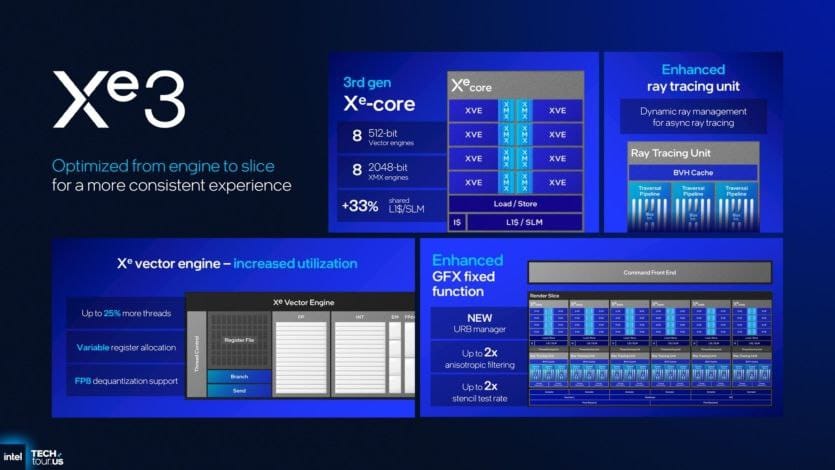

Intel unveiled Xe3, its third-generation integrated graphics architecture arriving in Panther Lake laptops this fall, targeting users who need serious graphics performance without discrete GPUs.
Driving the news: Two Xe3 configurations serve different needs. The 12-core variant packs 96 XMX compute modules (specialized math engines for AI tasks), 16 MB of L2 cache (fast-access memory keeping frequently used data instantly available), and 12 ray tracing blocks (hardware calculating realistic lighting in real time). The 4-core version scales to 32 XMX cores, 4 MB cache, and 4 RT blocks for ultraportables with separate graphics cards.
Why it matters: Intel holds roughly 79% of the mobile CPU market globally as of Q2 2025, according to market research firm IDC. That means Xe3 will reach millions of devices. Better integrated graphics transforms everyday work: video exports finish in minutes instead of hours, AI photo editing happens instantly, and casual gaming runs smoothly without $300 extra hardware.
The competition: Intel needs this win. AMD's Radeon 780M integrated GPU outperforms Intel's current Iris Xe by 30% in gaming benchmarks and approaches entry-level discrete laptop GPU performance, according to tests by Tom's Hardware. Apple's M3-series delivers 20–60% GPU improvements over prior generations and consistently beats Intel's integrated graphics by wide margins in creative applications.
The architecture: XMX modules accelerate machine learning tasks like background removal in video calls or AI writing assistants. RT blocks calculate how light bounces off surfaces, making game environments look photorealistic. The L2 cache works like keeping frequently used tools on your workbench instead of walking to the garage—it cuts waiting time dramatically.
The intrigue: Leaked roadmaps mention Nova Lake-AX, a high-performance chip combining 28 processor cores with an integrated Xe3P GPU featuring 384 execution units. That's 48 Xe3 cores—four times the standard configuration. The system may include a 256-bit memory bus delivering bandwidth up to 10667 MT/s (megatransfers per second, measuring how fast data moves). This would make Nova Lake-AX one of Intel's most powerful integrated solutions ever, potentially matching mid-range discrete graphics cards.
Reality check: Integrated GPU performance depends heavily on RAM speed and system design. The same chip performs differently across laptop models. Nova Lake-AX's wide memory bus could feed those 48 graphics cores effectively, but real-world results vary. Reports from DigiTimes suggest Intel might cancel the Nova Lake-AX project, though Xe3P remains on roadmaps. The company may revisit this ambitious design later.
What this enables: A freelance video editor rendering 1080p footage during a coffee shop session. A startup founder running AI market analysis on a thin-and-light laptop. A student playing AAA games at medium settings without lugging a gaming rig to the dorm. Xe3 brings capabilities once reserved for expensive workstations to mainstream laptops.
The bottom line: Panther Lake launches in the second half of 2025. Intel's challenge isn't just building better architecture—it's closing a performance gap while competitors advance. Execution matters more than specifications.
What to watch: Can Intel deliver the bandwidth and thermal management needed to unlock Xe3's potential across diverse laptop designs? Will budget laptops finally handle creative work smoothly? And if Nova Lake-AX resurfaces, could integrated graphics finally eliminate the need for discrete cards in most workflows? The answers arrive this fall. For millions of users choosing their next laptop, Xe3 could mean the difference between compromising on performance and getting everything they need in one affordable package.