
• My Feed
  • Home
  • What's Important
  • Media & Entertainment
Search

Stay Curious. Stay Wanture.

© 2026 Wanture. All rights reserved.

  • Terms of Use
  • Privacy Policy
Tech/Software
Amazon's Kindle AI reads along with you

Ask this Book answers questions without spoilers. Authors can't opt out

15 December 2025

—

Explainer *

Jordan McAllister
banner

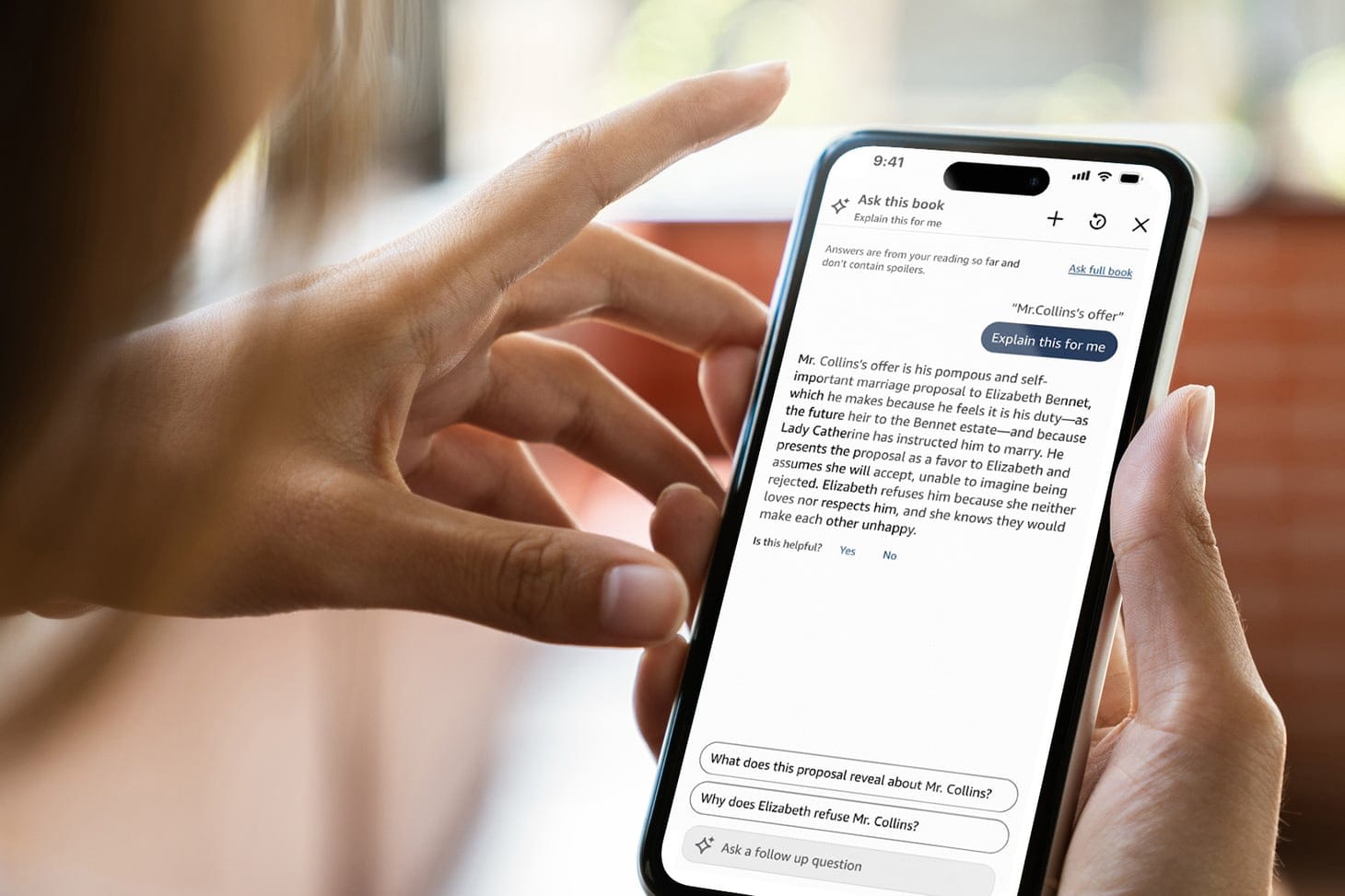
Amazon launched an AI assistant inside Kindle that explains characters, plot points, and themes as you read. It only references pages you've already finished. The feature works on iOS now, devices and Android in 2026. Authors and publishers have no way to disable it for their books. Here's how the spoiler prevention works and why writers object.

kindle-ask-this-book-2

Summary:

  • Amazon's new Kindle AI feature 'Ask this Book' helps readers navigate complex texts by answering questions about previously read pages without spoilers.
  • The AI uses reading position tracking, natural language processing, and a spoiler prevention algorithm to provide contextual book insights within the reading interface.
  • This technology transforms reading experience by offering immediate clarification while maintaining the narrative's integrity, with potential industry-wide implications for digital reading.

What Is AI-Assisted Reading? Amazon's Kindle Feature, Explained

You're reading a complex novel and forget a character's name from twelve chapters ago. Traditionally, you have two choices: flip backward through 200 pages, or keep reading and stay confused.

Amazon has added a third option. An AI assistant now lives inside the Kindle app, allowing readers to ask questions about their book. It answers based only on pages already read—no spoilers, no leaving the app, no internet required.

The feature is called "Ask this Book." It launched this year in the Kindle iOS app for thousands of English titles and is coming to Kindle devices and Android next year. Here's what it actually is and how it works.

What It Is

Ask this Book is an AI chatbot embedded in your Kindle reading interface. Think of it as a study partner who's read the same book and only discusses parts you've both covered.

The AI discusses plot points, explains character relationships, and analyzes themes. But it follows one strict rule: it only references pages you've already read.

This isn't a search tool for the whole book. It's contextual help that moves with you through the story. As you read more pages, the AI knows more it can discuss. It functions like a bookmark that remembers everything before it.

Why It Matters

Complex books create predictable problems. Readers lose track of characters in sprawling fantasy series. They forget who said what three chapters ago. They miss thematic connections.

Traditionally, you had three options: Google it and risk spoilers, flip back through pages hunting for that scene, or stay confused and keep reading.

Amazon sees confusion as a problem it can solve with technology. The company dominates e-books through Kindle, and now it's making those e-books "smarter" than print versions.

This raises important questions about how technology changes the reading experience. Does instant access to clarification enhance comprehension, or does it remove the productive struggle that deepens engagement with difficult texts? The answer likely depends on both the book and the reader.

How It Works

Reading Position Tracking

The system functions like GPS for your reading location. When you're on page 147, the AI knows you've read pages 1 through 147. It will not reference page 148 or beyond.

Your Kindle already tracks this data to sync reading progress across devices. The AI uses that same position marker. Every time you turn a page, the AI's allowed discussion range expands by one page automatically, requiring no setup.

Natural Language Processing

You can type questions in plain English. "Who is this character?" or "Why did that happen?" or "What's the connection between these two people?"

The AI interprets your question, identifies what information you're asking for, then searches only the pages you've completed.

This likely uses similar language technology to ChatGPT and other AI assistants. But Amazon constrains it significantly. The AI cannot browse the internet, cannot reference future pages, and only has access to the text behind you.

Spoiler Prevention System

Preventing spoilers in narrative texts presents a complex technical challenge. Authors plant clues early that only make sense later. Characters lie. Narrators deliberately mislead readers.

The AI must understand not just what information appears where, but how revealing certain connections might spoil future revelations. Amazon describes this as providing help "without spoiling the plot," though the company hasn't detailed exactly how the system determines what constitutes a spoiler versus legitimate clarification.

Context and Conversation

The AI maintains conversation context as you ask questions. It appears to prioritize information from recent chapters, similar to how human memory works when discussing books—recent events feel more relevant than older ones.

When you ask a question, the AI generates an answer in natural language based on the specific text you've read. The response appears in a chat window where you can ask follow-up questions, creating dialogue rather than isolated answers.

How Readers Might Use It

For students: The AI could help track complex narrative structures like those in Beloved or One Hundred Years of Solitude, where non-linear timelines and multiple generations make the story difficult to follow.

For series readers: In fantasy novels with dozens of named characters appearing across multiple books, the AI can function as a character encyclopedia that respects your current reading progress.

For interrupted reading: Commuters and others who read in short sessions could use the AI as a memory aid, asking "What happened last time I read?" to quickly reorient themselves.

Common Misconceptions

Myth: The AI spoils the ending.

Reality: It only discusses pages you've read. The spoiler prevention system is designed to block information from pages ahead of your current position.

Myth: The AI replaces careful reading.

Reality: It clarifies confusion so you can continue reading. It's designed to be most useful when you're already engaged but stuck on a detail.

Myth: Authors can turn it off for their books.

Reality: Amazon spokesperson Ale Iraheta told Publishers Lunch that authors and publishers cannot opt titles out of the feature.

What to Consider

AI-assisted reading changes the relationship between reader and text. It offers immediate answers to confusion, which for some books and some readers can be genuinely helpful. For others, it may short-circuit interpretive challenges that authors deliberately designed into their work.

The technology is spreading, with competitors like Kobo and Apple Books likely watching Amazon's experiment closely. How readers choose to use the feature—and whether they use it at all—will help determine whether AI assistance becomes standard or remains optional in digital reading.

Amazon has made the choice for Kindle users: the feature is on by default and cannot be disabled by authors. Whether this represents a genuine enhancement to reading or an unwelcome intrusion will be debated as the feature reaches all devices in the coming year.


What is this about?

  • Explainer */
  • Jordan McAllister/
  • Tech/
  • Software
  • AI reading assistant/
  • Amazon Kindle/
  • artificial intelligence/
  • digital reading experience

Feed

    Button AI Assistant Debuts, Offering Screen‑Free Voice Help

    Button AI Assistant Debuts, Offering Screen‑Free Voice Help

    Nostalgic iPod Shuffle design meets privacy‑first press‑to‑talk AI

    about 22 hours ago
    Razer Hammerhead V3 HyperSpeed Debuts with Dual‑Mode Case

    Razer Hammerhead V3 HyperSpeed Debuts with Dual‑Mode Case

    The USB‑C case also serves as a 2.4 GHz receiver, cutting dongles for PS5 and phones

    about 22 hours ago
    Apple ships 6.2 million Macs Q1 2026, M5‑MacBook Pro leads

    Apple ships 6.2 million Macs Q1 2026, M5‑MacBook Pro leads

    Apple’s share rises to 9.5%, moving it into fourth place among global PC makers

    about 22 hours ago
    Galaxy S22 Ultra can be bricked after factory reset

    Galaxy S22 Ultra can be bricked after factory reset

    US owners report IMEI‑level lock that hands control to unknown administrator Numero LLC

    about 22 hours ago
    Mouse: P.I. for Hire arrives April 16 on PC, PS5, and Xbox

    Mouse: P.I. for Hire arrives April 16 on PC, PS5, and Xbox

    Modes: 4K 60 fps quality or 120 fps performance on PS5 and Xbox Series X

    about 22 hours ago
    YouTube Rolls Out Auto Speed for Premium Users

    YouTube Rolls Out Auto Speed for Premium Users

    The AI‑driven playback boost aims to cut dead air on long videos

    1 day ago
    Blackwell Set to Capture Majority of the 2026 GPU Market

    Blackwell Set to Capture Majority of the 2026 GPU Market

    GB300/B300 GPUs Push Blackwell to 71% of Shipments; Rubin Falls to 22%

    2 days ago
    Google launches AI avatar tool for Shorts on April 9, 2026

    Google launches AI avatar tool for Shorts on April 9, 2026

    Ages 18+ can create digital replicas, with Synth ID tags and a 3‑year auto‑delete

    2 days ago
    Mac OS X 10.0 Cheetah runs on Wii

    Mac OS X 10.0 Cheetah runs on Wii

    Ports Mac OS X 10.0 Cheetah to the Wii, showing the PowerPC 750CL can run an OS

    2 days ago
    DuoBell Beats ANC: Safer Cycling with Apple AirPods Max

    DuoBell Beats ANC: Safer Cycling with Apple AirPods Max

    A 750 Hz blind‑spot lets DuoBell cut through ANC on popular headphones

    2 days ago
    Škoda DuoBell prototype unveiled on April 5, 2026

    Škoda DuoBell prototype unveiled on April 5, 2026

    750 Hz pulse and 2,000 Hz chime cut through ANC, alerting riders faster at 15 mph

    2 days ago
    SteamGPT Leak Reveals Dual‑Role AI on Steam

    SteamGPT Leak Reveals Dual‑Role AI on Steam

    Leak shows AI handling support and cheat‑detection for millions on the platform

    2 days ago
    Oppo Pad mini challenges Apple with Snapdragon 8 Gen 5

    Oppo Pad mini challenges Apple with Snapdragon 8 Gen 5

    April 21: Oppo Pad mini 8.8‑inch, Snapdragon 8 Gen 5, 5.39 mm, 279 g, 144 Hz OLED

    2 days ago
    Apple to ship 3 million foldable iPhones by end‑2026

    Apple to ship 3 million foldable iPhones by end‑2026

    Limited rollout equals 12 % of iPhone volume and rivals Samsung’s 2.4 million Galaxy Z Fold 7 sales

    2 days ago
    Apple unveils iPhone 18 Pro, iPhone 18 Pro Max, and iPhone Ultra

    Apple unveils iPhone 18 Pro, iPhone 18 Pro Max, and iPhone Ultra

    Mockups match leaked renders; 20 million Samsung panels for iPhone Ultra

    3 days ago
    Sony launches Playerbase program for Gran Turismo 7

    Sony launches Playerbase program for Gran Turismo 7

    PlayStation gamers can win a flight, facial scan, and an avatar in Gran Turismo 7

    3 days ago
    Claude Mythos Preview Beats Opus 4.6 in Cybersecurity!

    Claude Mythos Preview Beats Opus 4.6 in Cybersecurity!

    Claude Mythos Preview for five partners—pricing after a 100 million token credit

    3 days ago
    ChatGPT and AI Tools Let Solo Founders Launch Fast

    ChatGPT and AI Tools Let Solo Founders Launch Fast

    With GitHub Copilot, a founder can code, design, and deliver an MVP in days

    4 days ago
    Android 17 beta adds Notification Rules

    Android 17 beta adds Notification Rules

    New rules let users silence, block, or highlight alerts; Samsung eyes One UI 9

    4 days ago
    Utah Starts 12‑Month AI Chatbot Pilot for Psychiatric Meds

    Utah Starts 12‑Month AI Chatbot Pilot for Psychiatric Meds

    Legion Health pilot offers refills for 15 meds, easing shortages in rural Utah

    4 days ago
    Loading...
Tech/Software

Amazon's Kindle AI reads along with you

Ask this Book answers questions without spoilers. Authors can't opt out

December 15, 2025, 3:31 pm

Amazon launched an AI assistant inside Kindle that explains characters, plot points, and themes as you read. It only references pages you've already finished. The feature works on iOS now, devices and Android in 2026. Authors and publishers have no way to disable it for their books. Here's how the spoiler prevention works and why writers object.

kindle-ask-this-book-2

Summary

  • Amazon's new Kindle AI feature 'Ask this Book' helps readers navigate complex texts by answering questions about previously read pages without spoilers.
  • The AI uses reading position tracking, natural language processing, and a spoiler prevention algorithm to provide contextual book insights within the reading interface.
  • This technology transforms reading experience by offering immediate clarification while maintaining the narrative's integrity, with potential industry-wide implications for digital reading.

What Is AI-Assisted Reading? Amazon's Kindle Feature, Explained

You're reading a complex novel and forget a character's name from twelve chapters ago. Traditionally, you have two choices: flip backward through 200 pages, or keep reading and stay confused.

Amazon has added a third option. An AI assistant now lives inside the Kindle app, allowing readers to ask questions about their book. It answers based only on pages already read—no spoilers, no leaving the app, no internet required.

The feature is called "Ask this Book." It launched this year in the Kindle iOS app for thousands of English titles and is coming to Kindle devices and Android next year. Here's what it actually is and how it works.

What It Is

Ask this Book is an AI chatbot embedded in your Kindle reading interface. Think of it as a study partner who's read the same book and only discusses parts you've both covered.

The AI discusses plot points, explains character relationships, and analyzes themes. But it follows one strict rule: it only references pages you've already read.

This isn't a search tool for the whole book. It's contextual help that moves with you through the story. As you read more pages, the AI knows more it can discuss. It functions like a bookmark that remembers everything before it.

Why It Matters

Complex books create predictable problems. Readers lose track of characters in sprawling fantasy series. They forget who said what three chapters ago. They miss thematic connections.

Traditionally, you had three options: Google it and risk spoilers, flip back through pages hunting for that scene, or stay confused and keep reading.

Amazon sees confusion as a problem it can solve with technology. The company dominates e-books through Kindle, and now it's making those e-books "smarter" than print versions.

This raises important questions about how technology changes the reading experience. Does instant access to clarification enhance comprehension, or does it remove the productive struggle that deepens engagement with difficult texts? The answer likely depends on both the book and the reader.

How It Works

Reading Position Tracking

The system functions like GPS for your reading location. When you're on page 147, the AI knows you've read pages 1 through 147. It will not reference page 148 or beyond.

Your Kindle already tracks this data to sync reading progress across devices. The AI uses that same position marker. Every time you turn a page, the AI's allowed discussion range expands by one page automatically, requiring no setup.

Natural Language Processing

You can type questions in plain English. "Who is this character?" or "Why did that happen?" or "What's the connection between these two people?"

The AI interprets your question, identifies what information you're asking for, then searches only the pages you've completed.

This likely uses similar language technology to ChatGPT and other AI assistants. But Amazon constrains it significantly. The AI cannot browse the internet, cannot reference future pages, and only has access to the text behind you.

Spoiler Prevention System

Preventing spoilers in narrative texts presents a complex technical challenge. Authors plant clues early that only make sense later. Characters lie. Narrators deliberately mislead readers.

The AI must understand not just what information appears where, but how revealing certain connections might spoil future revelations. Amazon describes this as providing help "without spoiling the plot," though the company hasn't detailed exactly how the system determines what constitutes a spoiler versus legitimate clarification.

Context and Conversation

The AI maintains conversation context as you ask questions. It appears to prioritize information from recent chapters, similar to how human memory works when discussing books—recent events feel more relevant than older ones.

When you ask a question, the AI generates an answer in natural language based on the specific text you've read. The response appears in a chat window where you can ask follow-up questions, creating dialogue rather than isolated answers.

How Readers Might Use It

For students: The AI could help track complex narrative structures like those in Beloved or One Hundred Years of Solitude, where non-linear timelines and multiple generations make the story difficult to follow.

For series readers: In fantasy novels with dozens of named characters appearing across multiple books, the AI can function as a character encyclopedia that respects your current reading progress.

For interrupted reading: Commuters and others who read in short sessions could use the AI as a memory aid, asking "What happened last time I read?" to quickly reorient themselves.

Common Misconceptions

Myth: The AI spoils the ending.

Reality: It only discusses pages you've read. The spoiler prevention system is designed to block information from pages ahead of your current position.

Myth: The AI replaces careful reading.

Reality: It clarifies confusion so you can continue reading. It's designed to be most useful when you're already engaged but stuck on a detail.

Myth: Authors can turn it off for their books.

Reality: Amazon spokesperson Ale Iraheta told Publishers Lunch that authors and publishers cannot opt titles out of the feature.

What to Consider

AI-assisted reading changes the relationship between reader and text. It offers immediate answers to confusion, which for some books and some readers can be genuinely helpful. For others, it may short-circuit interpretive challenges that authors deliberately designed into their work.

The technology is spreading, with competitors like Kobo and Apple Books likely watching Amazon's experiment closely. How readers choose to use the feature—and whether they use it at all—will help determine whether AI assistance becomes standard or remains optional in digital reading.

Amazon has made the choice for Kindle users: the feature is on by default and cannot be disabled by authors. Whether this represents a genuine enhancement to reading or an unwelcome intrusion will be debated as the feature reaches all devices in the coming year.

What is this about?

  • Explainer */
  • Jordan McAllister/
  • Tech/
  • Software
  • AI reading assistant/
  • Amazon Kindle/
  • artificial intelligence/
  • digital reading experience

Feed

    Button AI Assistant Debuts, Offering Screen‑Free Voice Help

    Button AI Assistant Debuts, Offering Screen‑Free Voice Help

    Nostalgic iPod Shuffle design meets privacy‑first press‑to‑talk AI

    about 22 hours ago
    Razer Hammerhead V3 HyperSpeed Debuts with Dual‑Mode Case

    Razer Hammerhead V3 HyperSpeed Debuts with Dual‑Mode Case

    The USB‑C case also serves as a 2.4 GHz receiver, cutting dongles for PS5 and phones

    about 22 hours ago
    Apple ships 6.2 million Macs Q1 2026, M5‑MacBook Pro leads

    Apple ships 6.2 million Macs Q1 2026, M5‑MacBook Pro leads

    Apple’s share rises to 9.5%, moving it into fourth place among global PC makers

    about 22 hours ago
    Galaxy S22 Ultra can be bricked after factory reset

    Galaxy S22 Ultra can be bricked after factory reset

    US owners report IMEI‑level lock that hands control to unknown administrator Numero LLC

    about 22 hours ago
    Mouse: P.I. for Hire arrives April 16 on PC, PS5, and Xbox

    Mouse: P.I. for Hire arrives April 16 on PC, PS5, and Xbox

    Modes: 4K 60 fps quality or 120 fps performance on PS5 and Xbox Series X

    about 22 hours ago
    YouTube Rolls Out Auto Speed for Premium Users

    YouTube Rolls Out Auto Speed for Premium Users

    The AI‑driven playback boost aims to cut dead air on long videos

    1 day ago
    Blackwell Set to Capture Majority of the 2026 GPU Market

    Blackwell Set to Capture Majority of the 2026 GPU Market

    GB300/B300 GPUs Push Blackwell to 71% of Shipments; Rubin Falls to 22%

    2 days ago
    Google launches AI avatar tool for Shorts on April 9, 2026

    Google launches AI avatar tool for Shorts on April 9, 2026

    Ages 18+ can create digital replicas, with Synth ID tags and a 3‑year auto‑delete

    2 days ago
    Mac OS X 10.0 Cheetah runs on Wii

    Mac OS X 10.0 Cheetah runs on Wii

    Ports Mac OS X 10.0 Cheetah to the Wii, showing the PowerPC 750CL can run an OS

    2 days ago
    DuoBell Beats ANC: Safer Cycling with Apple AirPods Max

    DuoBell Beats ANC: Safer Cycling with Apple AirPods Max

    A 750 Hz blind‑spot lets DuoBell cut through ANC on popular headphones

    2 days ago
    Škoda DuoBell prototype unveiled on April 5, 2026

    Škoda DuoBell prototype unveiled on April 5, 2026

    750 Hz pulse and 2,000 Hz chime cut through ANC, alerting riders faster at 15 mph

    2 days ago
    SteamGPT Leak Reveals Dual‑Role AI on Steam

    SteamGPT Leak Reveals Dual‑Role AI on Steam

    Leak shows AI handling support and cheat‑detection for millions on the platform

    2 days ago
    Oppo Pad mini challenges Apple with Snapdragon 8 Gen 5

    Oppo Pad mini challenges Apple with Snapdragon 8 Gen 5

    April 21: Oppo Pad mini 8.8‑inch, Snapdragon 8 Gen 5, 5.39 mm, 279 g, 144 Hz OLED

    2 days ago
    Apple to ship 3 million foldable iPhones by end‑2026

    Apple to ship 3 million foldable iPhones by end‑2026

    Limited rollout equals 12 % of iPhone volume and rivals Samsung’s 2.4 million Galaxy Z Fold 7 sales

    2 days ago
    Apple unveils iPhone 18 Pro, iPhone 18 Pro Max, and iPhone Ultra

    Apple unveils iPhone 18 Pro, iPhone 18 Pro Max, and iPhone Ultra

    Mockups match leaked renders; 20 million Samsung panels for iPhone Ultra

    3 days ago
    Sony launches Playerbase program for Gran Turismo 7

    Sony launches Playerbase program for Gran Turismo 7

    PlayStation gamers can win a flight, facial scan, and an avatar in Gran Turismo 7

    3 days ago
    Claude Mythos Preview Beats Opus 4.6 in Cybersecurity!

    Claude Mythos Preview Beats Opus 4.6 in Cybersecurity!

    Claude Mythos Preview for five partners—pricing after a 100 million token credit

    3 days ago
    ChatGPT and AI Tools Let Solo Founders Launch Fast

    ChatGPT and AI Tools Let Solo Founders Launch Fast

    With GitHub Copilot, a founder can code, design, and deliver an MVP in days

    4 days ago
    Android 17 beta adds Notification Rules

    Android 17 beta adds Notification Rules

    New rules let users silence, block, or highlight alerts; Samsung eyes One UI 9

    4 days ago
    Utah Starts 12‑Month AI Chatbot Pilot for Psychiatric Meds

    Utah Starts 12‑Month AI Chatbot Pilot for Psychiatric Meds

    Legion Health pilot offers refills for 15 meds, easing shortages in rural Utah

    4 days ago
    Loading...
banner