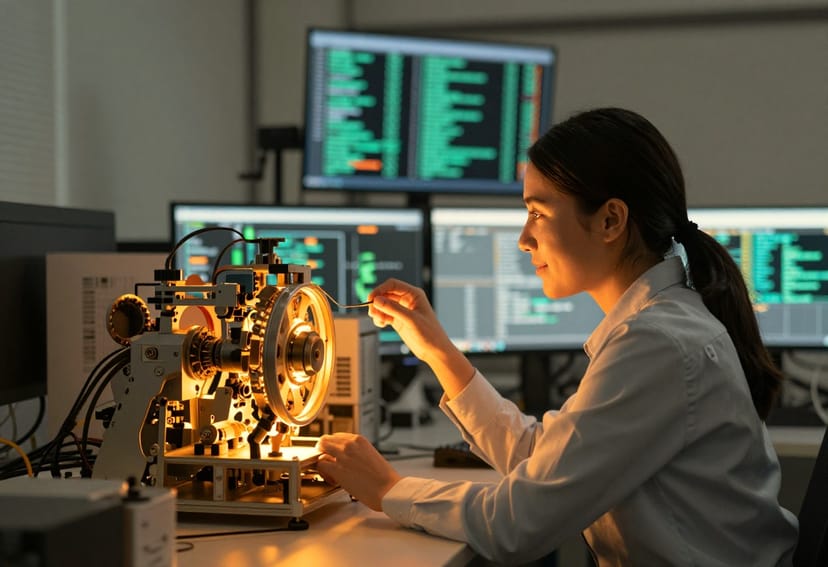
Fifteen probiotic strains—the kind found in yogurt—are generating electricity in a lab at Binghamton University. Not much. Just 4 microwatts. But these bacterial power plants do something lithium-ion batteries cannot: when their work finishes, they dissolve completely, leaving behind beneficial microorganisms and water-soluble paper. After twenty years of research, scientists have built the world's first fully biodegradable battery powered by living probiotics.
What Makes Bacteria Generate Electricity
Probiotics generate electricity by accident of evolution. These bacteria evolved to break down sugars for food. As they metabolize, they shuffle electrons around—moving them from one chemical to another. Scientists at Binghamton realized they could intercept those electrons mid-shuffle, essentially pickpocketing bacterial metabolism to create electrical current.
Think of it this way: probiotics dismantle sugar molecules the way you might disassemble furniture. As they work, electrons fly off like loosened screws. Normally, those electrons get absorbed into the bacterial cell or surrounding environment. But place the right materials nearby—modified electrodes coated with nanoparticles and conductive polymers—and you catch those electrons and channel them into a circuit.
The Binghamton team used fifteen commercial probiotic strains simultaneously. Result: 47 microamperes of current at 0.65 volts—enough to power ultra-low-energy sensors or temporary biomedical devices.
How the Battery Actually Works
The architecture is straightforward: probiotics sandwiched between modified electrodes on water-soluble paper. The paper dissolves when wet. The probiotics are alive and metabolically active. The electrodes—coated with nanoparticles and polymers—act as electron collectors, improving electron transfer efficiency by orders of magnitude.
Here's the clever part: researchers can control how long the battery operates. By adjusting design and adding pH-sensitive coatings, they achieved operational windows from 4 minutes to over 100 minutes. A pH-sensitive coating acts like a chemical timer—it degrades predictably as the battery operates, eventually exposing water-soluble components to moisture and triggering dissolution.
Compared to conventional batteries requiring lithium, cobalt, and rare earth mining, then toxic disposal management, this system operates on different logic. The battery doesn't leave waste—it becomes waste that's beneficial. When it dissolves, you're left with probiotic bacteria (the kind linked to gut health) and biodegradable paper pulp.
Why Twenty Years Matters
Twenty years might seem excessive for a 4-microwatt battery. But the timeline reveals the real challenge: getting bacteria to cooperate with electrodes efficiently enough to matter. Early microbial fuel cells produced negligible power because electron transfer between living cells and inorganic materials is biochemically awkward. Bacteria didn't evolve to interface with metal electrodes.
The breakthrough came from modifying electrode surfaces with nanoparticles and conductive polymers that speak the bacteria's electrochemical language. These coatings bridge the gap between biological metabolism and electrical circuits, increasing electron capture rates dramatically. That innovation took two decades—not the concept, but the interface.
Why 4 Microwatts Matters More Than It Sounds
Four microwatts won't charge your phone. A typical smartphone in standby mode consumes about 1,000 milliwatts—250,000 times more power than this battery produces.
The point is temporary electronics that need to vanish.
Medical implants that monitor healing for weeks, then safely dissolve inside the body. Environmental sensors dropped into ecosystems to collect data for months before biodegrading completely. Self-destructing identification tags for supply chain tracking that leave no physical trace. These applications don't need much power—they need power that disappears.
Consider a biodegradable glucose monitor implanted under skin after surgery. It needs to function for 72 hours, transmitting data wirelessly to track post-operative recovery. After that, you want it gone—no second surgery for removal, no long-term foreign body reactions, no medical waste. A probiotic battery could power the sensor, then dissolve harmlessly, releasing strains already recognized as safe for human consumption.
Current ultra-low-power sensors require about 1–10 microwatts for intermittent operation. Four microwatts sits right in that range. It's not about replacing AA batteries—it's about enabling electronics that were impossible before because removal or disposal was prohibitive.
What Happens When It Dissolves
Dissolution is the feature. When the battery completes its operational window, the pH-sensitive coating degrades, exposing water-soluble paper substrate to environmental moisture. The paper breaks down into cellulose fibers. The probiotics—already present on surfaces, in soil, in water—simply rejoin the microbial community. Nanoparticles and polymers used in electrodes degrade into non-toxic compounds.
This addresses one of electronics' ugliest problems: end-of-life disposal. Global e-waste reached 62.0 million metric tons in 2022, with only 22.3% formally collected and recycled. Projections show e-waste reaching approximately 82 million metric tons by 2030. The United States generated 7.188 million metric tons in 2022—47.0 pounds per capita, the highest rate globally—though formally recycled 56% according to UN methodology.
A dissolvable battery sidesteps that entire problem for applications where devices are temporary. The probiotics released are commercial strains already used in food production and supplements—Lactobacillus, Bifidobacterium, and similar genera recognized as safe by regulatory agencies worldwide.
Where This Technology Could Deploy
Biomedical implants represent the most immediate application. Drug delivery devices, post-surgical monitors, and temporary diagnostic sensors all share a common constraint: they're needed briefly, but removal requires additional procedures. A dissolvable power source solves that elegantly.
Environmental monitoring is another natural fit. Deploy thousands of biodegradable sensors across a watershed to track pollution, soil moisture, or wildlife movement. Traditional sensors require retrieval (expensive and labor-intensive) or become permanent litter. Dissolvable versions collect data for weeks or months, then vanish.
Supply chain tracking could use dissolvable tags for authentication or condition monitoring during shipping—particularly for pharmaceuticals or perishable goods where you need data during transport but don't want long-lived tracking technology embedded in products.
The largest application: disposable diagnostics for resource-limited settings. Point-of-care medical tests that need just enough power to run a colorimetric analysis or transmit a single data packet, then can be safely composted rather than requiring hazardous waste disposal infrastructure that may not exist.
The Engineering Constraints Still Unsolved
Four microwatts is a ceiling, not a starting point. Scaling power output from probiotic metabolism faces hard biochemical limits. Bacteria only generate so many electrons per glucose molecule metabolized, and you can only speed up bacterial metabolism so much before you kill organisms or exhaust fuel.
Temperature tolerance remains unclear. Probiotics have relatively narrow temperature ranges for optimal activity—too cold and metabolism slows, too hot and proteins denature. If these batteries need to operate outdoors in winter or inside the human body (99°F), thermal management becomes critical.
Storage is another open question. How do you store a battery made of living organisms? Probiotics can be freeze-dried and rehydrated, but does that affect electron transfer efficiency? How long is shelf life?
Cost remains the biggest wildcard for commercial viability. Can you produce these batteries at a price point competitive with coin cells for single-use applications? That depends on process engineering not yet disclosed.
What Twenty Years of Microbial Engineering Reveals
This battery is less a product than a proof of concept—evidence that we can design electronics around biological lifecycles rather than forcing biology to adapt to persistent materials. The real innovation isn't the power output; it's the demonstration that temporary functionality can be decoupled from permanent waste.
Twenty years to develop a 4-microwatt battery might seem inefficient until you consider what was actually being built: an entirely new interface between living metabolism and electronic systems, governed by dissolution rather than durability. That's not iteration—that's a different design philosophy.
For researchers working on biodegradable electronics, biomedical devices, or sustainable sensors, this represents a viable power solution where none existed before. For the rest of us, it's a reminder that the smallest organisms can solve problems invisible to conventional engineering—if we're patient enough to learn their language.