
GPS satellites orbiting above your head right now prove Einstein's wildest idea. Most people think gravity pulls objects together like magnets. This article shows how gravity is actually geometry, and why that changes everything from your morning commute to our understanding of reality itself.
What It Is
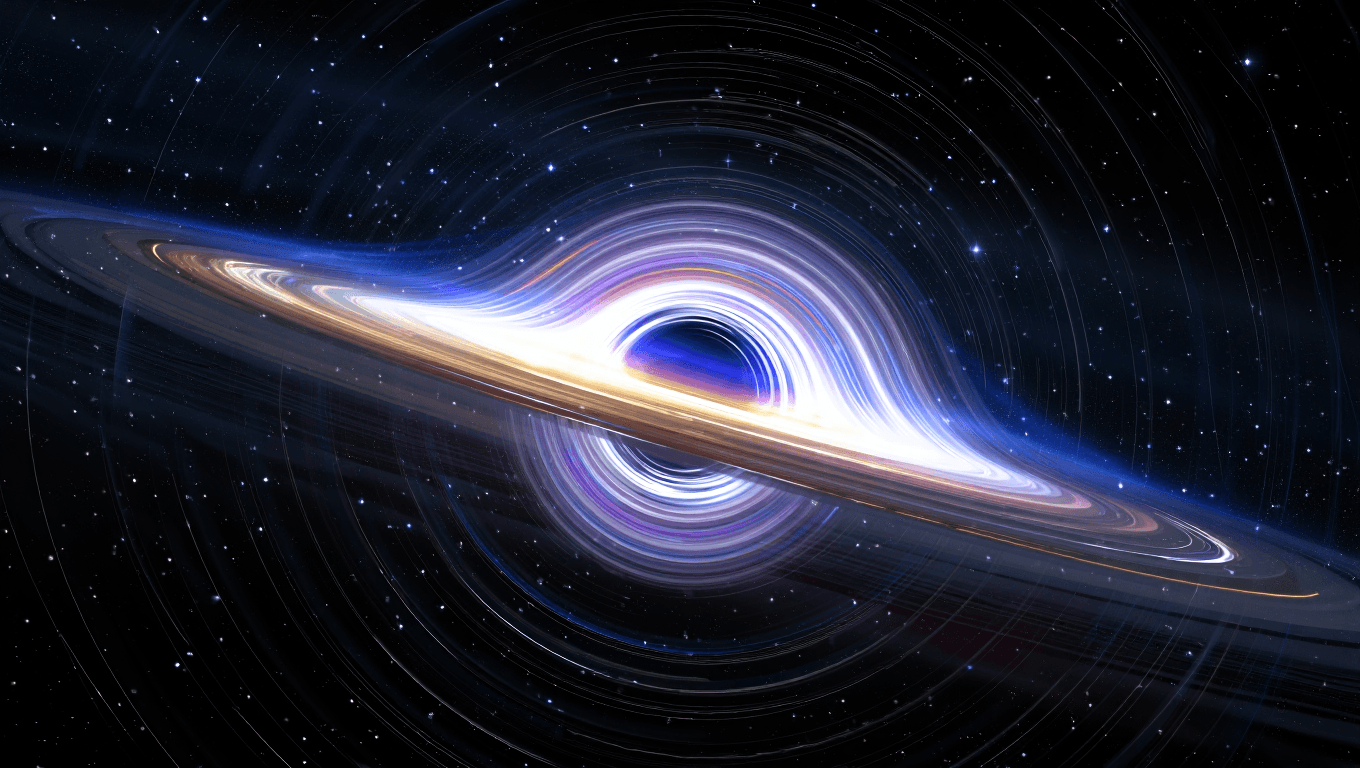
General relativity is Einstein's geometric theory of gravity. It describes gravity not as a force between objects. It describes gravity as the curvature of spacetime itself. Massive objects like stars and planets warp the fabric of space and time around them. Other objects moving through that warped spacetime follow curved paths. We perceive this as gravitational attraction.
This differs fundamentally from Newton's gravity. Newton imagined an invisible force acting instantly across any distance. Einstein showed that gravity is geometry. Matter tells spacetime how to curve. Curved spacetime tells matter how to move. There is no force. Only geometry in motion.
Why It Matters
Without general relativity, modern technology would fail. GPS satellites orbiting Earth experience time differently than clocks on the ground. Exactly as Einstein predicted. Engineers must correct for these relativistic time differences. Your navigation would drift miles off course without them.
Black holes, gravitational lensing, and the expansion of the universe itself make no sense without general relativity. The theory also solved a 19th-century mystery. Mercury's orbit wobbled in ways Newton's equations couldn't explain. Astronomers proposed an undiscovered planet. Einstein's equations predicted Mercury's exact orbit without inventing new planets. The math matched reality perfectly.
How It Works
Spacetime as a Unified Fabric
Spacetime is a single four-dimensional fabric. Einstein merged space and time. You cannot separate where something is from when it is. Every event in the universe has four coordinates. Three for space: length, width, height. One for time.
This fabric is not rigid. It flexes. It curves in response to energy and mass. Think of spacetime like a football field with a weight placed on the center. The turf dips. Roll a ball nearby. It curves toward the weight. Not because the weight pulls it. Because the field itself is curved. The ball follows the shape of the turf.
Planets orbit stars for the same reason. They follow curved spacetime. At any point in curved spacetime, the geometry determines how objects move.
The Einstein Field Equations
The mathematical heart of general relativity is a system of interconnected equations. These equations relate the curvature of spacetime to the distribution of mass and energy. The Einstein tensor describes curvature. The stress-energy tensor describes mass and energy. A cosmological constant appears in some versions. It represents the energy of empty space itself.
The equations are nonlinear. Gravitational effects do not simply add together. Two black holes orbiting each other create complex interactions impossible in Newton's linear framework. The nonlinearity makes the math extraordinarily difficult. Most solutions require supercomputers. But the complexity captures reality's actual behavior.
NASA's Jet Propulsion Laboratory in Pasadena, California, uses approximate solutions to these equations daily. They navigate spacecraft across the solar system. The approximations work with stunning precision. Einstein's 1915 equations guide every deep space mission America launches.
Time Dilation and Gravitational Redshift
Clocks run slower in stronger gravitational fields. This is not an illusion. This is not measurement error. Time itself passes more slowly near massive objects. An astronaut orbiting a black hole ages slower than someone on Earth. When they reunite, the astronaut is younger. Measurably, physically younger.
Light escaping a gravitational field loses energy. Its wavelength stretches toward the red end of the spectrum. This is gravitational redshift. Astronomers observe this in light from white dwarf stars. The photons climb out of the star's gravitational well. They arrive at Earth redshifted. Exactly as Einstein's equations predict.
Recent measurements at the National Institute of Standards and Technology in Boulder, Colorado, detected gravitational time differences at sub-millimeter scales. NIST's optical atomic clocks can measure time slowing down across the height of a desk.
Real-World Validation
The 1919 Solar Eclipse
Arthur Eddington led expeditions to photograph stars near the Sun during a total solar eclipse. Starlight passing close to the Sun should bend if spacetime curves. Newton's theory predicted a small deflection. Einstein's predicted twice as much. Eddington's photographs showed Einstein was right.
The announcement made Einstein world-famous overnight. American newspapers ran headlines for weeks. The New York Times called it "a revolution in science."
Gravitational Waves from Merging Black Holes
In September 2015, the LIGO detectors in Hanford, Washington, and Livingston, Louisiana, measured ripples in spacetime. Two black holes had collided 1.3 billion light-years away. The signal matched Einstein's predictions with stunning precision.
The discovery confirmed that massive accelerating objects create waves in spacetime itself. LIGO has since detected dozens more events. Each one confirms Einstein's century-old mathematics. The 2017 Nobel Prize in Physics went to three American physicists who built LIGO.
GPS Satellite Corrections
GPS satellites orbit 12,550 miles above Earth. At that altitude, general relativistic effects cause their clocks to run approximately 45.7 microseconds per day faster than clocks on the ground. The satellites also move at high speed. Special relativity slows their clocks by about 7.2 microseconds per day. The net effect is approximately 38.5 microseconds per day faster.
Engineers pre-set the satellite clock oscillators on the ground with a fractional frequency offset. They program them to run at approximately 10.22999999543 MHz instead of the nominal 10.23 MHz. When the satellites reach orbit, relativistic effects bring the rate into agreement with Earth time.
Without these relativistic corrections, GPS would accumulate position errors of approximately 6 to 7 miles per day. The U.S. Naval Observatory in Washington, D.C., continuously monitors GPS timing. They maintain nanosecond precision. Your phone's map app works because engineers accounted for Einstein's equations.
"Every GPS satellite is a flying laboratory proving general relativity. We're testing Einstein's theory billions of times per day. It never fails."
Dr. Neil Ashby, physicist emeritus at the University of Colorado Boulder who developed the relativistic corrections for GPS, explains this ongoing validation.
Gravity Probe B Mission
In 2004, NASA launched Gravity Probe B from Vandenberg Air Force Base in California. The satellite carried four gyroscopes. The mission tested two predictions from general relativity. First, Earth warps spacetime around it. Second, Earth's rotation drags spacetime along with it like honey swirling around a spoon.
The gyroscopes measured both effects. After seven years of data analysis, Stanford University physicists confirmed Einstein's predictions. The measurements matched general relativity to better than 1% accuracy.
Common Misconceptions
Myth: General relativity only matters for exotic phenomena like black holes.
Reality: General relativity affects everyday technology. GPS depends on it. Particle accelerators at Fermilab in Illinois account for relativistic effects when accelerating protons. Even your smartphone's timekeeping incorporates relativistic corrections for precision.
Myth: Einstein's equations are too complex to be useful.
Reality: While exact solutions are rare, physicists use approximation methods that work extraordinarily well. NASA uses these approximations to navigate spacecraft. Cosmologists model the entire universe's evolution with them. Engineers solve Einstein's equations on laptops.
Myth: General relativity disproved Newton's laws.
Reality: Newton's laws remain excellent approximations for weak gravitational fields and low speeds. Engineers use Newtonian mechanics to build bridges and predict planetary positions. General relativity becomes essential only when gravity is strong or speeds approach light speed. Newton's framework is a special case of Einstein's broader theory.
Where General Relativity Is Heading
Einstein's theory remains undefeated after a century of experimental tests. Yet physicists know it is incomplete. General relativity breaks down at quantum scales. Inside black holes. At the Big Bang's first instant.
The quest for quantum gravity aims to merge Einstein's geometric vision with quantum mechanics. String theory, loop quantum gravity, and other approaches attempt this unification. Research groups at MIT, Caltech, and Princeton lead American efforts. The Simons Foundation funds collaboration between physicists and mathematicians tackling these problems.
Meanwhile, astronomers use general relativity to map dark matter through gravitational lensing. They study the accelerating expansion of the universe. Gravitational wave astronomy has opened a new window on cosmic events. Every observation so far confirms Einstein's equations.
Recent advances in optical atomic clocks at NIST and JILA in Boulder, Colorado, have directly measured gravitational frequency shifts at sub-millimeter scales. These measurements detect gravitational time differences far smaller than GPS secular offsets. The precision approaches one part in 10¹⁸. That means losing one second every 30 billion years.
Takeaway
Understanding general relativity means grasping something profound. The universe is geometry. Space and time are not passive stages where events unfold. They are dynamic participants. They bend and flex in response to matter and energy.
That insight, born from Einstein's thought experiments about falling elevators and accelerating trains, reshaped human knowledge more deeply than perhaps any other scientific theory. A century later, we are still exploring its implications. American physicists, engineers, and astronomers continue pushing the boundaries. Every GPS signal. Every gravitational wave detection. Every spacecraft trajectory. They all prove Einstein right.
Sources:
- Einstein, A. (1915). "Die Feldgleichungen der Gravitation." Sitzungsberichte der Preussischen Akademie der Wissenschaften zu Berlin.
- LIGO Scientific Collaboration and Virgo Collaboration (2016). "Observation of Gravitational Waves from a Binary Black Hole Merger." Physical Review Letters, 116(6), 061102.
- Ashby, N. (2003). "Relativity in the Global Positioning System." Living Reviews in Relativity, 6(1), 1.
- U.S. Naval Observatory. "GPS Timing and Relativistic Corrections." GPS.gov, accessed 2025.
- Everitt, C. W. F., et al. (2011). "Gravity Probe B: Final Results of a Space Experiment to Test General Relativity." Physical Review Letters, 106(22), 221101.
- Will, C. M. (2014). "The Confrontation between General Relativity and Experiment." Living Reviews in Relativity, 17(1), 4.
- McGrew, W. F., et al. (2018). "Atomic Clock Performance Enabling Geodesy Below the Centimetre Level." Nature, 564(7734), 87-90.