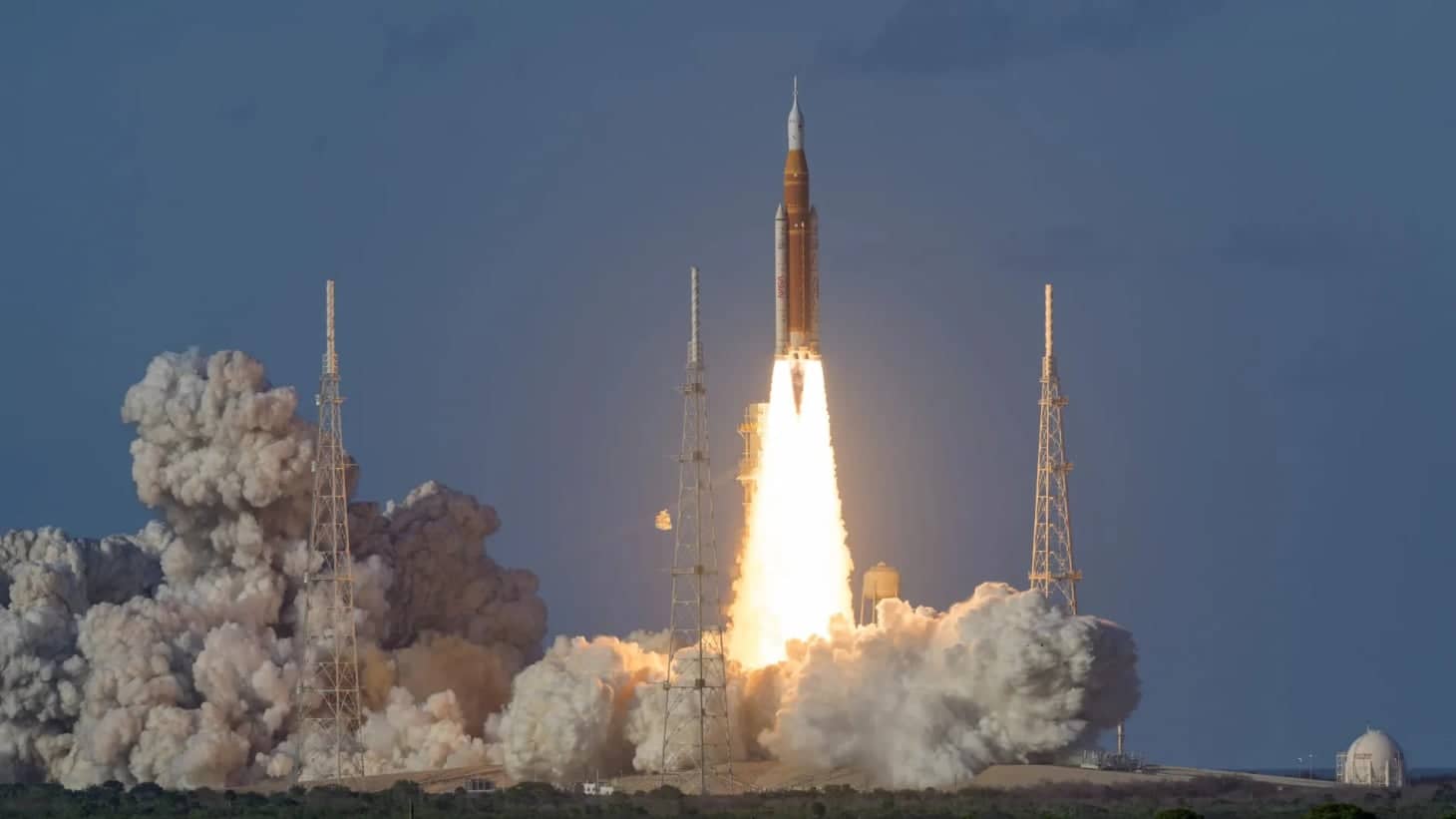
Twenty-five hours into the Artemis 2 mission, Orion's crew executed a six-minute engine burn that pitched them onto a lunar free-return trajectory—the first time human beings have departed Earth orbit since Apollo 17 in 1972. It was a quiet moment, in spacecraft terms: a brief flare of thrust, a gentle arc toward deep space, and then the Moon waiting three days away. But what that burn represented was anything but quiet.
This was the maneuver that proved we're going back.
Orbital mechanics are ruthlessly honest. The six-minute burn using Orion's orbital maneuvering system raised the spacecraft's path high enough that, even if every subsequent engine firing failed, the crew—Commander Gregory, Pilot Victor, and Mission Specialists Kristina and Jeremy—would swing past the far side of the Moon and arc back toward Earth on physics alone. It's called a free-return trajectory, and it's the kind of insurance policy you write when lives depend on Newton's laws.
The Moon is three days and twenty-three hours away. After that, the long return begins.
Mission control made a point of highlighting something unexpected aboard Orion: an iPhone 17 Pro Max. It wasn't a publicity stunt. It was a test case—proof that modern consumer electronics, built for pockets and purses, can survive the radiation environment and thermal extremes of deep space. If we're serious about making lunar exploration routine, we need to know whether off-the-shelf technology can replace expensive custom hardware for tasks like documentation, communication, and sensor monitoring.
The phone worked. That matters more than it sounds.
Not everything went perfectly. A brief water-supply issue with the onboard toilet system required the crew to tap into reserve stores. The pump had simply run low on water during initial setup; after refilling from reserves, the system operated normally. No lasting malfunction was reported. But it's worth noting: even on humanity's return to deep space, plumbing still matters. Engineering isn't just about propulsion and shielding—it's about keeping four people alive and functional across a quarter-million-mile commute.
Over the next seventy-two hours, Orion will execute short-duration correction burns to fine-tune its approach to the Moon. The far-side flyby will be recorded, monitored, and broadcast live via NASA's YouTube stream and mission control feeds from Houston. Telemetry graphics will track every metric through the AROW system—altitude, velocity, trajectory error, thermal margins.
Then comes the hard part: reentry. Returning from the Moon means hitting Earth's atmosphere at nearly 25,000 miles per hour. Orion's heat shield will face temperatures approaching 5,000 degrees Fahrenheit. If it works, the crew splashes down safely. If it doesn't, we'll have learned something we desperately need to know before Artemis 3 attempts a landing.
Exploration is humanity's longest-running experiment. And right now, four people are on the leading edge of it, writing the next chapter with every orbit.