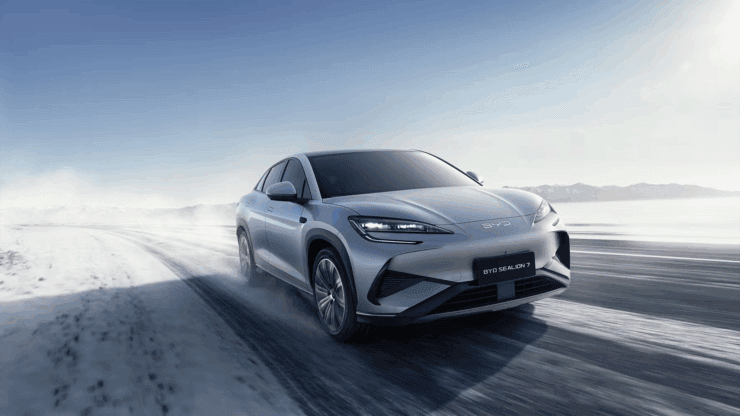

BYD's European warranty announcement matters for American EV shoppers—not because you can buy these vehicles today, but because it signals where the industry is heading. Chinese automaker BYD just extended its battery warranty to 8 years/155,000 miles (250,000 km) across its European lineup, offering 60% more coverage than Tesla, Volkswagen, or Hyundai. While BYD isn't sold through U.S. retail dealerships as of December 2025, understanding what this warranty reveals about Lithium Iron Phosphate (LFP) battery technology helps you evaluate the EVs you can buy today—and anticipate what's coming tomorrow.
This analysis examines BYD's warranty strategy across the Seal, Atto 3, and Sealion 7 European models, focusing on what their LFP chemistry performance means for American EV buyers considering similar technology already available in Tesla Model 3 Standard Range, Ford Mustang Mach-E Select, and other U.S.-market LFP-equipped vehicles.
Why a European Warranty Announcement Matters in Connecticut
When a major automaker warranties a battery for 155,000 miles, they're making a statistical bet on chemistry, not marketing. BYD's confidence in Lithium Iron Phosphate cells signals that this "budget chemistry" might actually outlast the nickel-manganese-cobalt (NMC) packs in most premium EVs.
That matters because LFP is already in U.S. driveways. Tesla switched the Model 3 Standard Range to LFP in 2021. Ford offers LFP in the Mustang Mach-E Select. Rivian is transitioning to LFP for standard-range models. BYD's warranty sets a benchmark these manufacturers will face pressure to match.
The key technical claim: 3,000 charge cycles while retaining reasonable capacity. Industry standard NMC cells deliver 1,500–2,000 cycles before hitting 80% state-of-health. If BYD's numbers hold—and early data from Chinese taxi fleets suggest they do—LFP could redefine the used EV market.
Here's the math: A 250-mile EV charged 3,000 times delivers 750,000 miles of theoretical lifetime range. Even accounting for degradation, cold-weather losses, and partial charging cycles, that's 500,000+ miles of usable service life. That's Toyota Camry territory in an electric package.
The Chemistry That Changes the Warranty Calculation
Winter 2024, Iowa I-80 rest stop, 8°F. A Tesla Model 3 Standard Range (LFP pack) and a Ford Mustang Mach-E Extended Range (NMC pack) sit at adjacent Electrify America stalls. Both preconditioned, both running 350 kW chargers. The Tesla hits 170 kW peak, holds 140 kW to 50%, finishes 10–80% in 22 minutes. The Mach-E peaks at 150 kW, drops to 90 kW by 40%, takes 29 minutes.
LFP's thermal stability advantage shows up exactly where warranties get stress-tested: extreme temperatures.
Chemistry Comparison (Based on Current Research and Industry Data):
- Cycle Life: LFP averages 3,000+ cycles vs. 1,500–2,000 for NMC
- Thermal Runaway Threshold: LFP ignites above 500°F; NMC around 390°F
- Calendar Aging: LFP loses ~2% capacity per year parked; NMC ~3–4%
- Cost per kWh (2025): LFP $85/kWh; NMC $110/kWh (Financial calculations and cost analyses presented are illustrative examples only and do not constitute financial advice. Actual costs, savings, and residual values will vary based on individual circumstances, market conditions, usage patterns, and other factors. Consult qualified financial advisors for personalized guidance.) (BloombergNEF data)
- Energy Density Trade-off: LFP packs weigh 15–20% more for equivalent range
Translation: Automakers can afford longer LFP warranties because replacement cost risk is lower and cycle life data is stronger. Early fleet reports from Chinese BYD Tang taxis exceeding 186,000 miles show 88–91% state-of-health, though sample sizes remain limited.
The Warranty Gap That Matters Today
Current U.S. EV warranties tell you what manufacturers genuinely trust:
- Tesla Model 3 Standard Range (LFP): 8 years/100,000 miles, 70% capacity retention guarantee
- Ford Mustang Mach-E Select (LFP): 8 years/100,000 miles, 70% capacity retention
- Hyundai Ioniq 5/Kia EV6 (NMC): 10 years/100,000 miles, no specific retention percentage published
- Rivian R1T/R1S (NMC transitioning to LFP): 8 years/175,000 miles, 70% capacity retention
- Lucid Air (NMC): 10 years/150,000 miles, 70% capacity retention
BYD's 155,000-mile European warranty sits 55% above the current U.S. market standard. That gap creates two questions American buyers should ask their dealers today:
1. Will Tesla and Ford extend their LFP warranties to match BYD's benchmark? If the chemistry supports 3,000 cycles, why warranty only 100,000 miles? Competitive pressure from Chinese manufacturers entering European markets could force U.S. warranty upgrades within 18 months.
2. Does your current EV warranty specify a minimum capacity retention percentage? BYD's European warranty language references "reasonable capacity" but doesn't publish a hard floor (70%, 75%, 65%). That ambiguity matters when calculating residual value. A Tesla Model 3 with a 70% guarantee provides clearer resale risk modeling than a warranty with undefined capacity retention.
What This Means for Your Next EV Purchase Decision
If you're considering an LFP-equipped EV available in the U.S. today (Tesla Model 3 Standard Range, Ford Mustang Mach-E Select), BYD's warranty announcement validates the long-term durability case. Here's how to factor this into your decision:
For high-mileage drivers (25,000+ miles/year): Current 100,000-mile warranties run out in four years. BYD's 155,000-mile benchmark suggests LFP can support longer coverage. Consider negotiating extended warranty options or prioritizing manufacturers with higher mileage limits (Rivian's 175,000-mile warranty, for example).
For moderate-mileage drivers (12,000–18,000 miles/year): Standard warranties cover 6–8 years of typical use. The warranty isn't your primary decision factor. Focus on charging infrastructure access, winter range in your climate zone, and total cost of ownership.
For used EV buyers: BYD's warranty strategy signals that LFP battery degradation risk is lower than previously assumed. This could stabilize residual values for LFP-equipped vehicles in the used market. A 2021 Tesla Model 3 Standard Range with 60,000 miles still has 40,000 miles of warranty coverage—and likely 400,000+ miles of actual battery life remaining.
The Infrastructure Question BYD's Warranty Can't Answer
A 155,000-mile warranty assumes a charging network that can support high-mileage drivers. In California, that infrastructure exists: 1,200+ DC fast-chargers over 50 kW, average station spacing under 40 miles on I-5, I-80, and US-101. In Montana, Wyoming, and the Dakotas, Electrify America operates 18 total stations across four states.
An LFP-equipped EV with 250 miles of EPA range drops to 175–200 miles at 10°F. Winter driving in the Great Plains or Intermountain West requires charging stops every 150 miles. If the nearest DC fast-charger is 90 miles away and a winter storm knocks out half the stations in a region, battery warranty length becomes irrelevant.
Regional Infrastructure Reality Check (December 2025):
- California, Oregon, Washington, Northeast Corridor: Dense DC fast-charging networks make high-mileage EV operation practical year-round
- Texas, Arizona, Colorado, Nevada: Major corridors well-covered; secondary routes require careful planning
- Great Plains, Northern Tier, Rural Intermountain West: Infrastructure gaps make long-distance EV travel challenging in winter; wait 2–3 years for network buildout
Three Scenarios Where Extended Warranties Change the Math
Scenario 1: Urban ride-share/delivery driver, 50,000 miles/year
Operating in San Francisco, Seattle, or New York with dense DC fast-charging access. An extended warranty covering 155,000 miles delivers three years of business operation without battery replacement risk. Current 100,000-mile warranties force replacement planning at the two-year mark. This directly impacts fleet acquisition decisions.
Scenario 2: Suburban family, two vehicles, 22,000 miles/year on primary vehicle
Commuting 60 miles daily in Connecticut or suburban Chicago with home Level 2 charging. Standard 100,000-mile warranty covers 4.5 years. Extended 155,000-mile coverage stretches to seven years, reducing mid-ownership battery anxiety and improving resale value. The longer coverage could justify choosing an LFP model over a longer-range NMC vehicle.
Scenario 3: Rural/exurban driver, 18,000 miles/year, limited DC fast-charging access
Operating in Montana, Wyoming, or rural Texas. Warranty length is irrelevant if charging infrastructure doesn't support your routes. Battery durability doesn't matter when the nearest working charger is 90 miles away during a winter storm. These markets need infrastructure investment before extended warranties provide practical value.
What to Watch: Competitive Warranty Response Timeline
BYD's European announcement creates competitive pressure. Here's the likely timeline for U.S. market response:
Q1–Q2 2026: Tesla and Ford evaluate extending Model 3/Mach-E LFP warranties from 100,000 to 120,000–150,000 miles. Financial modeling depends on actual degradation data from their 2021–2023 LFP fleet vehicles now crossing 60,000–100,000 miles.
Q3–Q4 2026: First U.S. manufacturer announces extended LFP warranty as competitive differentiator. Likely candidate: Manufacturer with strong fleet sales (commercial buyers prioritize long warranties) or brand needing market share boost.
2027: Industry standardization around 120,000–150,000 mile LFP warranties for base/standard range models. Premium NMC warranties likely remain at 100,000–120,000 miles due to higher replacement costs.
If BYD enters the U.S. market directly (requiring resolution of trade policy uncertainties), their 155,000-mile warranty becomes immediately competitive and forces faster industry response.
The Real Question: Does Battery Warranty Length Actually Matter?
For 80% of EV buyers, the answer is no—as long as the warranty exceeds your ownership period. Average U.S. vehicle ownership duration is 6.5 years. At 13,500 miles annually (U.S. average), that's 87,750 miles. Current 100,000-mile warranties provide adequate coverage.
Extended warranties matter in three specific scenarios:
1. High-mileage drivers exceeding 20,000 miles/year: You hit 100,000 miles in five years. Extended coverage directly reduces financial risk.
2. Used EV buyers purchasing vehicles with 40,000–60,000 miles: Remaining warranty coverage affects resale value and purchase risk calculation.
3. Commercial fleet operators: Extended warranties reduce total cost of ownership and improve financial modeling certainty.
For everyone else, warranty length is a signal of manufacturer confidence in battery chemistry—which does matter for long-term resale value even if you never use the full coverage.
The Bottom Line: What BYD's Warranty Tells You About EVs You Can Buy Today
BYD's 155,000-mile European warranty isn't immediately actionable for American buyers, but it validates three critical points about LFP battery technology already available in the U.S. market:
1. LFP chemistry supports significantly longer warranty coverage than current U.S. manufacturers offer. Tesla Model 3 Standard Range and Ford Mustang Mach-E Select buyers are likely getting 500,000+ miles of actual battery life covered by 100,000-mile warranties. That's conservative underwriting by the manufacturers—and opportunity for competitive warranty extension.
2. Used LFP-equipped EVs represent lower battery degradation risk than previously assumed. A 2022 Tesla Model 3 Standard Range with 50,000 miles has 50,000 miles of remaining warranty—and likely 400,000+ miles of actual battery life. This should strengthen residual values over the next 2–3 years as more durability data becomes public.
3. Extended warranties only matter if charging infrastructure supports your driving patterns. In California, Washington, Oregon, and the Northeast Corridor, high-mileage EV operation is practical today. In the Great Plains and rural Intermountain West, infrastructure gaps make warranty length irrelevant for long-distance driving.
If you're shopping for an EV today, ask your dealer one question: "Will you match or beat BYD's 155,000-mile battery warranty when it becomes the industry standard?" Their answer tells you how confident they are in the chemistry under your floor.
The warranty isn't just a number. It's a statistical bet on battery survival. And right now, LFP chemistry is winning that bet.