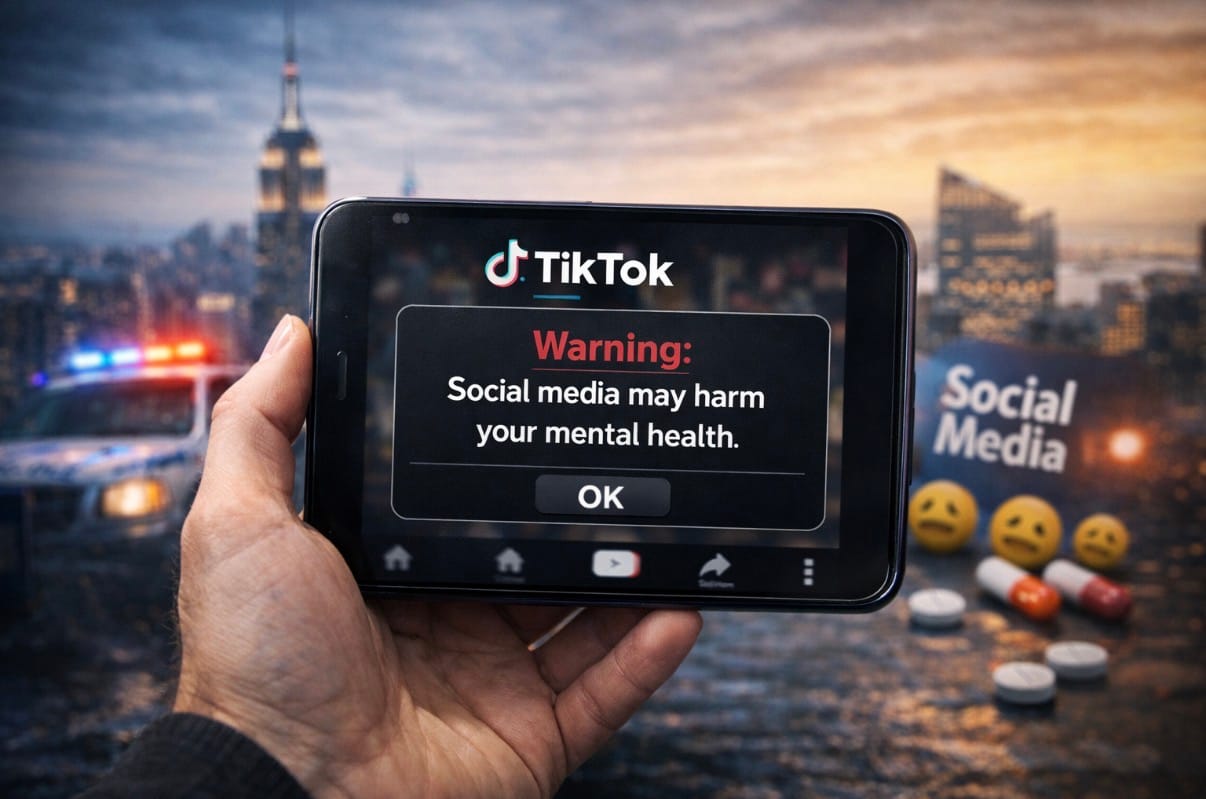

New York Governor Kathy Hochul signed the Social Media Mental Health Warning Law (A5346/S4505) on December 26, 2025, mandating non-skippable warnings on platforms with infinite-feed designs. State authorities have compared these labels to health risk warnings on tobacco products. The law positions New York alongside Minnesota, California, and Colorado in requiring mental health disclosures on social apps, though Minnesota enacted the first such statute earlier in 2025, effective July 1, 2026.
TikTok, Instagram, and any app that uses autoplay videos, personalization algorithms, or endless scrolling must show the label. The rule applies to all users, regardless of age, and cannot be turned off in settings. Companies gain no exemption by adding age gates or parental controls.
Governor Hochul noted that about half of teenagers say social media makes them feel worse about their bodies, and teenagers who use social media most actively are nearly twice as likely to rate their overall mental health as poor or very poor. A meta-analysis of 12 longitudinal studies (n = 45,000 teens) found that daily use exceeding three hours increased depressive symptom scores by 0.42 SD (p < 0.01). Current guidelines from the American Academy of Pediatrics recommend limiting recreational screen time to under two hours per day for adolescents.
Early-phase trials (Phase II, n = 1,200) suggest that variable-reward features such as infinite scroll elevate dopamine spikes, prolonging attention bursts and reducing sleep quality by an average of 45 minutes per night. Limitations include reliance on self-reported usage and short follow-up periods. Researchers have not yet published Phase III data showing long-term effects across diverse populations.
When a user opens the app, a banner appears stating, "Extended use may affect mood, sleep, and concentration." After 30 minutes of continuous scrolling, a pop-up prompts a brief pause and offers a link to mental health resources. Users cannot dismiss the warning until they acknowledge it with a tap or click.
Clinicians can access a downloadable guide that lists warning-triggered behaviors, such as nighttime usage, mood swings, or social withdrawal. The guide advises a brief self-assessment using the PHQ-9 or GAD-7 questionnaires. Pediatricians report that structured digital logs help identify patterns parents miss.
The New York Attorney General may levy fines up to $5,000 per violation. Companies must submit quarterly compliance reports. Non-compliant platforms face escalating penalties and potential injunctions.
Compliance audits will begin 180 days after the state publishes detailed rules, estimated for mid-2026. Companies can request a 30-day remediation period before fines are assessed. The timeline mirrors Colorado's approach, though that state's law faces ongoing federal challenges on First Amendment grounds.
Watch for sleep disruption of more than 30 minutes, persistent low mood, or reduced school engagement as signals of harmful use. If any of these appear, schedule a visit with a pediatrician or mental health professional. Track screen time through device settings to provide concrete data during appointments.
Parents can set daily usage limits on devices, encourage offline activities, and discuss the warning messages openly to reduce stigma. The law aims to empower families with actionable information rather than dictate behavior. Families who frame warnings as tools, not blame, report fewer conflicts over phone use.
California, Minnesota, and Colorado have enacted similar statutes, with varying timelines and legal obstacles. California's AB 56 requires warnings at initial daily access, after three hours of use, and hourly thereafter. Minnesota's law took effect July 1, 2026. Colorado's statute faces industry litigation, though the U.S. Supreme Court in August 2025 allowed Mississippi's parental consent law to remain active during appeals, signaling courts may permit some state regulation.
Utah, Arkansas, Texas, Florida, Virginia, Mississippi, and South Carolina have enacted or proposed related measures, including age verification and parental consent requirements. South Carolina enacted an Age-Appropriate Design Code Act on February 5, 2026, but industry groups challenged it within days. Legal experts expect cases to consolidate and reach appellate courts by late 2026.
If you notice warning labels appearing more frequently, log the instances and share them with your healthcare provider. Evidence-based conversations about digital habits produce better outcomes than device bans. The goal is informed use, not isolation.