
• My Feed
  • Home
  • What's Important
  • Media & Entertainment
Search

Stay Curious. Stay Wanture.

© 2026 Wanture. All rights reserved.

  • Terms of Use
  • Privacy Policy
Health/Biotech
Klotho Clock Assays Target Biological Age in Neuro Trials

11 March 2026

—

News

Emily Rivera

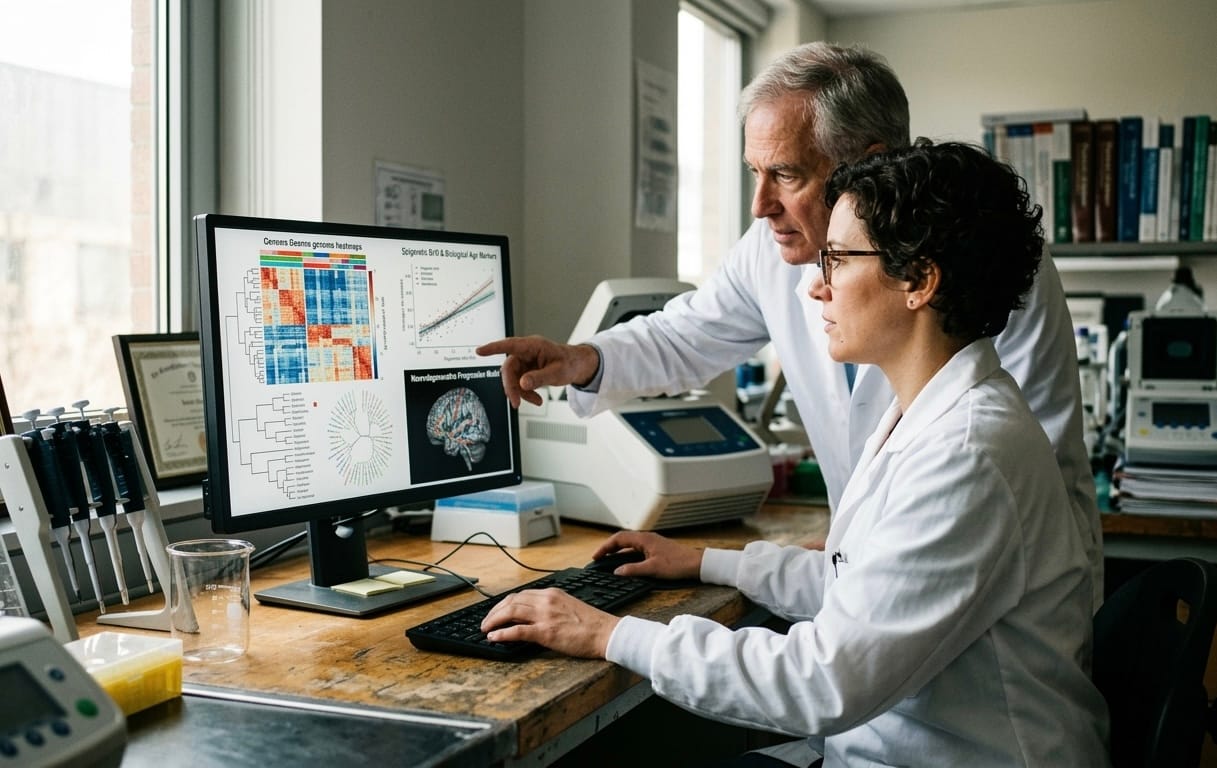
Klotho Neurosciences launched two genomics-based assays on March 10, 2026, designed to measure biological age—how fast your cells are aging—in patients enrolling in neurodegenerative disease trials. The company's "Klotho Clock" combines DNA analysis with messenger RNA profiling across nine genes linked to longevity, aiming to balance clinical trial groups by cellular health rather than birthdate alone.

Why does biological age matter in trials? Because mismatches between trial groups can hide whether a drug actually works. Two 65-year-olds may have the same number of birthdays, but their cells may be aging at very different rates. In Alzheimer's and ALS studies, participants of identical calendar age may have sharply different rates of cellular decline. When placebo groups happen to be biologically younger—healthier at the cellular level—even effective therapies may fail to show a measurable benefit.

Klotho's tests seek to prevent that imbalance by measuring epigenetic markers—chemical tags on DNA that accumulate as cells age and can silence important genes.

How the stratification works: Higher levels of these chemical tags at the KLOTHO gene correlate with accelerated aging, a relationship confirmed across multiple studies. By assigning patients with similar tagging patterns to treatment and placebo groups, researchers reduce hidden variation in trial populations. That sharpens the statistical power and can lower the number of volunteers needed to detect real drug effects.

In neurodegenerative trials, where disease progression is slow and dropout rates high, that efficiency could cut costs and shorten timelines by months.

The first assay analyzes cell-free DNA from a blood sample to measure chemical tagging at the KLOTHO gene; the second adds counts of active gene copies and uses artificial intelligence to analyze genetic variants across the nine-gene panel. Dr. Bret Barnes, former Illumina genomics lead, said the company designed its tests to account for natural human genetic variation, aiming to improve accuracy and reduce sequencing costs.

The science is promising but unproven: No peer-reviewed validation of the proprietary Klotho Clock exists as of March 2026. A registered trial (NCT07216781) lists epigenetic age as a baseline outcome measure, but performance metrics—such as sample size, error margins, reproducibility, and cost per test—remain undisclosed. The assay's classification as emerging science means independent confirmation is needed before it can guide high-stakes enrollment decisions.

U.S. regulators are still developing guidelines for these tools. The FDA has cleared DNA methylation tests for cancer diagnosis but has not yet approved aging clocks for therapeutic trial stratification. NIH aging research programs, including the Geroscience Initiative, are actively investigating whether epigenetic markers can predict disease trajectory, signaling federal interest but no formal guidance yet.

Klotho plans to use the tests in its own gene-therapy trials and offer them to outside trial sponsors seeking sharper patient selection. Independent validation, regulatory clearance, and transparent data-privacy safeguards will determine whether the clock becomes a standard research tool. The NCT07216781 trial will report baseline epigenetic age data in Q3 2026, offering the first public window into how well the assay performs against calendar age and clinical progression measures—a key test of whether biological age clocks can deliver on their promise.

Topic

AI AGI Development

Elon Musk's 2027 Warning: When Algorithms Replace Human Choice

Adrian Vega · 28 November 2025
Elon Musk's 2027 Warning: When Algorithms Replace Human Choice

AI's scaling era is ending. What comes next?

Adrian Vega · 25 November 2025
AI's scaling era is ending. What comes next?

Claude AI can now describe its own thoughts

Emily Rivera · 2 November 2025
Claude AI can now describe its own thoughts

America's AI lead is vanishing faster than expected

Emily Rivera · 28 October 2025
America's AI lead is vanishing faster than expected

Sam Altman says AI will eliminate jobs that were never real work

Samuel Carver · 27 October 2025
Sam Altman says AI will eliminate jobs that were never real work
Mobile Bottom Test Banner

What is this about?

  • News/
  • Emily Rivera/
  • Health/
  • Biotech/
  • dementia prevention/
  • inflammation biomarkers/
  • epigenetic aging/
  • clinical trial stratification

Feed

    Xbox’s Next Console Chooses Off‑Shelf AMD RDNA 2 GPU

    Xbox’s Next Console Chooses Off‑Shelf AMD RDNA 2 GPU

    AMD GPU brings FidelityFX Super Resolution, echoing PlayStation 5’s RDNA 2

    Priya Desaiabout 9 hours ago
    Foldable iPhone Keeps 4.4 mm Body, Camera Control Button

    Foldable iPhone Keeps 4.4 mm Body, Camera Control Button

    Launching this year, the foldable iPhone is slimmer than the iPhone Air and is eSIM‑only.

    Carter Brooksabout 9 hours ago
    2024 C400 4Matic EV Packs 483 hp, 420‑mile Range

    2024 C400 4Matic EV Packs 483 hp, 420‑mile Range

    U.S. launch offers 3.9‑second 0‑62 mph sprint, $55,000 MSRP and $7,500 federal EV credit

    Ethan Whitakerabout 9 hours ago
    OnePlus drops Ace 6 Ultra gaming phone on April 28

    OnePlus drops Ace 6 Ultra gaming phone on April 28

    Clip‑on case adds buttons, fan, and pass‑through charging for console‑level play

    Carter Brooks1 day ago
    iPhone Express Transit Flaw Lets Thieves Steal $10,000

    iPhone Express Transit Flaw Lets Thieves Steal $10,000

    Locked iPhone Visa cards can be tapped for fraud; Apple and Visa have no fix

    Carter Brooks1 day ago
    China's Dola‑Seed‑2.0 Cuts Gap to 2.7% vs. Claude Opus 4.6

    China's Dola‑Seed‑2.0 Cuts Gap to 2.7% vs. Claude Opus 4.6

    Rachel Stein1 day ago
    Apple delays refreshed Mac Studio launch to October

    Apple delays refreshed Mac Studio launch to October

    Supply shortages push MacBook Pro to late‑2026/early‑2027, Q4 earnings at risk

    Carter Brooks1 day ago
    Apple delays M6‑Pro/M6‑Max OLED MacBook Pro to 2027

    Apple delays M6‑Pro/M6‑Max OLED MacBook Pro to 2027

    Shortages delay M6‑Pro and M6‑Max to early 2027, pushing back the new Mac

    Carter Brooks1 day ago
    Apple unveils glassy Siri on Dynamic Island with iOS 27

    Apple unveils glassy Siri on Dynamic Island with iOS 27

    WWDC 2026: Siri expands Island on iPhone 14 Pro and up, arriving with iOS 27

    Carter Brooks1 day ago
    Honor Robot Shatters Half‑Marathon Record in 50:26

    Honor Robot Shatters Half‑Marathon Record in 50:26

    Robot Beats Human Benchmark by 7 Minutes, With 40% Fully Autonomous

    Marcus Dillard2 days ago
    Loading...
Health/Biotech

Klotho Clock Assays Target Biological Age in Neuro Trials

11 March 2026

—

News

Emily Rivera

Klotho Neurosciences launched two genomics-based assays on March 10, 2026, designed to measure biological age—how fast your cells are aging—in patients enrolling in neurodegenerative disease trials. The company's "Klotho Clock" combines DNA analysis with messenger RNA profiling across nine genes linked to longevity, aiming to balance clinical trial groups by cellular health rather than birthdate alone.

Why does biological age matter in trials? Because mismatches between trial groups can hide whether a drug actually works. Two 65-year-olds may have the same number of birthdays, but their cells may be aging at very different rates. In Alzheimer's and ALS studies, participants of identical calendar age may have sharply different rates of cellular decline. When placebo groups happen to be biologically younger—healthier at the cellular level—even effective therapies may fail to show a measurable benefit.

Klotho's tests seek to prevent that imbalance by measuring epigenetic markers—chemical tags on DNA that accumulate as cells age and can silence important genes.

How the stratification works: Higher levels of these chemical tags at the KLOTHO gene correlate with accelerated aging, a relationship confirmed across multiple studies. By assigning patients with similar tagging patterns to treatment and placebo groups, researchers reduce hidden variation in trial populations. That sharpens the statistical power and can lower the number of volunteers needed to detect real drug effects.

In neurodegenerative trials, where disease progression is slow and dropout rates high, that efficiency could cut costs and shorten timelines by months.

The first assay analyzes cell-free DNA from a blood sample to measure chemical tagging at the KLOTHO gene; the second adds counts of active gene copies and uses artificial intelligence to analyze genetic variants across the nine-gene panel. Dr. Bret Barnes, former Illumina genomics lead, said the company designed its tests to account for natural human genetic variation, aiming to improve accuracy and reduce sequencing costs.

The science is promising but unproven: No peer-reviewed validation of the proprietary Klotho Clock exists as of March 2026. A registered trial (NCT07216781) lists epigenetic age as a baseline outcome measure, but performance metrics—such as sample size, error margins, reproducibility, and cost per test—remain undisclosed. The assay's classification as emerging science means independent confirmation is needed before it can guide high-stakes enrollment decisions.

U.S. regulators are still developing guidelines for these tools. The FDA has cleared DNA methylation tests for cancer diagnosis but has not yet approved aging clocks for therapeutic trial stratification. NIH aging research programs, including the Geroscience Initiative, are actively investigating whether epigenetic markers can predict disease trajectory, signaling federal interest but no formal guidance yet.

Klotho plans to use the tests in its own gene-therapy trials and offer them to outside trial sponsors seeking sharper patient selection. Independent validation, regulatory clearance, and transparent data-privacy safeguards will determine whether the clock becomes a standard research tool. The NCT07216781 trial will report baseline epigenetic age data in Q3 2026, offering the first public window into how well the assay performs against calendar age and clinical progression measures—a key test of whether biological age clocks can deliver on their promise.
Topic

AI AGI Development

Elon Musk's 2027 Warning: When Algorithms Replace Human Choice

Adrian Vega · 28 November 2025
Elon Musk's 2027 Warning: When Algorithms Replace Human Choice

AI's scaling era is ending. What comes next?

Adrian Vega · 25 November 2025
AI's scaling era is ending. What comes next?

Claude AI can now describe its own thoughts

Emily Rivera · 2 November 2025
Claude AI can now describe its own thoughts

America's AI lead is vanishing faster than expected

Emily Rivera · 28 October 2025
America's AI lead is vanishing faster than expected

Sam Altman says AI will eliminate jobs that were never real work

Samuel Carver · 27 October 2025
Sam Altman says AI will eliminate jobs that were never real work

What is this about?

  • News/
  • Emily Rivera/
  • Health/
  • Biotech/
  • dementia prevention/
  • inflammation biomarkers/
  • epigenetic aging/
  • clinical trial stratification

Feed

    Xbox’s Next Console Chooses Off‑Shelf AMD RDNA 2 GPU

    Xbox’s Next Console Chooses Off‑Shelf AMD RDNA 2 GPU

    AMD GPU brings FidelityFX Super Resolution, echoing PlayStation 5’s RDNA 2

    Priya Desaiabout 9 hours ago
    Foldable iPhone Keeps 4.4 mm Body, Camera Control Button

    Foldable iPhone Keeps 4.4 mm Body, Camera Control Button

    Launching this year, the foldable iPhone is slimmer than the iPhone Air and is eSIM‑only.

    Carter Brooksabout 9 hours ago
    2024 C400 4Matic EV Packs 483 hp, 420‑mile Range

    2024 C400 4Matic EV Packs 483 hp, 420‑mile Range

    U.S. launch offers 3.9‑second 0‑62 mph sprint, $55,000 MSRP and $7,500 federal EV credit

    Ethan Whitakerabout 9 hours ago
    OnePlus drops Ace 6 Ultra gaming phone on April 28

    OnePlus drops Ace 6 Ultra gaming phone on April 28

    Clip‑on case adds buttons, fan, and pass‑through charging for console‑level play

    Carter Brooks1 day ago
    iPhone Express Transit Flaw Lets Thieves Steal $10,000

    iPhone Express Transit Flaw Lets Thieves Steal $10,000

    Locked iPhone Visa cards can be tapped for fraud; Apple and Visa have no fix

    Carter Brooks1 day ago
    China's Dola‑Seed‑2.0 Cuts Gap to 2.7% vs. Claude Opus 4.6

    China's Dola‑Seed‑2.0 Cuts Gap to 2.7% vs. Claude Opus 4.6

    Rachel Stein1 day ago
    Apple delays refreshed Mac Studio launch to October

    Apple delays refreshed Mac Studio launch to October

    Supply shortages push MacBook Pro to late‑2026/early‑2027, Q4 earnings at risk

    Carter Brooks1 day ago
    Apple delays M6‑Pro/M6‑Max OLED MacBook Pro to 2027

    Apple delays M6‑Pro/M6‑Max OLED MacBook Pro to 2027

    Shortages delay M6‑Pro and M6‑Max to early 2027, pushing back the new Mac

    Carter Brooks1 day ago
    Apple unveils glassy Siri on Dynamic Island with iOS 27

    Apple unveils glassy Siri on Dynamic Island with iOS 27

    WWDC 2026: Siri expands Island on iPhone 14 Pro and up, arriving with iOS 27

    Carter Brooks1 day ago
    Honor Robot Shatters Half‑Marathon Record in 50:26

    Honor Robot Shatters Half‑Marathon Record in 50:26

    Robot Beats Human Benchmark by 7 Minutes, With 40% Fully Autonomous

    Marcus Dillard2 days ago
    Loading...