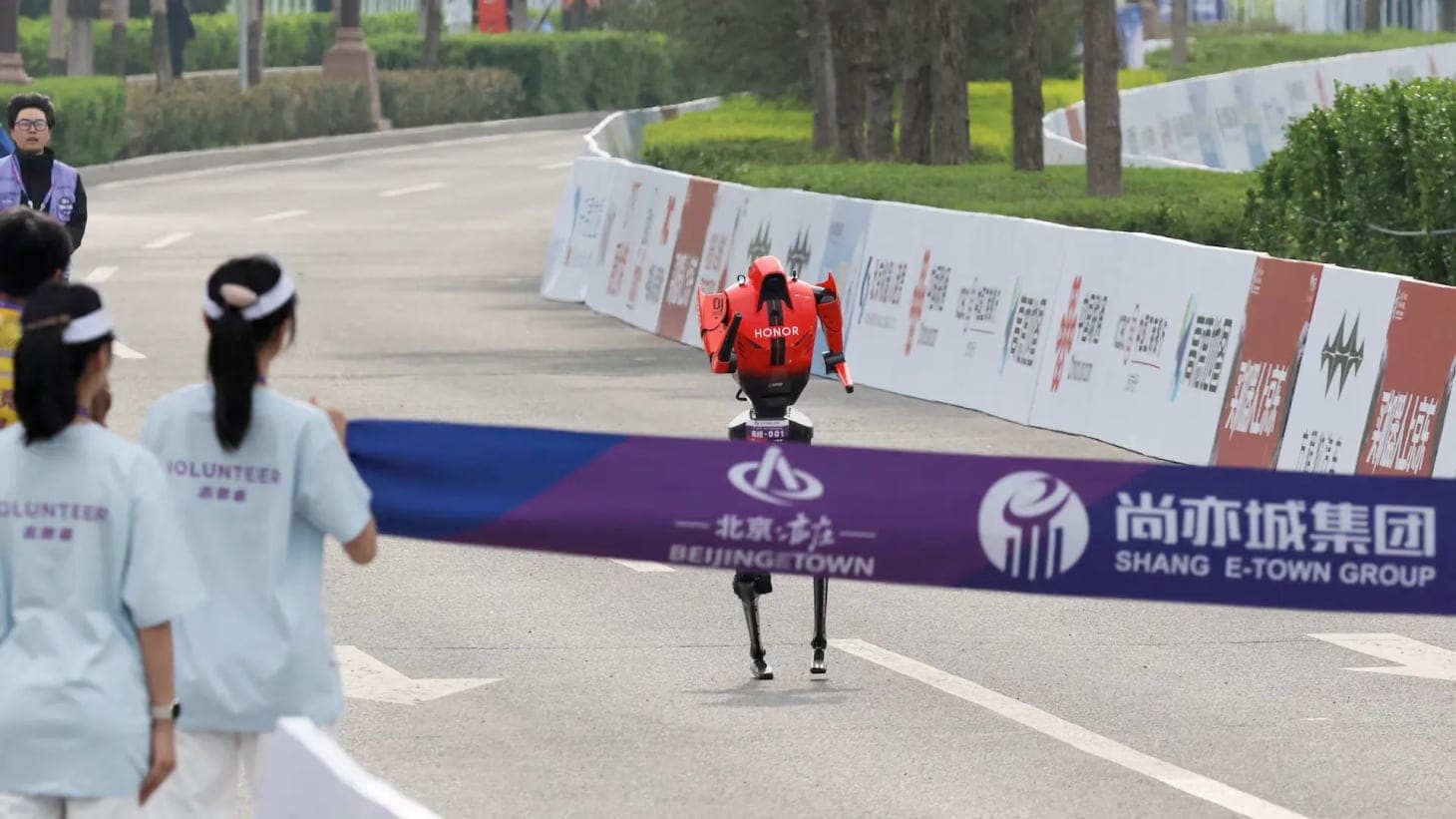

Honor's humanoid robot completed a half marathon in Beijing on April 19 in 50 minutes and 26 seconds, beating the human world record by seven minutes and marking a dramatic leap in AI powered robotics.
Several thousand human runners shared the course with several hundred mechanical competitors. Most robots remained tethered to remote operators, but about 40 percent ran autonomously, sensing pavement, calculating stride, and making real-time corrections without human input.
Why it matters: The winning time shatters Jacob Kiplimo's human benchmark and compresses what many expected to take years of development into months of refining gait algorithms and servo response systems.
Catch up quick: Training footage released days before the race showed prototypes stumbling mid-stride and shedding components on test tracks, underscoring how even breakthrough performances emerge from failure and iteration. Last year's best robot finish took 2 hours and 40 minutes.
Chu stood trackside as the machines passed and told reporters the running posture impressed him most: not flawless, but eerily adaptive. His assessment reflects broader industry conviction that AI adoption will accelerate across sectors, from logistics warehouses to surgical suites, whether society is ready or not.
The big picture: Organizers routed humans and robots along parallel paths to avoid collisions, a pragmatic choice that also served as metaphor. Two types of runners moved in the same direction but not yet sharing the same lane.
The autonomous machines navigated turns and pacing decisions independently, while remote-controlled counterparts responded to operator inputs from nearby control stations. The split reveals the current frontier: full autonomy in dynamic, unpredictable environments remains the engineering challenge, even as partial autonomy becomes routine.
What's next: Race organizers plan to expand autonomous robot participation in future events, refining safety protocols and exploring how mixed competitions might evolve. Observers will track not just performance gains but regulatory responses and whether frameworks governing AI competition keep pace with the technology itself.
The Beijing half marathon offers a preview: a world where machines don't just assist human effort but compete against it, where the finish line becomes a measure of how far artificial endurance has come, and how quickly the gap is closing.