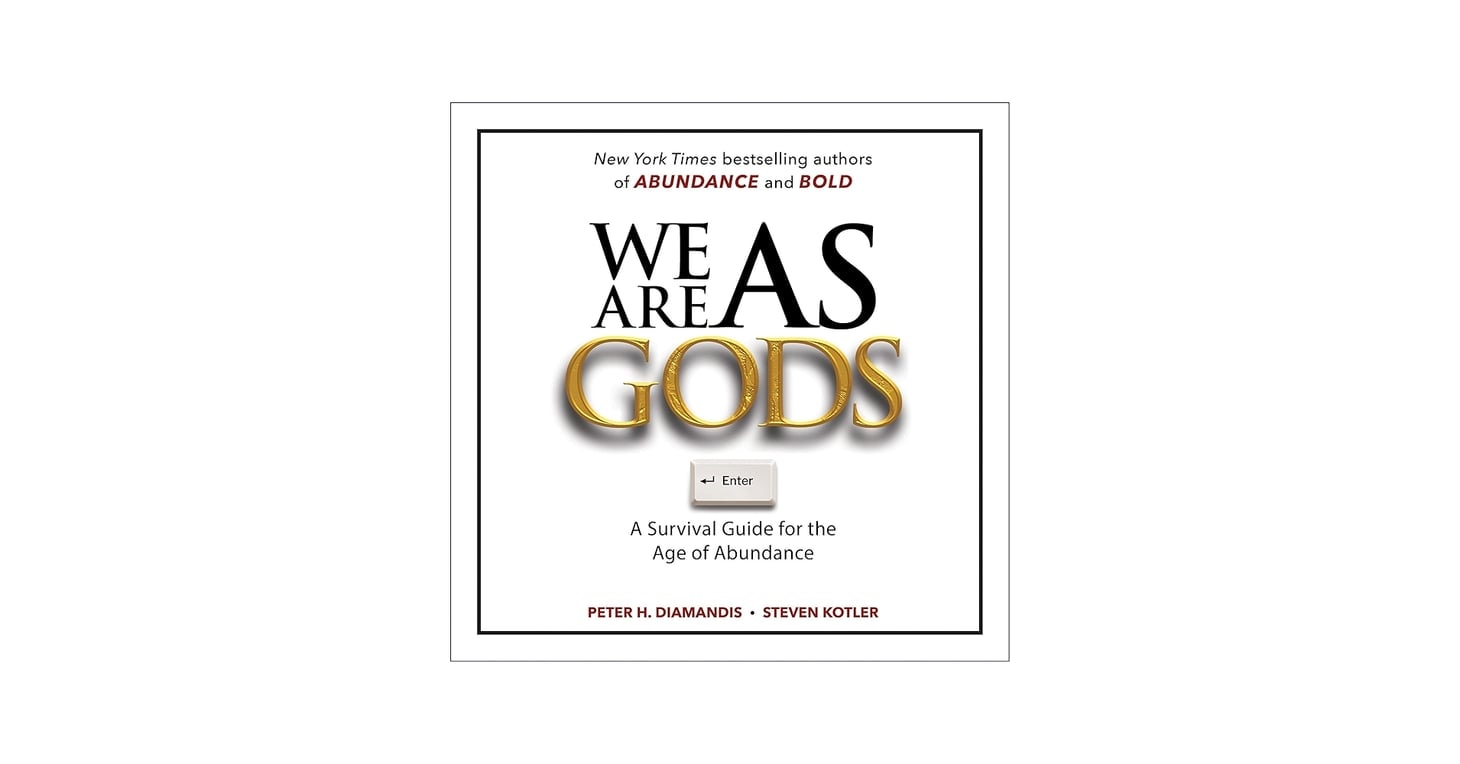


Exactly one month ago today, on April 14, 2026, Peter H. Diamandis and Steven Kotler released We Are as Gods: A Survival Guide for the Age of Abundance through Simon & Schuster, a 320-page examination of exponential technologies that promises both radical plenty and catastrophic risk. The book poses a stark choice: harness tools that could abolish scarcity, or watch them spiral into existential threats. Kirkus Reviews called it "provocative and bracing," framing it as a "self-help manifesto for an AI-shaped future."
The Abundance Thesis: What It Means and How It Works
When Diamandis speaks of "abundance," he means a world where essentials (food, water, energy, healthcare) become radically cheap and universally available. The engine behind this shift is exponential technology: any tool that, once digitized (converted into data that computers can process), improves in price and performance at a predictable, compounding rate. Think Moore's Law, the observation that transistor counts on chips doubled roughly every two years for decades, making computing power cheaper and more capable at an accelerating pace.
Diamandis, founder of the XPRIZE Foundation and a veteran of Silicon Valley moonshots, has watched this pattern repeat. Smartphone penetration in the U.S. reached 91% of adults by 2025. The music industry, which once relied on physical albums and radio, shifted to streaming. Streaming accounted for the vast majority of U.S. recorded music revenue by recent years, collapsing distribution costs overnight. These aren't isolated events. They're the signature of digitization at work.
The Six Ds Framework: From Digitization to Democratization
Diamandis and Kotler structure their argument around the "Six Ds of Exponentials", a roadmap they claim every digitized technology follows. Each stage flows into the next like a snowball gaining momentum downhill.
Digitization
Digitization is the conversion of a product, service, or process into digital form, into bits. Once something becomes information, it can ride exponential curves in computing and storage. Photography moved from film to pixels. Medical records shifted from paper to electronic health systems. Nearly 96% of U.S. non-federal acute-care hospitals had adopted certified EHR systems by recent counts.
Deception
The deceptive phase is the misleading early stretch. Exponential growth looks slow at first. Each doubling is small in absolute terms. Early digital cameras had laughable megapixel counts. DNA sequencing costs fell modestly for years before plummeting. This is the phase where incumbents dismiss the threat.
Disruption
Then comes disruption. The curve goes vertical. The new technology outperforms legacy systems and reshapes markets. Rideshare apps disrupted taxi medallions. Studies documented sharp drops in medallion values in cities like New York as Uber and Lyft scaled. E-commerce hollowed out brick-and-mortar retail.
Demonetization
Demonetization arrives when the marginal cost of digital goods falls toward zero. Music, maps, and communication that once required payment become free or nearly free. Craigslist devastated newspaper classified ad revenue by offering free listings. VoIP calls demonetized long-distance telephone charges.
Dematerialization
Dematerialization is the disappearance of physical objects. Functions once handled by separate devices consolidate into software. Your smartphone replaced your camera, GPS unit, alarm clock, and music player. Kodak, which dominated film photography, filed for bankruptcy in 2012 as cameras dematerialized into sensors and apps.
Democratization
Finally, democratization: the technology becomes so cheap and ubiquitous that access spreads from elites to billions. Genome sequencing, which cost hundreds of millions during the Human Genome Project in the early 2000s, dropped below $1,500 per genome by 2015. Educational platforms like Coursera and Udemy now reach over 290 million learners globally. Coursera alone reported 205 million registered users as of March 2026.
Concrete Examples: Where the Six Ds Have Already Played Out
The framework isn't abstract theory. Solar photovoltaic module prices fell roughly 88 to 94% between 2009 and 2022, making clean energy economically viable in remote regions that never had grid access. In the U.S., solar installation costs for utility-scale projects dropped to around $1.16 per watt by early 2023.
Synthetic biology now engineers microbes to produce insulin. While academic models estimate manufacturer-level production costs at a few dollars per vial, the gap between cost and U.S. retail price remains a policy problem, not a technical one. Medicare's $35 monthly insulin cap, effective since 2023, demonstrates that regulatory intervention can reshape access curves as sharply as technology.
Consider 3D printing, which dematerializes inventory. Digital files replace warehouses. Parts can be printed on demand anywhere. In manufacturing, this means shorter supply chains and localized production. In medicine, it opens pathways to custom prosthetics and organ models for surgical planning.
The Shadow Side: Risks Embedded in Exponential Growth
Diamandis spends considerable pages on what can go wrong. Climate disruption accelerates as industrial activity scales faster than mitigation technologies deploy. AI algorithms embed bias, erode privacy, and lower barriers to autonomous weapons. Biological engineering that cures genetic diseases also makes engineered pathogens easier to create.
Then there's the infodemic. As sensor networks and synthetic media proliferate, distinguishing truth from noise becomes a survival skill. Diamandis argues we need "truth filters", protocols for assessing validity rooted in first-principles reasoning rather than authority. He points to the Six Ds themselves as one such filter, a lens for evaluating which hyped claims will compound and which will fizzle.
Practical Strategies for Individuals Navigating Disruption
The book shifts from diagnosis to prescription with three concrete recommendations.
First, commit to perpetual learning. Platforms that have scaled education infrastructure (Coursera, Udemy, Khan Academy) aren't peripheral tools. They're the new backbone of skill acquisition. The cost of learning has dematerialized; the constraint is now attention and discipline.
Second, adopt moonshot thinking. Set goals that demand 10x improvements, not 10% tweaks. This forces first-principles problem-solving rather than optimization of existing systems. Diamandis built XPRIZE on this philosophy, running outcome-based competitions that have spurred over $100 million in private investment across space, health, and environmental challenges.
Third, prototype cheaply and iterate fast. Microcontroller kits, cloud compute credits, and open-source biology tools lower experimentation costs to levels where individuals can test ideas that once required institutional backing. The shift from "Can we build this?" to "Should we build this?" marks the terrain where ethical questions become urgent.
What 2026 and Beyond May Hold: Near-Term Scenarios
Diamandis's vision of a "trillion-sensor economy" isn't distant speculation. Continuous wearable diagnostics feeding AI models that flag illness before symptoms emerge. Autonomous drones delivering essentials to any address. Adaptive education modules that adjust in real time to each learner's pace. The technical building blocks exist. The constraints are regulatory, economic, and ethical.
In the U.S., the FAA has moved toward standardized frameworks for commercial drone delivery. Operators like Zipline, Wing, and Amazon have secured limited approvals for package deliveries in select regions. The question isn't whether this scales, but how fast and under what governance structures.
Gene-editing therapies have crossed from lab to clinic. The FDA approved the first CRISPR-based cell therapy, CASGEVY, in December 2023, for sickle cell disease and beta thalassemia. Commercial patient treatments began in 2024. This is no longer theoretical. It's operational medicine.
The Central Tension: Transformative Powers, Human Wisdom
The book's title borrows Stewart Brand's famous line: "We are as gods and might as well get good at it." Diamandis takes the mandate seriously. Humanity now wields civilization-scale powers: to edit genomes, redirect rivers, reshape atmospheres, yet we still operate with human-scale wisdom. This gap between our capabilities and our judgment is the defining challenge of the coming decades.
We Are as Gods presents abundance and catastrophe not as alternatives but as coexisting probabilities. Exponential technologies will lift billions out of material poverty. They will also generate novel failure modes at civilizational scale. Understanding the mechanisms (how digitization cascades into democratization, how incentive prizes unlock private capital, how first-principles reasoning cuts through hype) equips readers not with certainty but with agency.
Takeaways and the Proactive Mindset
The book doesn't promise we'll choose wisely. It promises we'll have to choose. And soon.
For readers, the path forward involves three interlocking postures. Embrace exponential literacy: learn to recognize when a technology has digitized and entered the deceptive phase, so you aren't blindsided by disruption. Cultivate ethical foresight: ask not just "Can we?" but "Should we?" and "Who benefits?" Finally, act as if agency matters, because in a world of accelerating change, the difference between passive observation and informed participation is the difference between being shaped by the future and helping to shape it.
Diamandis and Kotler offer no guarantees. They offer a framework, examples, and a challenge: understand the mechanisms, weigh the risks, and engage. The Age of Abundance is here. What we do with it is up to us.