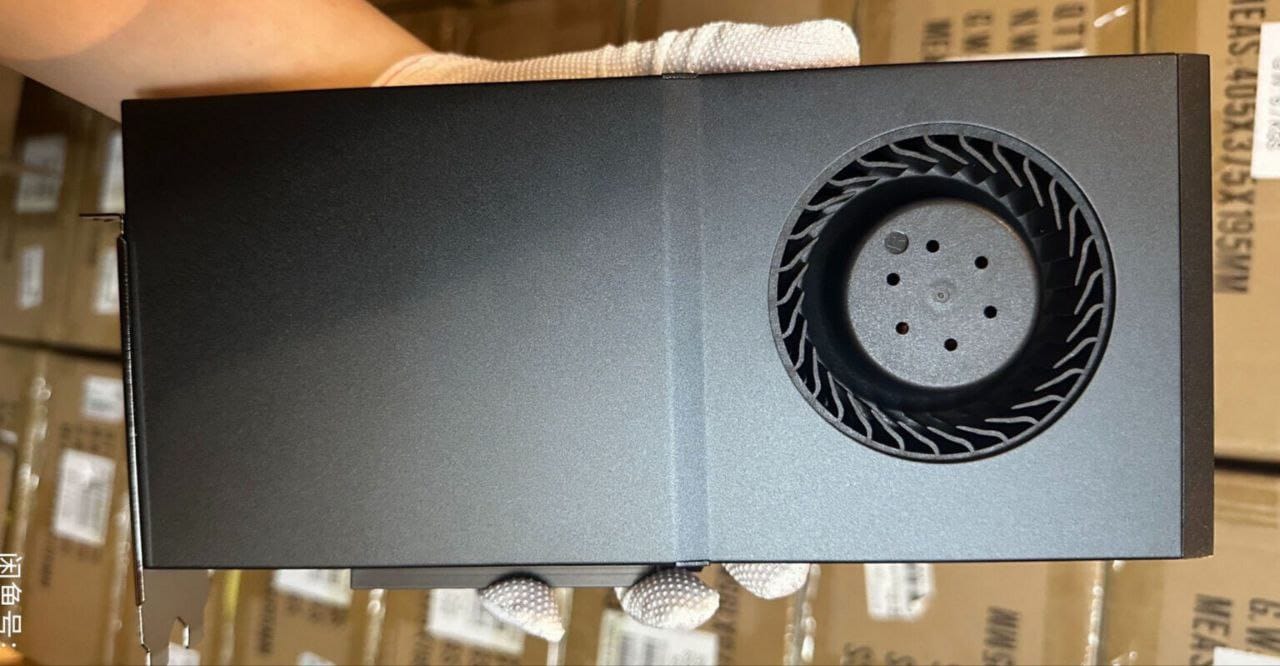

Nvidia RTX 5090 graphics cards with datacenter turbine cooling appeared on Goofish—Alibaba's Chinese marketplace—disguised as older RTX 4090 models to sidestep U.S. export restrictions on advanced AI chips.
What's happening: Sellers list the cards as "RTX 5090 32G D7 Turbo" but ship them in boxes labeled "RTX 4090 24G AIB BLOWER." The mislabeling obscures specifications during customs inspection, helping packages clear international checkpoints.
Why it matters: Grey market distributors reroute supply chains when regulatory barriers block official channels. Demand for Blackwell-architecture chips accelerates as AI infrastructure expands, creating incentives for underground networks.
The hardware details: Cards contain full GB202 GPU silicon—the same processor officially released RTX 5090 models use. Turbine fans blast hot air directly out of server racks—efficient for data centers but far noisier than consumer cards. The cooling design signals these units came from server supply chains rather than consumer production lines.
Export control reality: U.S. export controls target technical capabilities, not product names. The Bureau of Industry and Security sets thresholds for Total Processing Performance, performance density (computing power per physical area), and memory bandwidth. Any GPU exceeding these limits requires export licensing regardless of its consumer or datacenter marketing.
Multiple manufacturers including MSI publicly denied authorized RTX 5090 distribution in China. They warned that parallel imports carry no warranty coverage.
Nvidia created China-specific RTX 5090D variants with reduced AI performance—cutting AI TOPS by almost 23%—to fall below export thresholds.
Supply chain pressure: Nvidia reportedly suspended shipments of China-targeted RTX 5090D SKUs in Q2-Q3 2025 amid tightened U.S. restrictions, according to industry reports. Chinese market sellers reported order cancellations and supply freezes, intensifying pressure on unofficial distribution networks.
Policy shift ahead: President Trump announced December 8, 2025 that the U.S. would allow export of Nvidia H200 datacenter AI accelerators to approved Chinese customers with a 25% fee. Congressional legislators introduced bills in November-December 2025 to either tighten restrictions or prioritize domestic U.S. supply, according to legislative tracking reports.
The bottom line: Acquiring these grey market cards means warranty voids, authenticity concerns, and potential legal exposure from purchasing hardware that deliberately circumvents export controls. The evolving regulatory landscape suggests enforcement patterns for high-end GPU trade may shift as policymakers balance economic and security considerations.