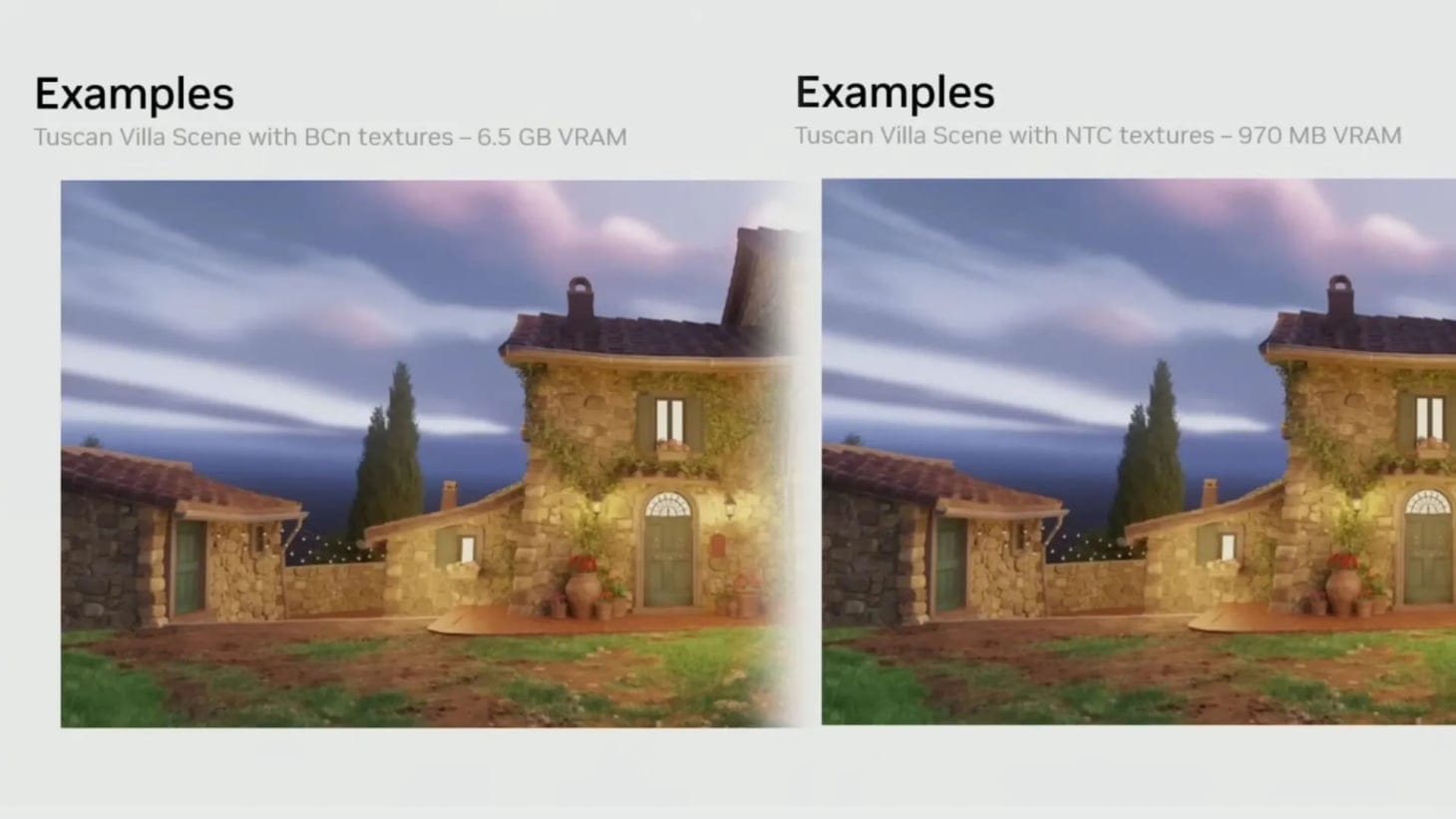

Nvidia introduced Neural Texture Compression at GDC 2026, demonstrating a prototype that slashed video memory requirements from 6.5 GB down to 970 MB (an 85 percent reduction) without sacrificing visual fidelity. It's the kind of compression breakthrough that seems almost too good to be true until you consider what it unlocks: smaller game installs, lower hardware thresholds for high resolution gaming, and freed up VRAM for richer environments and more complex assets.
Unlike DLSS, which upscales already rendered frames, Neural Texture Compression embeds compact neural networks directly into the rendering pipeline. Those networks decode textures on the fly, meaning the compression happens upstream, not as a post processing step. Nvidia's engineers described it as a shift in how we think about asset storage: instead of storing every pixel, you store the instructions to reconstruct them.
In test scenes, that 970 MB budget delivered more fine detail than traditional compression methods operating at the same memory limit. The technique also powers Neural Materials, which compressed a 19 channel shader down to 8 channels and accelerated 1080p rendering by a factor of 1.4 to 7.7 times, depending on scene complexity.
For developers, the appeal is straightforward: optimize assets without rewriting workflows. Nvidia plans to roll the technology into upcoming SDKs, letting studios fold neural compression into existing pipelines with minimal friction. For players, especially those running mid tier hardware or juggling storage constraints, the benefits compound: smaller downloads, smoother performance, and access to titles that might have previously demanded top shelf GPUs.
This isn't just about squeezing more texture data into less space. It's a signal that rendering efficiency is no longer just a question of brute force compute power. By treating compression as a design problem (one that can be solved with thoughtful architecture and machine learning) Nvidia is opening a path toward more sustainable, accessible gaming infrastructure. Every megabyte saved is one less barrier to entry, one less gigabyte hogging SSD space, and one more channel freed up for the next layer of visual storytelling.