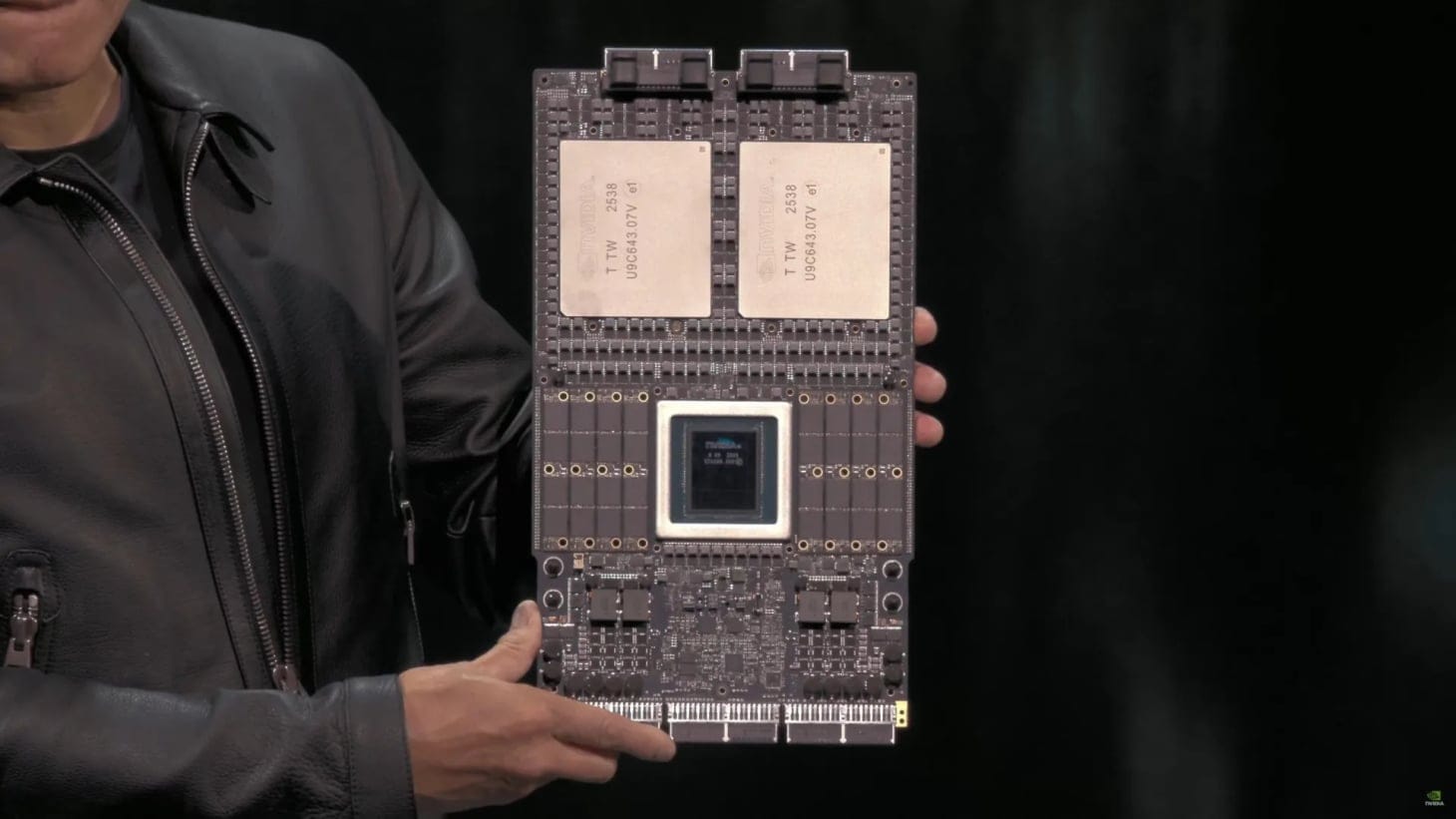

Nvidia revealed today that its Blackwell architecture will command over 70% of high performance GPU shipments through 2026, a major shift toward AI optimized processors that is reshaping data center modernization across the United States.
The dominance of Blackwell, anchored by the GB300 and B300 models, reflects more than a product roadmap adjustment. It represents an acceleration of deployment timelines. U.S. cloud providers, eager to scale their AI infrastructure, now face an unexpected advantage: immediate access to proven architecture while next generation Rubin chips face development delays.
What was once a transitional product is now the infrastructure foundation for 2026.
TrendForce's latest analysis attributes Blackwell's expanded market share to a series of bottlenecks delaying Rubin. HBM4 memory testing, the introduction of CX9 network controllers, and ongoing power consumption and liquid cooling challenges have collectively reduced Rubin's projected shipment share from ==29% to 22%==.
The delay isn't catastrophic. It's revealing. It shows how semiconductor production at this scale depends on materials science, thermal physics, and the complex economics of manufacturing yield.
Blackwell will represent ==71%== of Nvidia's high performance GPU deliveries this year. Meanwhile, Hopper H200 shipments destined for China have contracted to just ==7%==, a reflection of both export controls and geopolitical complications. Mid range Edge AI accelerators, designed for distributed inference workloads, will account for over ==32%== of total units shipped, signaling a geographic and functional diversification of AI computing.
Nvidia expects to deliver hundreds of thousands of logical processors optimized specifically for inference tasks, evidence that the era of training only infrastructure is giving way to production scale AI deployment.
The concentrated push toward Blackwell positions American enterprises at the leading edge of available AI performance. It also underscores a practical reality: companies that can effectively deploy today's technology will outpace those waiting for tomorrow's promise.
Supply constraints have forced a strategic focus, and in doing so, clarified Nvidia's near term priorities. The architecture shipping now will define AI capability for the next year and a half. For U.S. data centers, that's not a compromise. It's an opportunity shaped by precise timing and manufacturing realities.
Blackwell isn't a placeholder. It's the architecture powering AI's present and immediate future.