
• My Feed
  • Home
  • What's Important
  • Media & Entertainment
Search

Stay Curious. Stay Wanture.

© 2026 Wanture. All rights reserved.

  • Terms of Use
  • Privacy Policy
Tech/Gadgets
Inside LEGO’s Smart Brick: How a 2×4 Brick Plays Sound

A teardown shows the 45 mAh battery, speaker and RFID trigger that add sound

9 March 2026

—

Explainer *

Omar Haddad
banner

Nelson’s acetone‑free teardown of LEGO’s 2×4 Smart Brick uncovers a 45 mAh battery, tiny speaker and RFID trigger that fire character‑specific audio in milliseconds. The article explains how the sealed mini‑figure modules work, lists the first three 2026 sets (75421, 75423, 75427) and hints at future upgrades such as longer playtime and custom sound libraries.

Ta3nb5zRXQQR

Summary:

  • LEGO's Smart Brick, launched March 1 2026, replaces screens with on‑brick sound triggered by nearby RFID‑enabled mini‑figures, needing no Wi‑Fi or Bluetooth.
  • The brick houses a 45 mAh Li‑poly battery, speaker and circuit in a standard 2×4 footprint, weighing about 0.5 oz and lasting several hours of play.
  • Priced $70–$160 for starter sets and $40–$100 for add‑on kits, the Smart Brick lets kids keep building while getting instant audio feedback like a game.

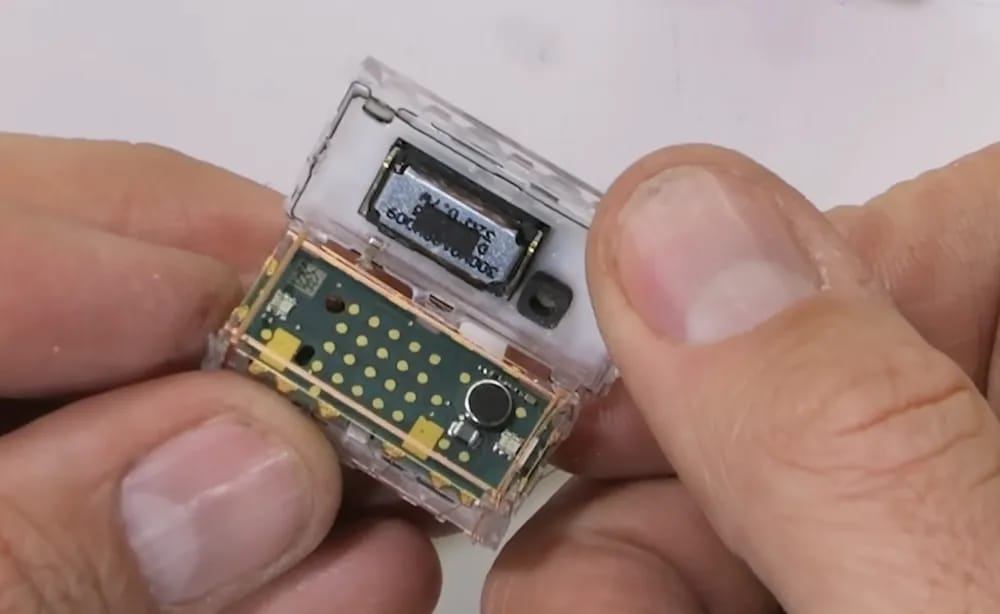
Nelson poured acetone into a small dish and dropped a LEGO Smart Brick inside. The clear solvent ate the brick. In minutes, the outer plastic softened and dissolved, peeling away in translucent layers. He lifted the remaining core with tweezers, exposing a speaker, a circuit board, a 45 mAh battery, and a microphone on his workbench.

The dissolve revealed something unexpected: a sensor system designed to compete with screens, using magnets and sound instead of pixels and apps.

LEGO launched the Smart Brick on March 1, 2026, as a physical answer to digital entertainment. The brick listens for nearby trigger pieces embedded in mini-figures or vehicles, detects them within milliseconds, and plays character-specific audio without requiring Wi-Fi, Bluetooth, or a smartphone. The system works entirely through proximity, using passive signals and onboard storage.

Three All-in-One starter sets arrived the same day, priced from $69.99 to $159.99, each containing at least one Smart Brick. Additional compatible sets range from $39.99 to $99.99 but require a separate purchase of the brick and charger.

How the Brick Detects and Responds in Milliseconds

The Smart Brick triggers sound the moment a compatible mini-figure or vehicle contacts it. The interactive piece hides a magnet or passive RFID tag. When the piece touches the brick, the tag emits a short-range signal that the brick's microphone captures. The circuit board matches the signal to a stored audio file and sends it to the speaker. The whole process happens in milliseconds.

No App, No Connection, Just Contact

The system works without any external connectivity; there's no pairing, no battery in the trigger piece. The RFID tag draws power from the electromagnetic field the brick's microphone creates when the surfaces touch.

Think of it like a hotel keycard: the card holds no battery, but the door reader powers it long enough to verify the code. The Smart Brick uses the same principle. Proximity supplies power. Detection follows. Sound plays.

This design choice matters. Kids drop bricks. They lose chargers. They move between rooms, cars, and backpacks. A system that relies on Wi-Fi or Bluetooth would fail in a moving vehicle, at a park, or in a home without stable connectivity. The brick works anywhere a child builds.

Inside the 2 × 4 Shell: Battery, Board, and Speaker

The Smart Brick packs a speaker, a 45 mAh lithium-polymer battery, and a compact circuit board into a standard 2 × 4 LEGO footprint.

The battery powers the microphone in a low-power listening mode, preserving runtime while keeping the brick's dimensions unchanged. The speaker sits on one side, positioned to project audio outward during play. The entire assembly weighs about 0.5 oz, matching the heft of a typical LEGO brick.

The circuit board orchestrates detection and playback. It stores multiple audio files, each linked to a specific RFID signature. When the microphone picks up a signal, the board cross-references the signature against its library, retrieves the matching file, and sends it to the speaker.

The process resembles a jukebox: insert a coin, the machine reads it, selects the track, and plays it. The Smart Brick substitutes proximity for coins and uses RFID tags instead of grooves.

Why 45 mAh Matters for Playtime

A 45 mAh battery is tiny. For comparison, a typical wireless earbud contains a 40- to 50-mAh cell and runs four to six hours. The Smart Brick faces different power demands. The microphone listens constantly but draws minimal current in standby mode. The speaker activates only during sound playback, which lasts seconds per trigger.

A child might activate the brick dozens of times in an hour, but each event consumes only a fraction of the battery's capacity. LEGO hasn't released official runtime figures, but the low-power design suggests several hours of active play before a recharge is needed.

The battery fits because the brick sacrifices internal space. Standard LEGO bricks are hollow but have thick walls for structural integrity. The Smart Brick thins those walls slightly to accommodate the battery, board, and speaker. The change is invisible from the outside. The brick still connects to other pieces using the same studs and tubes. Builders can't tell it apart from a regular brick until they press an interactive piece against it and hear sound.

Why Acetone Couldn't Fully Dissolve the Trigger

Acetone dissolved the Smart Brick's outer plastic but left the miniature trigger component intact. Nelson applied the solvent to a mini-figure torso next. The surrounding polymer melted away within minutes, exposing a small, sealed module embedded in the chest. The module's metal housing resisted the solvent.

Acetone dissolves many plastics, especially acrylonitrile butadiene styrene—the material LEGO uses for most bricks. Metals, however, remain unaffected. The trigger's antenna and transmitter sit inside a protective shell designed to survive rough handling, accidental drops, and extended exposure to moisture or dirt.

This resistance demonstrates durability. Kids chew bricks. They step on them. They leave them in sandboxes, bathtubs, and car cup holders. A trigger that failed after minimal abuse would render the system useless. The metal housing ensures the RFID tag keeps transmitting even after the mini-figure endures years of play. The design prioritizes longevity over ease of disassembly.

How Interactive Mini-Figures Differ from Standard Ones

Interactive mini-figures contain a sealed trigger module inside their torso, while standard figures remain entirely plastic. Standard LEGO mini-figures separate at the waist, letting builders swap torsos freely. Interactive figures don't. The factory glues the torso halves together, locking the trigger inside.

This limitation frustrates collectors and customizers. Standard LEGO mini-figures let you swap heads, torsos, and legs to create new characters. Interactive figures lock the torso in place. A child can still swap the head and legs, but the core body stays fixed. The restriction preserves the trigger's functionality but reduces creative flexibility. LEGO chose reliability over modularity. The decision reflects a broader tension: how much customization can a sensor-driven system tolerate before it breaks?

What the Glued Torso Reveals About Design Priorities

LEGO could have embedded the trigger in a removable backpack or accessory. That approach would preserve full modularity, but it would also increase the risk of lost triggers. A separate piece can fall behind furniture, slip through couch cushions, or vanish into a sibling's collection.

By gluing the trigger inside the torso, LEGO ensures the electronic component stays with the figure. The trade-off is intentional. The company prioritized durability and ease of use over the ability to mix and match every part.

Why Physical Toys Are Fighting Back Against Screens

The Smart Brick exists because physical play is losing ground to tablets, game consoles, and streaming video. Children spend an average of five to seven hours per day on screens, according to recent studies. Traditional toys compete for the remaining hours. LEGO's response is to add interactivity without adding screens.

The brick delivers instant feedback, character voices, and sound effects, but it requires hands-on building and tactile manipulation. A child cannot swipe or tap their way through play. They must construct, connect, and move physical pieces.

This approach matters for skill development. Building with bricks strengthens fine-motor skills, spatial reasoning, and problem-solving. Screen-based play often emphasizes reaction speed and pattern recognition. Both offer value, but physical construction engages different cognitive pathways. The Smart Brick attempts to bridge the gap. It offers the immediate sensory reward of digital media while maintaining the physical demands of traditional toys.

What Happens When Sensors Improve

Future iterations could support customizable sound libraries. A child might record their own voice and assign it to a mini-figure. Longer battery life could extend play sessions beyond a single afternoon. Smaller sensors might fit inside standard, fully modular torsos, eliminating the need for glued components.

As battery technology and miniaturized sensors continue to improve, the boundary between physical and digital play will shift again. The Smart Brick represents an early step in that evolution.

What Makers Might Build Next

The teardown reveals opportunities for modification. The circuit board uses standard components. The battery connects via a simple two-wire interface. A maker could replace the board with a programmable microcontroller, swap the speaker for a higher-quality model, or add new sensors to detect light, motion, or temperature. LEGO does not officially support such modifications, but the brick's internal architecture invites experimentation.

Interactive bricks also suggest new possibilities for education. A teacher could use them to demonstrate basic electronics, sensor logic, and audio playback. Students could design their own trigger pieces using inexpensive RFID tags and test how proximity affects detection range. The platform is simple enough for middle schoolers but flexible enough for advanced hobbyists.

The Smart Brick proves that physical toys can respond to the sensory appeal of digital entertainment without surrendering tactile engagement. Acetone dissolved the plastic shell, but it exposed a sensor system designed to keep children building, listening, and playing with their hands instead of their thumbs. As screens continue to dominate leisure time, this kind of hardware offers a concrete alternative: sound, proximity, and a battery small enough to fit inside a brick.

What is this about?

  • Explainer */
  • Omar Haddad/
  • Tech/
  • Gadgets
•
  • battery technology/
  • hardware innovation/
  • consumer electronics/
  • magnetic nanorobotics/
  • interactive toys

Feed

    Google launches AI avatar tool for Shorts on April 9, 2026

    Google launches AI avatar tool for Shorts on April 9, 2026

    Ages 18+ can create digital replicas, with Synth ID tags and a 3‑year auto‑delete

    about 1 hour ago
    Mac OS X 10.0 Cheetah runs on Wii

    Mac OS X 10.0 Cheetah runs on Wii

    Ports Mac OS X 10.0 Cheetah to the Wii, showing the PowerPC 750CL can run an OS

    about 4 hours ago
    DuoBell Beats ANC: Safer Cycling with Apple AirPods Max

    DuoBell Beats ANC: Safer Cycling with Apple AirPods Max

    A 750 Hz blind‑spot lets DuoBell cut through ANC on popular headphones

    about 4 hours ago
    Škoda DuoBell prototype unveiled on April 5, 2026

    Škoda DuoBell prototype unveiled on April 5, 2026

    750 Hz pulse and 2,000 Hz chime cut through ANC, alerting riders faster at 15 mph

    about 7 hours ago
    SteamGPT Leak Reveals Dual‑Role AI on Steam

    SteamGPT Leak Reveals Dual‑Role AI on Steam

    Leak shows AI handling support and cheat‑detection for millions on the platform

    about 7 hours ago
    Oppo Pad mini challenges Apple with Snapdragon 8 Gen 5

    Oppo Pad mini challenges Apple with Snapdragon 8 Gen 5

    April 21: Oppo Pad mini 8.8‑inch, Snapdragon 8 Gen 5, 5.39 mm, 279 g, 144 Hz OLED

    about 7 hours ago
    Apple to ship 3 million foldable iPhones by end‑2026

    Apple to ship 3 million foldable iPhones by end‑2026

    Limited rollout equals 12 % of iPhone volume and rivals Samsung’s 2.4 million Galaxy Z Fold 7 sales

    about 7 hours ago
    Apple unveils iPhone 18 Pro, iPhone 18 Pro Max, and iPhone Ultra

    Apple unveils iPhone 18 Pro, iPhone 18 Pro Max, and iPhone Ultra

    Mockups match leaked renders; 20 million Samsung panels for iPhone Ultra

    1 day ago
    Sony launches Playerbase program for Gran Turismo 7

    Sony launches Playerbase program for Gran Turismo 7

    PlayStation gamers can win a flight, facial scan, and an avatar in Gran Turismo 7

    1 day ago
    Claude Mythos Preview Beats Opus 4.6 in Cybersecurity!

    Claude Mythos Preview Beats Opus 4.6 in Cybersecurity!

    Claude Mythos Preview for five partners—pricing after a 100 million token credit

    1 day ago
    ChatGPT and AI Tools Let Solo Founders Launch Fast

    ChatGPT and AI Tools Let Solo Founders Launch Fast

    With GitHub Copilot, a founder can code, design, and deliver an MVP in days

    2 days ago
    Android 17 beta adds Notification Rules

    Android 17 beta adds Notification Rules

    New rules let users silence, block, or highlight alerts; Samsung eyes One UI 9

    2 days ago
    Utah Starts 12‑Month AI Chatbot Pilot for Psychiatric Meds

    Utah Starts 12‑Month AI Chatbot Pilot for Psychiatric Meds

    Legion Health pilot offers refills for 15 meds, easing shortages in rural Utah

    2 days ago
    Meta Turns Ray‑Ban & Oakley Glasses into Calorie Counters

    Meta Turns Ray‑Ban & Oakley Glasses into Calorie Counters

    U.S. rollout set for summer 2026, limited to adults 18+ on compatible models

    2 days ago
    Samsung's Q1 2026 profit spikes 8.5‑fold to 57.2 trillion won

    Samsung's Q1 2026 profit spikes 8.5‑fold to 57.2 trillion won

    Memory crunch drives AI data center demand, pushing Samsung shares up 1.4%

    2 days ago
    Sony tests new PS5 UI with dedicated Store and Plus tabs

    Sony tests new PS5 UI with dedicated Store and Plus tabs

    Select gamers get a cleaner three‑tab UI for PS Plus, Store and Library

    2 days ago
    Samsung adds Galaxy S27 Pro as a fourth flagship

    Samsung adds Galaxy S27 Pro as a fourth flagship

    Pro slots between Galaxy S27 and S27 Ultra, keeps privacy screen, and drops S‑Pen

    3 days ago
    Pixel 8 Pro Suffers March 2026 Feature Drop Glitches

    Pixel 8 Pro Suffers March 2026 Feature Drop Glitches

    Wi‑Fi, Bluetooth, and lock‑screen freezes hit Pixel 8 Pro owners with March 2026 update

    3 days ago
    Claude Pro, Max Subscribers Hit Extra Charges

    Claude Pro, Max Subscribers Hit Extra Charges

    Anthropic adds pay‑as‑you‑go fees for OpenClaw and other third‑party AI agents

    4 days ago
    Legion Go 2 price jumps to $1,999 for top model

    Legion Go 2 price jumps to $1,999 for top model

    Base model hits $1,499; premium variant reaches $1,999, prompting buyers to rethink

    4 days ago
    Loading...
Tech/Gadgets

Inside LEGO’s Smart Brick: How a 2×4 Brick Plays Sound

A teardown shows the 45 mAh battery, speaker and RFID trigger that add sound

March 9, 2026, 1:34 pm

Nelson’s acetone‑free teardown of LEGO’s 2×4 Smart Brick uncovers a 45 mAh battery, tiny speaker and RFID trigger that fire character‑specific audio in milliseconds. The article explains how the sealed mini‑figure modules work, lists the first three 2026 sets (75421, 75423, 75427) and hints at future upgrades such as longer playtime and custom sound libraries.

Ta3nb5zRXQQR

Summary

  • LEGO's Smart Brick, launched March 1 2026, replaces screens with on‑brick sound triggered by nearby RFID‑enabled mini‑figures, needing no Wi‑Fi or Bluetooth.
  • The brick houses a 45 mAh Li‑poly battery, speaker and circuit in a standard 2×4 footprint, weighing about 0.5 oz and lasting several hours of play.
  • Priced $70–$160 for starter sets and $40–$100 for add‑on kits, the Smart Brick lets kids keep building while getting instant audio feedback like a game.

Nelson poured acetone into a small dish and dropped a LEGO Smart Brick inside. The clear solvent ate the brick. In minutes, the outer plastic softened and dissolved, peeling away in translucent layers. He lifted the remaining core with tweezers, exposing a speaker, a circuit board, a 45 mAh battery, and a microphone on his workbench.

The dissolve revealed something unexpected: a sensor system designed to compete with screens, using magnets and sound instead of pixels and apps.

LEGO launched the Smart Brick on March 1, 2026, as a physical answer to digital entertainment. The brick listens for nearby trigger pieces embedded in mini-figures or vehicles, detects them within milliseconds, and plays character-specific audio without requiring Wi-Fi, Bluetooth, or a smartphone. The system works entirely through proximity, using passive signals and onboard storage.

Three All-in-One starter sets arrived the same day, priced from $69.99 to $159.99, each containing at least one Smart Brick. Additional compatible sets range from $39.99 to $99.99 but require a separate purchase of the brick and charger.

How the Brick Detects and Responds in Milliseconds

The Smart Brick triggers sound the moment a compatible mini-figure or vehicle contacts it. The interactive piece hides a magnet or passive RFID tag. When the piece touches the brick, the tag emits a short-range signal that the brick's microphone captures. The circuit board matches the signal to a stored audio file and sends it to the speaker. The whole process happens in milliseconds.

No App, No Connection, Just Contact

The system works without any external connectivity; there's no pairing, no battery in the trigger piece. The RFID tag draws power from the electromagnetic field the brick's microphone creates when the surfaces touch.

Think of it like a hotel keycard: the card holds no battery, but the door reader powers it long enough to verify the code. The Smart Brick uses the same principle. Proximity supplies power. Detection follows. Sound plays.

This design choice matters. Kids drop bricks. They lose chargers. They move between rooms, cars, and backpacks. A system that relies on Wi-Fi or Bluetooth would fail in a moving vehicle, at a park, or in a home without stable connectivity. The brick works anywhere a child builds.

Inside the 2 × 4 Shell: Battery, Board, and Speaker

The Smart Brick packs a speaker, a 45 mAh lithium-polymer battery, and a compact circuit board into a standard 2 × 4 LEGO footprint.

The battery powers the microphone in a low-power listening mode, preserving runtime while keeping the brick's dimensions unchanged. The speaker sits on one side, positioned to project audio outward during play. The entire assembly weighs about 0.5 oz, matching the heft of a typical LEGO brick.

The circuit board orchestrates detection and playback. It stores multiple audio files, each linked to a specific RFID signature. When the microphone picks up a signal, the board cross-references the signature against its library, retrieves the matching file, and sends it to the speaker.

The process resembles a jukebox: insert a coin, the machine reads it, selects the track, and plays it. The Smart Brick substitutes proximity for coins and uses RFID tags instead of grooves.

Why 45 mAh Matters for Playtime

A 45 mAh battery is tiny. For comparison, a typical wireless earbud contains a 40- to 50-mAh cell and runs four to six hours. The Smart Brick faces different power demands. The microphone listens constantly but draws minimal current in standby mode. The speaker activates only during sound playback, which lasts seconds per trigger.

A child might activate the brick dozens of times in an hour, but each event consumes only a fraction of the battery's capacity. LEGO hasn't released official runtime figures, but the low-power design suggests several hours of active play before a recharge is needed.

The battery fits because the brick sacrifices internal space. Standard LEGO bricks are hollow but have thick walls for structural integrity. The Smart Brick thins those walls slightly to accommodate the battery, board, and speaker. The change is invisible from the outside. The brick still connects to other pieces using the same studs and tubes. Builders can't tell it apart from a regular brick until they press an interactive piece against it and hear sound.

Why Acetone Couldn't Fully Dissolve the Trigger

Acetone dissolved the Smart Brick's outer plastic but left the miniature trigger component intact. Nelson applied the solvent to a mini-figure torso next. The surrounding polymer melted away within minutes, exposing a small, sealed module embedded in the chest. The module's metal housing resisted the solvent.

Acetone dissolves many plastics, especially acrylonitrile butadiene styrene—the material LEGO uses for most bricks. Metals, however, remain unaffected. The trigger's antenna and transmitter sit inside a protective shell designed to survive rough handling, accidental drops, and extended exposure to moisture or dirt.

This resistance demonstrates durability. Kids chew bricks. They step on them. They leave them in sandboxes, bathtubs, and car cup holders. A trigger that failed after minimal abuse would render the system useless. The metal housing ensures the RFID tag keeps transmitting even after the mini-figure endures years of play. The design prioritizes longevity over ease of disassembly.

How Interactive Mini-Figures Differ from Standard Ones

Interactive mini-figures contain a sealed trigger module inside their torso, while standard figures remain entirely plastic. Standard LEGO mini-figures separate at the waist, letting builders swap torsos freely. Interactive figures don't. The factory glues the torso halves together, locking the trigger inside.

This limitation frustrates collectors and customizers. Standard LEGO mini-figures let you swap heads, torsos, and legs to create new characters. Interactive figures lock the torso in place. A child can still swap the head and legs, but the core body stays fixed. The restriction preserves the trigger's functionality but reduces creative flexibility. LEGO chose reliability over modularity. The decision reflects a broader tension: how much customization can a sensor-driven system tolerate before it breaks?

What the Glued Torso Reveals About Design Priorities

LEGO could have embedded the trigger in a removable backpack or accessory. That approach would preserve full modularity, but it would also increase the risk of lost triggers. A separate piece can fall behind furniture, slip through couch cushions, or vanish into a sibling's collection.

By gluing the trigger inside the torso, LEGO ensures the electronic component stays with the figure. The trade-off is intentional. The company prioritized durability and ease of use over the ability to mix and match every part.

Why Physical Toys Are Fighting Back Against Screens

The Smart Brick exists because physical play is losing ground to tablets, game consoles, and streaming video. Children spend an average of five to seven hours per day on screens, according to recent studies. Traditional toys compete for the remaining hours. LEGO's response is to add interactivity without adding screens.

The brick delivers instant feedback, character voices, and sound effects, but it requires hands-on building and tactile manipulation. A child cannot swipe or tap their way through play. They must construct, connect, and move physical pieces.

This approach matters for skill development. Building with bricks strengthens fine-motor skills, spatial reasoning, and problem-solving. Screen-based play often emphasizes reaction speed and pattern recognition. Both offer value, but physical construction engages different cognitive pathways. The Smart Brick attempts to bridge the gap. It offers the immediate sensory reward of digital media while maintaining the physical demands of traditional toys.

What Happens When Sensors Improve

Future iterations could support customizable sound libraries. A child might record their own voice and assign it to a mini-figure. Longer battery life could extend play sessions beyond a single afternoon. Smaller sensors might fit inside standard, fully modular torsos, eliminating the need for glued components.

As battery technology and miniaturized sensors continue to improve, the boundary between physical and digital play will shift again. The Smart Brick represents an early step in that evolution.

What Makers Might Build Next

The teardown reveals opportunities for modification. The circuit board uses standard components. The battery connects via a simple two-wire interface. A maker could replace the board with a programmable microcontroller, swap the speaker for a higher-quality model, or add new sensors to detect light, motion, or temperature. LEGO does not officially support such modifications, but the brick's internal architecture invites experimentation.

Interactive bricks also suggest new possibilities for education. A teacher could use them to demonstrate basic electronics, sensor logic, and audio playback. Students could design their own trigger pieces using inexpensive RFID tags and test how proximity affects detection range. The platform is simple enough for middle schoolers but flexible enough for advanced hobbyists.

The Smart Brick proves that physical toys can respond to the sensory appeal of digital entertainment without surrendering tactile engagement. Acetone dissolved the plastic shell, but it exposed a sensor system designed to keep children building, listening, and playing with their hands instead of their thumbs. As screens continue to dominate leisure time, this kind of hardware offers a concrete alternative: sound, proximity, and a battery small enough to fit inside a brick.

What is this about?

  • Explainer */
  • Omar Haddad/
  • Tech/
  • Gadgets
•
  • battery technology/
  • hardware innovation/
  • consumer electronics/
  • magnetic nanorobotics/
  • interactive toys

Feed

    Google launches AI avatar tool for Shorts on April 9, 2026

    Google launches AI avatar tool for Shorts on April 9, 2026

    Ages 18+ can create digital replicas, with Synth ID tags and a 3‑year auto‑delete

    about 1 hour ago
    Mac OS X 10.0 Cheetah runs on Wii

    Mac OS X 10.0 Cheetah runs on Wii

    Ports Mac OS X 10.0 Cheetah to the Wii, showing the PowerPC 750CL can run an OS

    about 4 hours ago
    DuoBell Beats ANC: Safer Cycling with Apple AirPods Max

    DuoBell Beats ANC: Safer Cycling with Apple AirPods Max

    A 750 Hz blind‑spot lets DuoBell cut through ANC on popular headphones

    about 4 hours ago
    Škoda DuoBell prototype unveiled on April 5, 2026

    Škoda DuoBell prototype unveiled on April 5, 2026

    750 Hz pulse and 2,000 Hz chime cut through ANC, alerting riders faster at 15 mph

    about 7 hours ago
    SteamGPT Leak Reveals Dual‑Role AI on Steam

    SteamGPT Leak Reveals Dual‑Role AI on Steam

    Leak shows AI handling support and cheat‑detection for millions on the platform

    about 7 hours ago
    Oppo Pad mini challenges Apple with Snapdragon 8 Gen 5

    Oppo Pad mini challenges Apple with Snapdragon 8 Gen 5

    April 21: Oppo Pad mini 8.8‑inch, Snapdragon 8 Gen 5, 5.39 mm, 279 g, 144 Hz OLED

    about 7 hours ago
    Apple to ship 3 million foldable iPhones by end‑2026

    Apple to ship 3 million foldable iPhones by end‑2026

    Limited rollout equals 12 % of iPhone volume and rivals Samsung’s 2.4 million Galaxy Z Fold 7 sales

    about 7 hours ago
    Apple unveils iPhone 18 Pro, iPhone 18 Pro Max, and iPhone Ultra

    Apple unveils iPhone 18 Pro, iPhone 18 Pro Max, and iPhone Ultra

    Mockups match leaked renders; 20 million Samsung panels for iPhone Ultra

    1 day ago
    Sony launches Playerbase program for Gran Turismo 7

    Sony launches Playerbase program for Gran Turismo 7

    PlayStation gamers can win a flight, facial scan, and an avatar in Gran Turismo 7

    1 day ago
    Claude Mythos Preview Beats Opus 4.6 in Cybersecurity!

    Claude Mythos Preview Beats Opus 4.6 in Cybersecurity!

    Claude Mythos Preview for five partners—pricing after a 100 million token credit

    1 day ago
    ChatGPT and AI Tools Let Solo Founders Launch Fast

    ChatGPT and AI Tools Let Solo Founders Launch Fast

    With GitHub Copilot, a founder can code, design, and deliver an MVP in days

    2 days ago
    Android 17 beta adds Notification Rules

    Android 17 beta adds Notification Rules

    New rules let users silence, block, or highlight alerts; Samsung eyes One UI 9

    2 days ago
    Utah Starts 12‑Month AI Chatbot Pilot for Psychiatric Meds

    Utah Starts 12‑Month AI Chatbot Pilot for Psychiatric Meds

    Legion Health pilot offers refills for 15 meds, easing shortages in rural Utah

    2 days ago
    Meta Turns Ray‑Ban & Oakley Glasses into Calorie Counters

    Meta Turns Ray‑Ban & Oakley Glasses into Calorie Counters

    U.S. rollout set for summer 2026, limited to adults 18+ on compatible models

    2 days ago
    Samsung's Q1 2026 profit spikes 8.5‑fold to 57.2 trillion won

    Samsung's Q1 2026 profit spikes 8.5‑fold to 57.2 trillion won

    Memory crunch drives AI data center demand, pushing Samsung shares up 1.4%

    2 days ago
    Sony tests new PS5 UI with dedicated Store and Plus tabs

    Sony tests new PS5 UI with dedicated Store and Plus tabs

    Select gamers get a cleaner three‑tab UI for PS Plus, Store and Library

    2 days ago
    Samsung adds Galaxy S27 Pro as a fourth flagship

    Samsung adds Galaxy S27 Pro as a fourth flagship

    Pro slots between Galaxy S27 and S27 Ultra, keeps privacy screen, and drops S‑Pen

    3 days ago
    Pixel 8 Pro Suffers March 2026 Feature Drop Glitches

    Pixel 8 Pro Suffers March 2026 Feature Drop Glitches

    Wi‑Fi, Bluetooth, and lock‑screen freezes hit Pixel 8 Pro owners with March 2026 update

    3 days ago
    Claude Pro, Max Subscribers Hit Extra Charges

    Claude Pro, Max Subscribers Hit Extra Charges

    Anthropic adds pay‑as‑you‑go fees for OpenClaw and other third‑party AI agents

    4 days ago
    Legion Go 2 price jumps to $1,999 for top model

    Legion Go 2 price jumps to $1,999 for top model

    Base model hits $1,499; premium variant reaches $1,999, prompting buyers to rethink

    4 days ago
    Loading...
banner