
Logo
My feedToday
Logo
Decide better.Live better.
My feedToday
Logo
My feedToday

Stay Curious. Stay Wanture.

© 2026 Wanture. All rights reserved.

  • Terms of Use
  • Privacy Policy
Logo
My feedTodayTechScienceHealthMobilityMindProductivityHomeExperiencesLongevity
Logo
Decide better.Live better.
My feedTodayTechScienceHealthMobilityMindProductivityHomeExperiencesLongevity
Logo
My feedTodayTechScienceHealthMobilityMindProductivityHomeExperiencesLongevity
Science/Tech

Honor Robot Shatters Half‑Marathon Record in 50:26

19 April 2026

—

News

Marcus Dillard

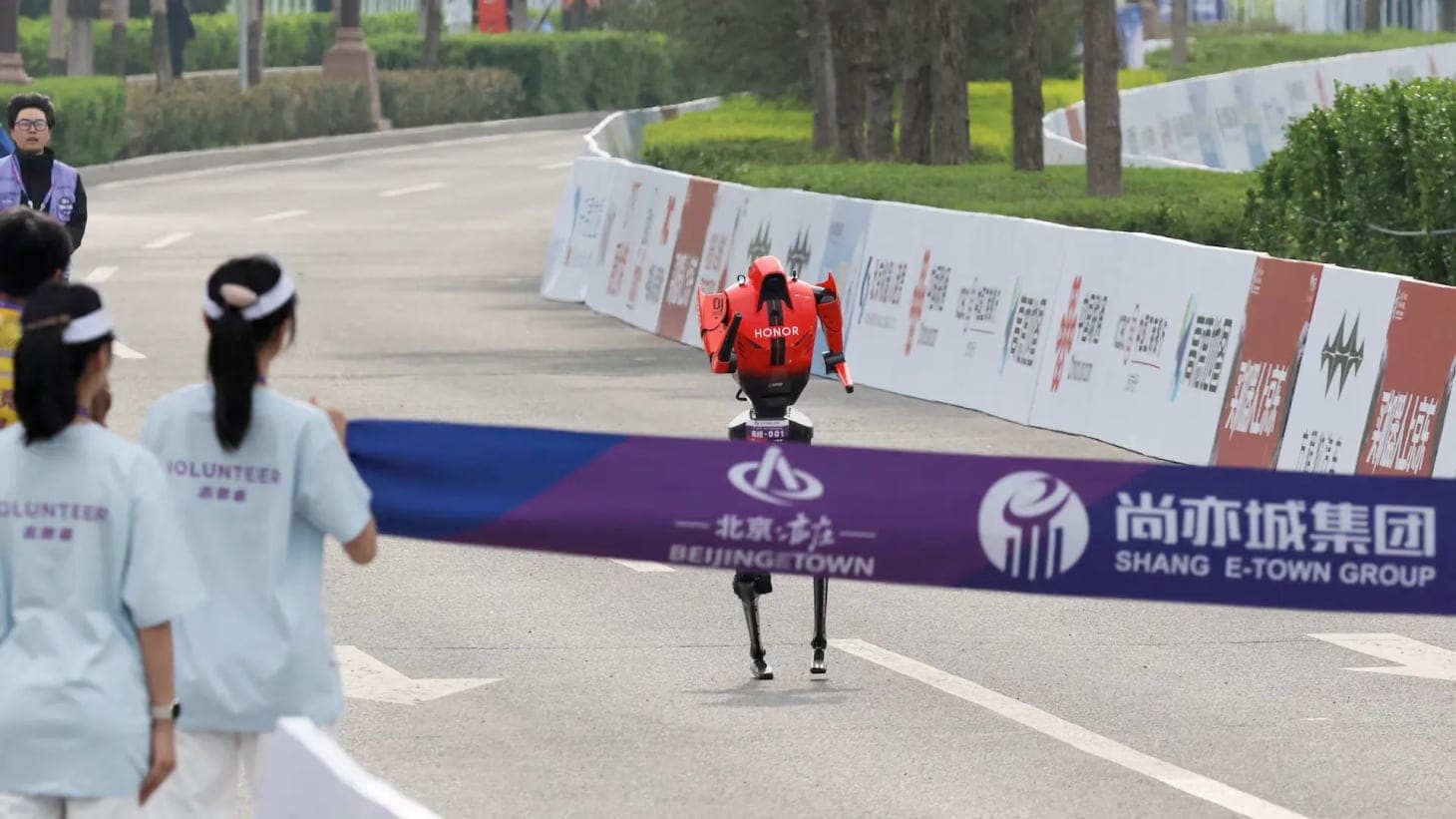
Honor's humanoid robot completed a half marathon in Beijing on April 19 in 50 minutes and 26 seconds, beating the human world record by seven minutes and marking a dramatic leap in AI powered robotics.

Several thousand human runners shared the course with several hundred mechanical competitors. Most robots remained tethered to remote operators, but about 40 percent ran autonomously, sensing pavement, calculating stride, and making real-time corrections without human input.

Why it matters: The winning time shatters Jacob Kiplimo's human benchmark and compresses what many expected to take years of development into months of refining gait algorithms and servo response systems.

Catch up quick: Training footage released days before the race showed prototypes stumbling mid-stride and shedding components on test tracks, underscoring how even breakthrough performances emerge from failure and iteration. Last year's best robot finish took 2 hours and 40 minutes.

Chu stood trackside as the machines passed and told reporters the running posture impressed him most: not flawless, but eerily adaptive. His assessment reflects broader industry conviction that AI adoption will accelerate across sectors, from logistics warehouses to surgical suites, whether society is ready or not.

The big picture: Organizers routed humans and robots along parallel paths to avoid collisions, a pragmatic choice that also served as metaphor. Two types of runners moved in the same direction but not yet sharing the same lane.

The autonomous machines navigated turns and pacing decisions independently, while remote-controlled counterparts responded to operator inputs from nearby control stations. The split reveals the current frontier: full autonomy in dynamic, unpredictable environments remains the engineering challenge, even as partial autonomy becomes routine.

What's next: Race organizers plan to expand autonomous robot participation in future events, refining safety protocols and exploring how mixed competitions might evolve. Observers will track not just performance gains but regulatory responses and whether frameworks governing AI competition keep pace with the technology itself.

The Beijing half marathon offers a preview: a world where machines don't just assist human effort but compete against it, where the finish line becomes a measure of how far artificial endurance has come, and how quickly the gap is closing.
What is this about?

  • News
  • Marcus Dillard
  • Science
  • Tech
  • Autonomous Robots
  • Robotic Endurance
  • Robot Sports Competition
  • AI Competition Regulation

Feed

    Apple Secures Four ADC Annual Awards

    Apple Secures Four ADC Annual Awards

    Design excellence recognized at the 105th ADC Annual Awards

    Renée Itoabout 20 hours ago
    Do GLP-1 Drugs Cause Muscle Loss? The Science Behind Semaglutide and Tirzepatide

    Do GLP-1 Drugs Cause Muscle Loss? The Science Behind Semaglutide and Tirzepatide

    Marcus Leeabout 21 hours ago

    UCSD reverses aging in blood stem cells via lysosomal repair

    Breakthrough in gene modulation restores 78% differentiation efficiency in aged human cells

    James Whitmore3 days ago

    Scientists Reverse Blood Stem Cell Aging by Restoring Cellular Recycling

    James Whitmore3 days ago
    Amazon Acquires Globalstar for $11.57 Billion

    Amazon Acquires Globalstar for $11.57 Billion

    Deal gives Amazon control of Apple Watch Ultra 3 satellite network

    Carter Brooks3 days ago
    We Are as Gods: Peter Diamandis's Survival Guide for the Age of Abundance

    We Are as Gods: Peter Diamandis's Survival Guide for the Age of Abundance

    Marcus Dillard3 days ago
    Daemon Tools 12.5.0.2421‑2434 Compromised, 12.6.0.2445 Fixed

    Daemon Tools 12.5.0.2421‑2434 Compromised, 12.6.0.2445 Fixed

    Kaspersky flags 12.5.0.2421‑2434 installers compromised; upgrade to 12.6.0.2445

    Logan Price6 May 2026
    Xiaomi Mijia Robot Vacuum and Mop 6 Launches in China

    Xiaomi Mijia Robot Vacuum and Mop 6 Launches in China

    The 28 000 Pa suction robot adds roller‑wet cleaning, but U.S. must wait

    Logan Price6 May 2026
    Apple unveils iOS 27 AI overhaul at WWDC on June 8, 2026

    Apple unveils iOS 27 AI overhaul at WWDC on June 8, 2026

    Siri gets a standalone app, AI Photos tools, and health coaching in iOS 27

    Carter Brooks5 May 2026

    Google Workspace Icon Redesign: From Flat Color Blocks to Gradient‑Rich, Rounded Designs

    Google replaced its 2020 four‑color Workspace icons with gradient‑rich, rounded versions. The redesign cut misclicks, eased app recognition, and underscored the importance of usability over strict brand uniformity.

    Renée Ito3 May 2026
    Loading...
Science/Tech

Honor Robot Shatters Half‑Marathon Record in 50:26

19 April 2026

—

News

Marcus Dillard

Honor's humanoid robot completed a half marathon in Beijing on April 19 in 50 minutes and 26 seconds, beating the human world record by seven minutes and marking a dramatic leap in AI powered robotics.

Several thousand human runners shared the course with several hundred mechanical competitors. Most robots remained tethered to remote operators, but about 40 percent ran autonomously, sensing pavement, calculating stride, and making real-time corrections without human input.

Why it matters: The winning time shatters Jacob Kiplimo's human benchmark and compresses what many expected to take years of development into months of refining gait algorithms and servo response systems.

Catch up quick: Training footage released days before the race showed prototypes stumbling mid-stride and shedding components on test tracks, underscoring how even breakthrough performances emerge from failure and iteration. Last year's best robot finish took 2 hours and 40 minutes.

Chu stood trackside as the machines passed and told reporters the running posture impressed him most: not flawless, but eerily adaptive. His assessment reflects broader industry conviction that AI adoption will accelerate across sectors, from logistics warehouses to surgical suites, whether society is ready or not.

The big picture: Organizers routed humans and robots along parallel paths to avoid collisions, a pragmatic choice that also served as metaphor. Two types of runners moved in the same direction but not yet sharing the same lane.

The autonomous machines navigated turns and pacing decisions independently, while remote-controlled counterparts responded to operator inputs from nearby control stations. The split reveals the current frontier: full autonomy in dynamic, unpredictable environments remains the engineering challenge, even as partial autonomy becomes routine.

What's next: Race organizers plan to expand autonomous robot participation in future events, refining safety protocols and exploring how mixed competitions might evolve. Observers will track not just performance gains but regulatory responses and whether frameworks governing AI competition keep pace with the technology itself.

The Beijing half marathon offers a preview: a world where machines don't just assist human effort but compete against it, where the finish line becomes a measure of how far artificial endurance has come, and how quickly the gap is closing.
What is this about?

  • News/
  • Marcus Dillard/
  • Science/
  • Tech/
  • Autonomous Robots/
  • Robotic Endurance/
  • Robot Sports Competition/
  • AI Competition Regulation

Feed

    Apple Secures Four ADC Annual Awards

    Apple Secures Four ADC Annual Awards

    Design excellence recognized at the 105th ADC Annual Awards

    Renée Itoabout 20 hours ago
    Do GLP-1 Drugs Cause Muscle Loss? The Science Behind Semaglutide and Tirzepatide

    Do GLP-1 Drugs Cause Muscle Loss? The Science Behind Semaglutide and Tirzepatide

    Marcus Leeabout 21 hours ago

    UCSD reverses aging in blood stem cells via lysosomal repair

    Breakthrough in gene modulation restores 78% differentiation efficiency in aged human cells

    James Whitmore3 days ago

    Scientists Reverse Blood Stem Cell Aging by Restoring Cellular Recycling

    James Whitmore3 days ago
    Amazon Acquires Globalstar for $11.57 Billion

    Amazon Acquires Globalstar for $11.57 Billion

    Deal gives Amazon control of Apple Watch Ultra 3 satellite network

    Carter Brooks3 days ago
    We Are as Gods: Peter Diamandis's Survival Guide for the Age of Abundance

    We Are as Gods: Peter Diamandis's Survival Guide for the Age of Abundance

    Marcus Dillard3 days ago
    Daemon Tools 12.5.0.2421‑2434 Compromised, 12.6.0.2445 Fixed

    Daemon Tools 12.5.0.2421‑2434 Compromised, 12.6.0.2445 Fixed

    Kaspersky flags 12.5.0.2421‑2434 installers compromised; upgrade to 12.6.0.2445

    Logan Price6 May 2026
    Xiaomi Mijia Robot Vacuum and Mop 6 Launches in China

    Xiaomi Mijia Robot Vacuum and Mop 6 Launches in China

    The 28 000 Pa suction robot adds roller‑wet cleaning, but U.S. must wait

    Logan Price6 May 2026
    Apple unveils iOS 27 AI overhaul at WWDC on June 8, 2026

    Apple unveils iOS 27 AI overhaul at WWDC on June 8, 2026

    Siri gets a standalone app, AI Photos tools, and health coaching in iOS 27

    Carter Brooks5 May 2026

    Google Workspace Icon Redesign: From Flat Color Blocks to Gradient‑Rich, Rounded Designs

    Google replaced its 2020 four‑color Workspace icons with gradient‑rich, rounded versions. The redesign cut misclicks, eased app recognition, and underscored the importance of usability over strict brand uniformity.

    Renée Ito3 May 2026
    Loading...
Home
Home
Search
Search