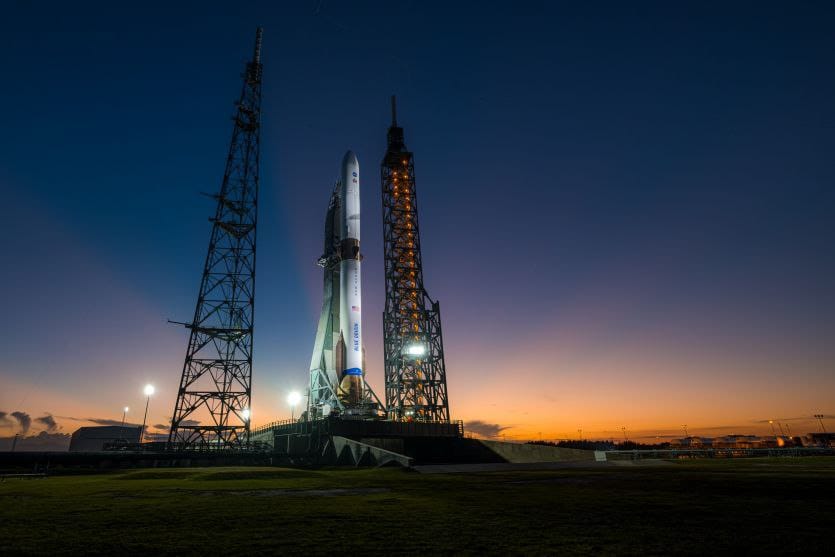

Blue Origin successfully landed its New Glenn rocket booster on an Atlantic Ocean platform Thursday, becoming only the second company after SpaceX to achieve controlled booster recovery—a breakthrough that reshapes the economics of space access.
The 190-foot booster touched down on Blue Origin's recovery ship Jacklyn just 10 minutes after liftoff from Cape Canaveral's LC-36. Four minutes into flight, the second stage separated and continued toward orbit while the booster executed its return sequence.
Why it matters: This breakthrough dramatically reduces launch costs by eliminating the need to build new boosters for each mission. Blue Origin now joins SpaceX in demonstrating this capability, intensifying competition in the commercial space sector and strengthening America's position in the global space race.
New Glenn's upper stage placed NASA's ESCAPADE mission into orbit approximately 34 minutes after launch. The mission consists of two identical small orbiters—nicknamed Blue and Gold—built by Rocket Lab to study Mars' upper atmosphere, ionosphere, and how solar wind strips atmosphere from the Red Planet.
The spacecraft are healthy and undergoing early commissioning checks of power systems, solar arrays, and communications. They will remain in a special Earth orbit for about a year before departing for Mars in November 2026, arriving in 2027 for an 11-month science campaign.
The backstory: Blue Origin's first New Glenn launch in January ended when the booster exploded before landing. The company worked with the FAA to implement design modifications—including enhanced landing leg reinforcement and improved guidance algorithms—that ensured this second attempt succeeded.
New Glenn can lift 110,000 pounds to low Earth orbit—similar to Falcon Heavy's capacity and nearly twice the payload capability of United Launch Alliance's Vulcan Centaur rocket.
What's next: Blue Origin must now demonstrate the ability to refurbish and relaunch the recovered booster. Both Blue Origin and SpaceX face pressure from the U.S. government to accelerate lunar exploration efforts amid Starship delays and intensifying competition with China for space leadership.
The bottom line: The landing proves that reusable rocket technology is no longer a single-company advantage. It's becoming the standard for how America reaches space.