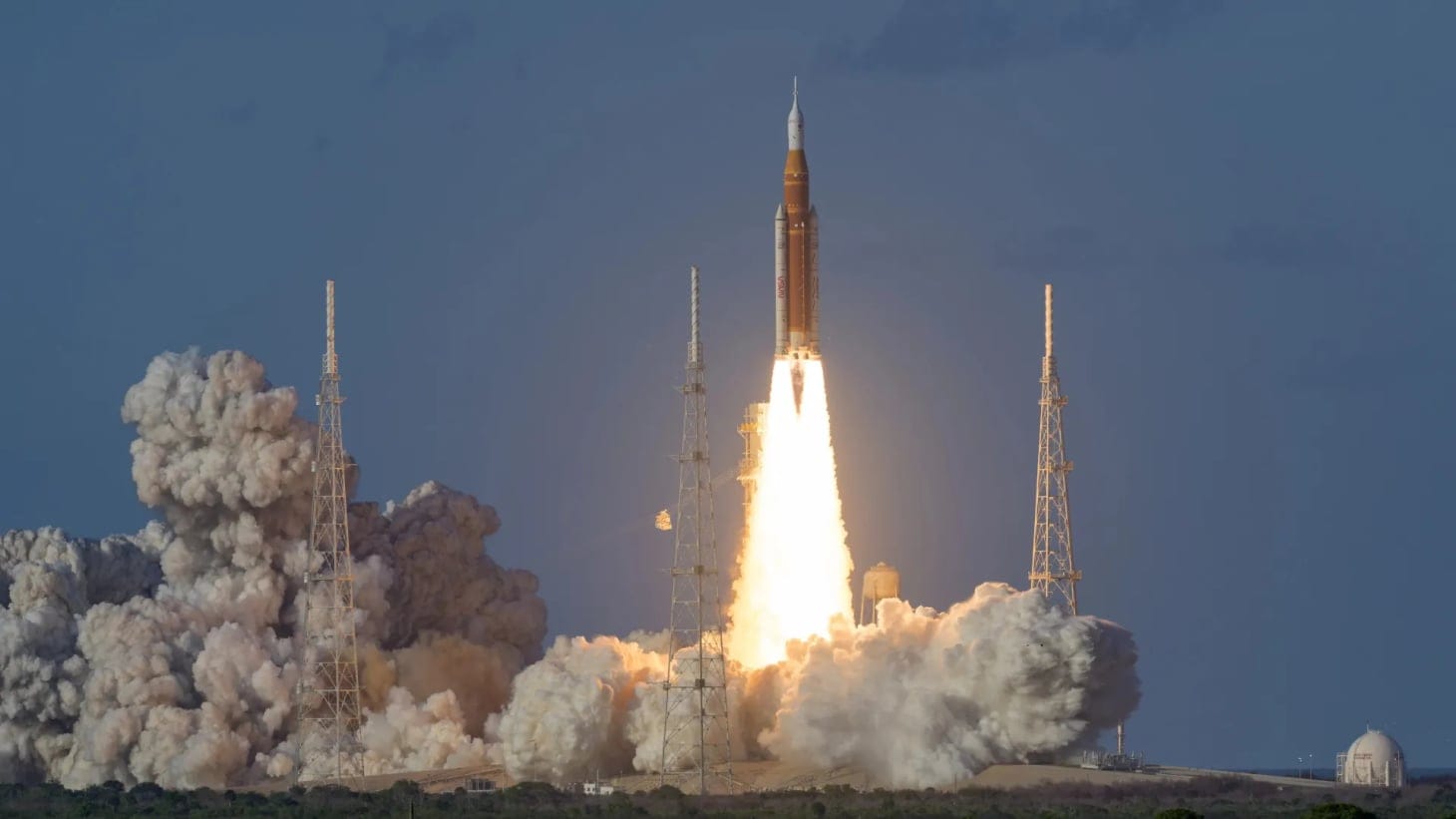

Artemis 2 lifted off from Kennedy Space Center at 8:23 a.m. Eastern Time today, marking humanity's first crewed mission beyond low Earth orbit since Apollo 17 in 1972. The Space Launch System rocket and Orion spacecraft are now on a 10-day mission that will loop around the Moon and return to Earth.
The mission tests critical hardware for future lunar landings. Orion will trial laser-optical communications designed to stream high-definition science data across cislunar space, a new radiation-shielding system, and the Orion Crew Survival System—the next-generation lunar suit astronauts will wear during launch, re-entry, and emergencies.
The spacecraft will pass the Moon's far side on day 6 at approximately 6,000 km from the surface. At that point, Orion will be roughly 402,000 km from Earth—farther than any human has ever traveled, eclipsing the Apollo 13 record set in 1970.
Commander Reid Wiseman leads a historic crew. The team includes Victor Glover, the first Black astronaut on a deep-space mission; Christina Koch, the first woman to travel to the Moon; and Jeremy Hansen, the first Canadian on a lunar flight.
The mission paves the way for commercial and scientific partners to expand lunar research. Data from Artemis 2 will guide habitat design, resource extraction strategies, and long-duration crew health protocols—foundational work for a sustainable human presence beyond Earth.
NASA is streaming the mission live on its YouTube channel and expects to release the first lunar-surface photographs around day 6. Splashdown is scheduled for approximately 10 days after launch, after which the crew will undergo medical evaluation and share lessons learned for Artemis 3.
Exploration is humanity's longest-running experiment. Today, we added another data point.