
Logo
Decide better.Live better.
My feedToday
Logo
Decide better.Live better.
My feedToday
Logo
My feedToday

Stay Curious. Stay Wanture.

© 2026 Wanture. All rights reserved.

  • Terms of Use
  • Privacy Policy
Logo
Decide better.Live better.
My feedTodayTechScienceHealthMobilityMindProductivityHomeExperiencesLongevity
Logo
Decide better.Live better.
My feedTodayTechScienceHealthMobilityMindProductivityHomeExperiencesLongevity
Logo
My feedTodayTechScienceHealthMobilityMindProductivityHomeExperiencesLongevity

MIT Built a Battery That Breathes Air

Sodium-air fuel cell hits 1,700 watt-hours per kilogram—enough to power electric planes

MIT Built a Battery That Breathes Air

MIT engineers created a fuel cell that pulls oxygen from the atmosphere and runs on sodium from sea salt. It delivers 1,700 watt-hours per kilogram, seven times the energy density of lithium-ion batteries. This breakthrough makes electric aviation economically viable. The ceramic core operates safely at high temperatures without fire risk.

5 December 2025

—

Explainer

Nadia Bennett
banner

Summary:

  • MIT engineers develop sodium-air fuel cell achieving 1,700 watt-hours/kg, enabling practical electric aviation with breakthrough energy density.
  • Fuel cell uses sodium metal and atmospheric oxygen, with a ceramic electrolyte creating a safe, refillable power system for aircraft.
  • Technology targets drone testing within a year, with potential for regional electric flights by 2040, transforming transportation infrastructure.

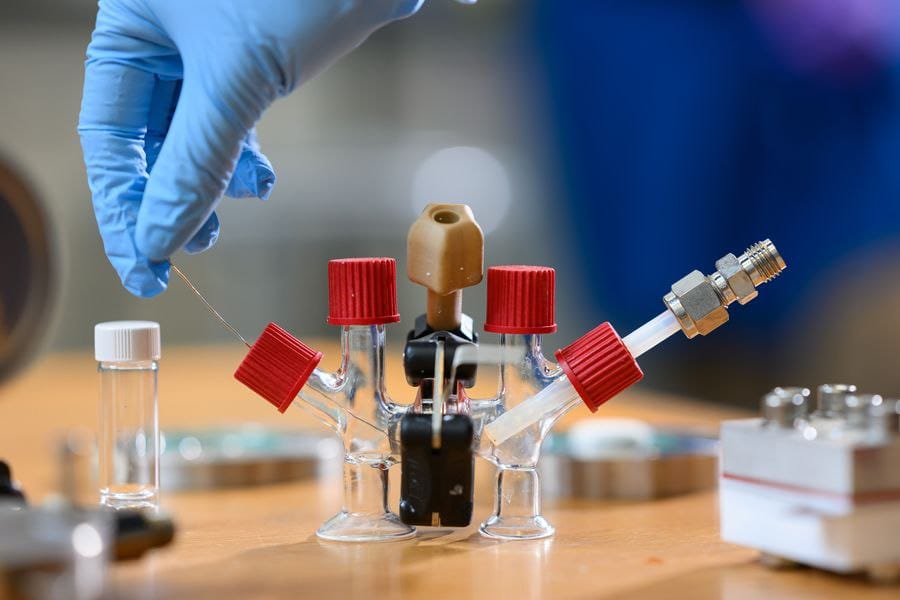
MIT engineers built a battery that breathes. It pulls oxygen from the air. It runs on sodium from sea salt. And it delivers 1,700 watt-hours per kilogram. That's enough energy density to lift electric aircraft off the ground and keep them flying.

What It Is

A sodium-air fuel cell generates electricity by reacting liquid sodium metal with oxygen drawn directly from the atmosphere. Unlike the rechargeable lithium-ion battery in your phone, this is a fuel cell. You fill it with sodium fuel, similar to filling a gas tank. The sodium reacts with ambient air to produce power. When the sodium runs out, you refill it rather than plugging it in to recharge.

Why It Matters

Commercial aviation remains trapped by a brutal constraint. Planes need enormous energy to lift cargo and passengers. Current lithium-ion batteries are too heavy. The MIT fuel cell achieves 1,700 watt-hours per kilogram at stack level. That's a 70% margin above the minimum threshold engineers say electric aviation requires. Airlines could operate regional electric routes profitably within the next two decades.

How Sodium-Air Fuel Cells Work

Sodium as the Active Fuel

Sodium metal is highly reactive. When it meets oxygen, it forms sodium peroxide. That reaction releases electrons. Those electrons become electric current.

The fuel cell stores pure sodium in a protected chamber. Oxygen comes from ambient air. The cell doesn't carry an oxidizer tank. It breathes like a jet engine. That saves weight. It saves space. And it enables the energy density numbers that make aviation viable.

Think of it like starting a car. You need fuel and oxygen. Mix them together, and you get energy. Here, sodium is the fuel. Air provides the oxygen. The result is electricity instead of combustion.

The Ceramic Electrolyte Barrier

The solid ceramic electrolyte is the safety layer. It works like a coffee filter. A filter lets coffee through but blocks the grounds. The ceramic lets sodium ions pass but blocks electrons. This separation creates voltage while keeping reactive sodium contained.

Ceramic electrolytes operate at 572 to 752 degrees Fahrenheit (300 to 400 degrees Celsius). That's hot, but manageable. Aircraft engines already generate significant heat. Thermal management systems are part of aviation design. The ceramic doesn't evaporate. It doesn't degrade. And it eliminates the fire risk that haunts lithium-ion systems.

Drawing Oxygen from the Atmosphere

The cell pulls oxygen directly from surrounding air. This is how jet engines work. They use ambient air rather than carrying oxidizer. The oxygen reacts with sodium ions at the cathode (the positive electrode where the chemical reaction occurs). This forms sodium peroxide and completes the electrical circuit.

In a traditional battery, both fuel and oxidizer are stored internally. Here, only sodium is stored. That's the breakthrough. The energy-to-weight ratio jumps because half the reaction mass comes from the environment. You're not lifting it off the ground. You're pulling it from the air around you.

Carbon Dioxide as a Byproduct

The reaction also captures carbon dioxide. Sodium peroxide binds with CO₂ from the air during operation. This isn't the primary function. It's an elegant side effect. The cell doesn't just avoid emissions. It removes a small amount of atmospheric carbon.

The scale per cell is modest. But deploy this across thousands of flights, and the cumulative effect becomes measurable. It's systems-level thinking where chemistry, physics, and infrastructure align.

Real-World Applications

Example 1: Large Drone Testing

The MIT team isn't starting with passenger jets. Their first target is large drones. These platforms are smaller and face less regulatory scrutiny. They allow rapid iteration on design.

The team plans to build a brick-sized prototype for initial testing. This form factor generates useful power while remaining testable on unmanned aerial vehicles. This approach demonstrates the concept under real flight conditions without the regulatory complexity of manned aircraft. Once the design proves stable, the technology scales to larger commercial platforms.

Example 2: Maritime Vessel Electrification

Ships face the same energy challenges as planes. They need high power output for long durations. They carry heavy cargo. And they're among the largest contributors to transportation emissions globally.

Maritime companies have expressed interest in electric propulsion systems for short-haul routes. Sodium-air fuel cells could address maritime electrification in parallel with aviation. The same energy density that lifts an aircraft can propel a cargo vessel. The ceramic electrolyte survives saltwater environments with proper housing.

Advantages Over Lithium-Ion Batteries

Lithium-ion batteries store energy in metal compounds. They're rechargeable. They're proven. But they hit a physics ceiling around 300 watt-hours per kilogram. Incremental improvements won't break that barrier.

The sodium-air fuel cell generates energy through reaction, not storage. It's refillable, not rechargeable. That distinction matters. Refilling is faster than recharging. Think gas station versus phone charging. Pull up, fill the tank, keep moving. And the energy density scales beyond what storage chemistry allows.

Sodium is abundant. Lithium is scarce. Sodium extraction is decentralized. Lithium mining is geopolitically concentrated. One system depends on resource access. The other depends on seawater. Coastal regions could extract sodium domestically, reducing supply chain vulnerabilities.

Ceramic electrolytes are stable. Liquid electrolytes in lithium-ion cells are flammable. One design eliminates fire risk. The other manages it through engineering controls.

Common Misconceptions

Myth: Sodium-air fuel cells are rechargeable like phone batteries.

Reality: These are fuel cells, not rechargeable batteries. You refill them with sodium fuel, similar to filling a gas tank. The spent sodium peroxide is replaced with fresh sodium. The process takes minutes, not hours.

Myth: Sodium is dangerous because it reacts violently with water.

Reality: The sodium is sealed inside a ceramic electrolyte that prevents contact with moisture. The ceramic operates at high temperature and blocks water vapor. The design isolates reactive sodium completely. This is safer than lithium-ion batteries, which contain flammable liquid electrolytes.

Myth: Electric planes using this technology will fly next year.

Reality: This is a fifteen-to-twenty-year infrastructure project. The physics work. The materials are available. But production scaling, certification, and supply chain development take time. Regional electric flights are likely in the coming decades, not immediate years.

What Comes Next

The prototype phase will test thermal management, power output stability, and durability. Sodium-air fuel cells need to handle rapid power draw changes during takeoff and landing. They need to operate reliably at altitude. And they need to demonstrate lifecycle performance that justifies manufacturing investment.

The MIT team has formed a startup to commercialize the technology, with support from government research programs focused on advancing high-energy-density technologies. These programs support innovations achieving energy densities above 1,000 watt-hours per kilogram.

Aviation certification requirements will be extensive. Regulatory agencies evaluate new propulsion systems for years before commercial approval. Government initiatives supporting clean aviation goals are providing funding through the 2030s. Airlines are monitoring electric propulsion developments closely.

If these milestones are met, production scaling becomes the next challenge. Ceramic electrolyte manufacturing is more complex than rolling out lithium-ion sheets. Specialized facilities will need to be built. Supply chains for high-purity sodium will need to scale.

This isn't a five-year timeline. It's a fifteen-to-twenty-year infrastructure project. But the physics work. The materials are available. And the energy density numbers are verified.

Energy density has always been the limiting factor in electric transportation. Batteries improved steadily over two decades, but the gains were incremental. This is different. This is a step-change improvement.

If this technology scales, it changes the economics of electric aviation. Airlines could operate regional electric routes profitably. Cargo companies could electrify short-haul flights. And manufacturers could design aircraft around electric propulsion rather than retrofitting jet designs.

This is what it looks like when engineering solves the problem rather than working around it. The Wright brothers didn't improve horse-drawn carriages. They built something entirely new. This fuel cell does the same for electric flight. It's not an upgrade. It's a different approach to the fundamental problem.

The Takeaway

Sodium-air fuel cells achieve 1,700 watt-hours per kilogram by reacting abundant sodium with atmospheric oxygen through a stable ceramic electrolyte. Understanding this breakthrough matters because it represents the first practical path to commercial electric aviation. The technology moves from MIT labs to prototype testing, with regional electric flights becoming feasible in the coming decades. For tech-savvy readers, this represents a fundamental shift in how we approach energy storage—not through incremental battery improvements, but through reimagining the chemistry itself. This is the kind of breakthrough that transforms industries and creates new possibilities for sustainable transportation within our lifetimes.

Sources:

  • MIT News Office press release on sodium-air fuel cell research
  • U.S. Advanced Research Projects Agency-Energy program documentation
  • Department of Mechanical Engineering, Massachusetts Institute of Technology
  • Federal Aviation Administration propulsion system requirements
  • Clean aviation technology research reports

What is this about?

  • Explainer/
  • Nadia Bennett/
  • Mobility/
  • Aviation

Feed

    Tesla gets European approval for semi-autonomous driving — here's what you need to pass before using it

    Tesla gets European approval for semi-autonomous driving — here's what you need to pass before using it

    You must pass a mandatory safety quiz and accept a "Max Speed" setting as regulators weigh U.S. crash data against autonomous claims

    Auden Wheelock3 days ago
    Apple Breaks Autumn Cadence: iPhone 18 Pro and iPhone Ultra

    Apple Breaks Autumn Cadence: iPhone 18 Pro and iPhone Ultra

    Plan purchases around September’s standard lineup or wait for Q4 hardware

    Ben Ramos4 days ago
    Apple Watch Ultra 4 could track blood pressure trends

    Apple Watch Ultra 4 could track blood pressure trends

    A potential hardware redesign with 8 sensors aims to move from simple alerts to direct cardiovascular measurement

    Ben Ramos22 May 2026

    Your earbuds could become a secure digital key via your heartbeat

    AccLock uses standard accelerometers to verify identity without needing premium optical heart trackers

    Ben Ramos21 May 2026
    Memory chip shortages could end by 2027

    Memory chip shortages could end by 2027

    Aggressive Chinese production expansions from YMTC and CXMT may lower hardware costs sooner than the 2030 consensus

    Ben Ramos21 May 2026
    Hisense Explorer X1 Pro brings 120-inch cinema to your living room

    Hisense Explorer X1 Pro brings 120-inch cinema to your living room

    A new tri-color laser engine offers 110% BT.2020 color gamut, though US availability remains unannounced

    Logan Price21 May 2026
    Onyx Boox Poke 7 series brings paper-like clarity to your library

    Onyx Boox Poke 7 series brings paper-like clarity to your library

    New 300 ppi displays and 2 TB expandable storage offer a sharper, larger reading experience

    Ben Ramos20 May 2026
    SpaceX IPO: A historic bet on the space economy

    SpaceX IPO: A historic bet on the space economy

    With 2025 revenue hitting $18.6 billion, the Nasdaq debut tests market appetite for Elon Musk

    Jasmine Wu20 May 2026
    Figma AI agents turn manual design into high-level direction

    Figma AI agents turn manual design into high-level direction

    New intent-based tools allow designers to build layouts using natural language instead of clicking and dragging

    Evelyn Park20 May 2026
    NanoClaw's sandbox stops AI agents from compromising your OS

    NanoClaw's sandbox stops AI agents from compromising your OS

    NanoCo secures $12 million to scale its isolated architecture for enterprise AI deployment

    Marcus Dillard20 May 2026
    Loading...

MIT Built a Battery That Breathes Air

Sodium-air fuel cell hits 1,700 watt-hours per kilogram—enough to power electric planes

December 5, 2025, 11:30 pm

MIT engineers created a fuel cell that pulls oxygen from the atmosphere and runs on sodium from sea salt. It delivers 1,700 watt-hours per kilogram, seven times the energy density of lithium-ion batteries. This breakthrough makes electric aviation economically viable. The ceramic core operates safely at high temperatures without fire risk.

MIT Built a Battery That Breathes Air

Summary

  • MIT engineers develop sodium-air fuel cell achieving 1,700 watt-hours/kg, enabling practical electric aviation with breakthrough energy density.
  • Fuel cell uses sodium metal and atmospheric oxygen, with a ceramic electrolyte creating a safe, refillable power system for aircraft.
  • Technology targets drone testing within a year, with potential for regional electric flights by 2040, transforming transportation infrastructure.

MIT engineers built a battery that breathes. It pulls oxygen from the air. It runs on sodium from sea salt. And it delivers 1,700 watt-hours per kilogram. That's enough energy density to lift electric aircraft off the ground and keep them flying.

What It Is

A sodium-air fuel cell generates electricity by reacting liquid sodium metal with oxygen drawn directly from the atmosphere. Unlike the rechargeable lithium-ion battery in your phone, this is a fuel cell. You fill it with sodium fuel, similar to filling a gas tank. The sodium reacts with ambient air to produce power. When the sodium runs out, you refill it rather than plugging it in to recharge.

Why It Matters

Commercial aviation remains trapped by a brutal constraint. Planes need enormous energy to lift cargo and passengers. Current lithium-ion batteries are too heavy. The MIT fuel cell achieves 1,700 watt-hours per kilogram at stack level. That's a 70% margin above the minimum threshold engineers say electric aviation requires. Airlines could operate regional electric routes profitably within the next two decades.

How Sodium-Air Fuel Cells Work

Sodium as the Active Fuel

Sodium metal is highly reactive. When it meets oxygen, it forms sodium peroxide. That reaction releases electrons. Those electrons become electric current.

The fuel cell stores pure sodium in a protected chamber. Oxygen comes from ambient air. The cell doesn't carry an oxidizer tank. It breathes like a jet engine. That saves weight. It saves space. And it enables the energy density numbers that make aviation viable.

Think of it like starting a car. You need fuel and oxygen. Mix them together, and you get energy. Here, sodium is the fuel. Air provides the oxygen. The result is electricity instead of combustion.

The Ceramic Electrolyte Barrier

The solid ceramic electrolyte is the safety layer. It works like a coffee filter. A filter lets coffee through but blocks the grounds. The ceramic lets sodium ions pass but blocks electrons. This separation creates voltage while keeping reactive sodium contained.

Ceramic electrolytes operate at 572 to 752 degrees Fahrenheit (300 to 400 degrees Celsius). That's hot, but manageable. Aircraft engines already generate significant heat. Thermal management systems are part of aviation design. The ceramic doesn't evaporate. It doesn't degrade. And it eliminates the fire risk that haunts lithium-ion systems.

Drawing Oxygen from the Atmosphere

The cell pulls oxygen directly from surrounding air. This is how jet engines work. They use ambient air rather than carrying oxidizer. The oxygen reacts with sodium ions at the cathode (the positive electrode where the chemical reaction occurs). This forms sodium peroxide and completes the electrical circuit.

In a traditional battery, both fuel and oxidizer are stored internally. Here, only sodium is stored. That's the breakthrough. The energy-to-weight ratio jumps because half the reaction mass comes from the environment. You're not lifting it off the ground. You're pulling it from the air around you.

Carbon Dioxide as a Byproduct

The reaction also captures carbon dioxide. Sodium peroxide binds with CO₂ from the air during operation. This isn't the primary function. It's an elegant side effect. The cell doesn't just avoid emissions. It removes a small amount of atmospheric carbon.

The scale per cell is modest. But deploy this across thousands of flights, and the cumulative effect becomes measurable. It's systems-level thinking where chemistry, physics, and infrastructure align.

Real-World Applications

Example 1: Large Drone Testing

The MIT team isn't starting with passenger jets. Their first target is large drones. These platforms are smaller and face less regulatory scrutiny. They allow rapid iteration on design.

The team plans to build a brick-sized prototype for initial testing. This form factor generates useful power while remaining testable on unmanned aerial vehicles. This approach demonstrates the concept under real flight conditions without the regulatory complexity of manned aircraft. Once the design proves stable, the technology scales to larger commercial platforms.

Example 2: Maritime Vessel Electrification

Ships face the same energy challenges as planes. They need high power output for long durations. They carry heavy cargo. And they're among the largest contributors to transportation emissions globally.

Maritime companies have expressed interest in electric propulsion systems for short-haul routes. Sodium-air fuel cells could address maritime electrification in parallel with aviation. The same energy density that lifts an aircraft can propel a cargo vessel. The ceramic electrolyte survives saltwater environments with proper housing.

Advantages Over Lithium-Ion Batteries

Lithium-ion batteries store energy in metal compounds. They're rechargeable. They're proven. But they hit a physics ceiling around 300 watt-hours per kilogram. Incremental improvements won't break that barrier.

The sodium-air fuel cell generates energy through reaction, not storage. It's refillable, not rechargeable. That distinction matters. Refilling is faster than recharging. Think gas station versus phone charging. Pull up, fill the tank, keep moving. And the energy density scales beyond what storage chemistry allows.

Sodium is abundant. Lithium is scarce. Sodium extraction is decentralized. Lithium mining is geopolitically concentrated. One system depends on resource access. The other depends on seawater. Coastal regions could extract sodium domestically, reducing supply chain vulnerabilities.

Ceramic electrolytes are stable. Liquid electrolytes in lithium-ion cells are flammable. One design eliminates fire risk. The other manages it through engineering controls.

Common Misconceptions

Myth: Sodium-air fuel cells are rechargeable like phone batteries.

Reality: These are fuel cells, not rechargeable batteries. You refill them with sodium fuel, similar to filling a gas tank. The spent sodium peroxide is replaced with fresh sodium. The process takes minutes, not hours.

Myth: Sodium is dangerous because it reacts violently with water.

Reality: The sodium is sealed inside a ceramic electrolyte that prevents contact with moisture. The ceramic operates at high temperature and blocks water vapor. The design isolates reactive sodium completely. This is safer than lithium-ion batteries, which contain flammable liquid electrolytes.

Myth: Electric planes using this technology will fly next year.

Reality: This is a fifteen-to-twenty-year infrastructure project. The physics work. The materials are available. But production scaling, certification, and supply chain development take time. Regional electric flights are likely in the coming decades, not immediate years.

What Comes Next

The prototype phase will test thermal management, power output stability, and durability. Sodium-air fuel cells need to handle rapid power draw changes during takeoff and landing. They need to operate reliably at altitude. And they need to demonstrate lifecycle performance that justifies manufacturing investment.

The MIT team has formed a startup to commercialize the technology, with support from government research programs focused on advancing high-energy-density technologies. These programs support innovations achieving energy densities above 1,000 watt-hours per kilogram.

Aviation certification requirements will be extensive. Regulatory agencies evaluate new propulsion systems for years before commercial approval. Government initiatives supporting clean aviation goals are providing funding through the 2030s. Airlines are monitoring electric propulsion developments closely.

If these milestones are met, production scaling becomes the next challenge. Ceramic electrolyte manufacturing is more complex than rolling out lithium-ion sheets. Specialized facilities will need to be built. Supply chains for high-purity sodium will need to scale.

This isn't a five-year timeline. It's a fifteen-to-twenty-year infrastructure project. But the physics work. The materials are available. And the energy density numbers are verified.

Energy density has always been the limiting factor in electric transportation. Batteries improved steadily over two decades, but the gains were incremental. This is different. This is a step-change improvement.

If this technology scales, it changes the economics of electric aviation. Airlines could operate regional electric routes profitably. Cargo companies could electrify short-haul flights. And manufacturers could design aircraft around electric propulsion rather than retrofitting jet designs.

This is what it looks like when engineering solves the problem rather than working around it. The Wright brothers didn't improve horse-drawn carriages. They built something entirely new. This fuel cell does the same for electric flight. It's not an upgrade. It's a different approach to the fundamental problem.

The Takeaway

Sodium-air fuel cells achieve 1,700 watt-hours per kilogram by reacting abundant sodium with atmospheric oxygen through a stable ceramic electrolyte. Understanding this breakthrough matters because it represents the first practical path to commercial electric aviation. The technology moves from MIT labs to prototype testing, with regional electric flights becoming feasible in the coming decades. For tech-savvy readers, this represents a fundamental shift in how we approach energy storage—not through incremental battery improvements, but through reimagining the chemistry itself. This is the kind of breakthrough that transforms industries and creates new possibilities for sustainable transportation within our lifetimes.

Sources:

  • MIT News Office press release on sodium-air fuel cell research
  • U.S. Advanced Research Projects Agency-Energy program documentation
  • Department of Mechanical Engineering, Massachusetts Institute of Technology
  • Federal Aviation Administration propulsion system requirements
  • Clean aviation technology research reports

What is this about?

  • Explainer/
  • Nadia Bennett/
  • Mobility/
  • Aviation

Feed

    Tesla gets European approval for semi-autonomous driving — here's what you need to pass before using it

    Tesla gets European approval for semi-autonomous driving — here's what you need to pass before using it

    You must pass a mandatory safety quiz and accept a "Max Speed" setting as regulators weigh U.S. crash data against autonomous claims

    Auden Wheelock3 days ago
    Apple Breaks Autumn Cadence: iPhone 18 Pro and iPhone Ultra

    Apple Breaks Autumn Cadence: iPhone 18 Pro and iPhone Ultra

    Plan purchases around September’s standard lineup or wait for Q4 hardware

    Ben Ramos4 days ago
    Apple Watch Ultra 4 could track blood pressure trends

    Apple Watch Ultra 4 could track blood pressure trends

    A potential hardware redesign with 8 sensors aims to move from simple alerts to direct cardiovascular measurement

    Ben Ramos22 May 2026

    Your earbuds could become a secure digital key via your heartbeat

    AccLock uses standard accelerometers to verify identity without needing premium optical heart trackers

    Ben Ramos21 May 2026
    Memory chip shortages could end by 2027

    Memory chip shortages could end by 2027

    Aggressive Chinese production expansions from YMTC and CXMT may lower hardware costs sooner than the 2030 consensus

    Ben Ramos21 May 2026
    Hisense Explorer X1 Pro brings 120-inch cinema to your living room

    Hisense Explorer X1 Pro brings 120-inch cinema to your living room

    A new tri-color laser engine offers 110% BT.2020 color gamut, though US availability remains unannounced

    Logan Price21 May 2026
    Onyx Boox Poke 7 series brings paper-like clarity to your library

    Onyx Boox Poke 7 series brings paper-like clarity to your library

    New 300 ppi displays and 2 TB expandable storage offer a sharper, larger reading experience

    Ben Ramos20 May 2026
    SpaceX IPO: A historic bet on the space economy

    SpaceX IPO: A historic bet on the space economy

    With 2025 revenue hitting $18.6 billion, the Nasdaq debut tests market appetite for Elon Musk

    Jasmine Wu20 May 2026
    Figma AI agents turn manual design into high-level direction

    Figma AI agents turn manual design into high-level direction

    New intent-based tools allow designers to build layouts using natural language instead of clicking and dragging

    Evelyn Park20 May 2026
    NanoClaw's sandbox stops AI agents from compromising your OS

    NanoClaw's sandbox stops AI agents from compromising your OS

    NanoCo secures $12 million to scale its isolated architecture for enterprise AI deployment

    Marcus Dillard20 May 2026
    Loading...
Home
Home
Search
Search
banner