
• My Feed
  • Home
  • What's Important
  • Media & Entertainment
Search

Stay Curious. Stay Wanture.

© 2026 Wanture. All rights reserved.

  • Terms of Use
  • Privacy Policy
Health/Mental
What Actually Happens to Your Brain During a Digital Detox?

The neuroscience behind dopamine recalibration, sleep quality, and why extreme phone fasts backfire

11 February 2026

—

Explainer *

Cameron Ellis
banner

Your phone operates on the same reward mechanism as a slot machine, recalibrating your brain's dopamine sensitivity with every scroll. Research shows measurable cognitive shifts happen within days of strategic reduction—but only if you understand what you're actually resetting. Here's the science behind digital detox, who benefits most, and why small friction beats cold turkey every time.

image-230

Summary:

  • Apps exploit variable reinforcement—unpredictable rewards like slot machines—triggering dopamine hits that recalibrate your brain's sensitivity threshold, making normal activities feel boring and fragmenting baseline concentration within days.
  • Strategic detox beats cold turkey: grayscale mode, notification removal, bedroom phone ban, and desktop-only social media add friction without requiring willpower, producing measurable improvements in sleep, focus, and anxiety within 10 days.
  • Studies show limiting use to ≤2 hours daily cuts depression 25%, anxiety 16%, and insomnia 15% in young adults—but detox fails if your phone is a necessary work tool or if life stress, not scrolling, drives the behavior.

You reach for your phone within three minutes of waking up. The first notification pulls you in. Then the second. Then a scroll. By the time you're dressed, you've burned through fifteen minutes of fragmented attention—and you haven't even started your day. This pattern repeats every few hours: unlock, scroll, dopamine hit, lock. Your brain is running on a slot machine schedule.

Digital detox has become the wellness buzzword of 2026, but the question isn't whether you should quit your phone—it's whether recalibrating your relationship with it actually changes anything measurable in your brain and behavior. The answer depends on understanding what's happening under the hood when you scroll.

Your Phone Is a Dopamine Slot Machine

The core issue isn't the device itself—it's the behavioral architecture apps are built on. Every notification, every pull-to-refresh, every autoplay video operates on variable reinforcement: the psychological mechanism that makes slot machines so addictive.

Here's how it works. When a reward is unpredictable—sometimes you get a like, sometimes you don't; sometimes there's a message, sometimes silence—your brain releases dopamine not just when you receive the reward, but in anticipation of it. That's why you compulsively check. You're chasing the possibility.

Over time, constant micro-stimulation from these dopamine hits reduces your brain's sensitivity to dopamine itself. The system recalibrates to expect higher stimulation just to feel normal. The result: your baseline concentration drops, irritability rises, and procrastination becomes your default mode. You're not weak-willed. You're neurologically adapted to a feedback loop designed to capture attention.

Brain imaging research demonstrates this recalibration happens fast. In a 2025 study, just 72 hours of smartphone restriction altered activity in reward, salience, and inhibitory control regions—patterns resembling reward system recalibration seen in other habit-change scenarios. PET imaging has also found that higher proportions of smartphone social app interactions correlate with lower dopamine synthesis capacity in bilateral putamen, providing direct neurochemical evidence linking smartphone social behavior to dopamine function.

The takeaway: detox works only if it reduces the frequency of these dopamine micro-hits long enough for your brain to reset its sensitivity threshold.

What Actually Shifts When You Pull Back

The changes aren't abstract—they show up in measurable cognitive and emotional outcomes within days, not months. In a U.S. cohort study published in November 2025 involving 295 young adults aged 18 to 24, a one-week social media detox produced measurable improvements: depression symptoms decreased by 24.8%, anxiety decreased by 16.1%, and insomnia decreased by 14.5%.

A randomized controlled trial in Austria involving 111 university students found that limiting smartphone use to two hours or less per day for three weeks produced statistically significant improvements in depression, sleep quality, and well-being, though effects attenuated when screen time increased again post-intervention.

Laboratory research has shown that just 45 minutes of smartphone use impaired vigilance and reduced inhibitory control compared to baseline—providing acute evidence that smartphone exposure fragments attention in the short term.

People report a stronger subjective sense of time—hours feel longer, days feel less blurred. Sleep quality improves significantly when screens are removed one to two hours before bed. The effects are most pronounced in specific groups: individuals with screen time exceeding four to five hours daily on their phones (not counting work computers), those experiencing disrupted sleep, people with high baseline anxiety, and teenagers whose dopamine systems are still developing.

But here's the nuance: not everyone benefits equally. If your stress source is work deadlines, relationship conflict, or financial pressure—not the phone itself—digital detox won't solve the underlying problem. It might even increase anxiety if the phone is your primary social connection or coping tool.

Why Extreme Fasts Backfire

A dramatic seven-day "digital fast" sounds appealing, but it often triggers a rebound effect. You white-knuckle through a week, feel temporarily clearheaded, then crash back into old patterns with even more intensity because the environment that shaped the behavior hasn't changed.

The brain adapts to absence the same way it adapts to presence. When you reintroduce the phone after total abstinence, the novelty and dopamine response can actually spike higher than before. It's the same mechanism that makes "cheat days" in diets so destabilizing.

A sustainable model isn't about deprivation—it's about friction and environment design. Small structural changes consistently applied outperform extreme resets every time.

Sleep Gets the Biggest Win

Of all the benefits tied to reducing phone use, sleep quality improvement is the most immediate and measurable. Blue light from screens suppresses melatonin production, the hormone that signals your body it's time to sleep. Late-night scrolling also spikes cortisol—the stress hormone—because your brain interprets the influx of information (news, messages, comparisons) as requiring a response.

Even if the content isn't objectively stressful, the volume and unpredictability create cognitive load. The combination fragments your sleep architecture. You might fall asleep, but your sleep cycles don't deepen properly. Heart rate variability (HRV)—a metric that reflects nervous system recovery—stays elevated, meaning your body never fully shifts into rest mode.

Studies show removing phones from bedrooms reduces sleep onset latency by an average of 14 minutes and increases REM sleep duration by 8 to 12 percent. For someone averaging six hours of sleep, that translates to an additional 29 to 43 minutes of restorative REM sleep per night—the phase critical for memory consolidation and emotional processing.

One intervention alone—"phone out of the bedroom"—improves sleep onset latency (how long it takes to fall asleep), sleep depth, and HRV. You don't need a full detox. You need physical distance during the hours your brain is trying to power down.

Who Benefits Most—and When Detox Doesn't Work

Digital detox isn't a universal solution, and pretending it is undermines trust in the intervention. The people who see the clearest benefits: individuals with anxiety disorders, particularly social anxiety amplified by comparison loops on Instagram or TikTok; teenagers, whose prefrontal cortex (the region managing impulse control and long-term planning) is still developing and more vulnerable to addictive design; people whose work demands sustained cognitive load—designers, writers, researchers, developers—who notice context-switching is fracturing their ability to hold deep focus; anyone showing signs of dopamine burnout—apathy, distractibility, inability to enjoy activities that used to feel rewarding.

Longitudinal neuroimaging data from approximately 8,324 children aged 9 to 11 found that higher screen time was associated with greater reward orientation and weaker fronto-striatal connectivity (inhibitory control network) over two years—suggesting high screen exposure influences development of reward-control circuits.

A composite example illustrates the pattern: a 32-year-old software engineer in Austin reduced her evening screen time from 4.5 hours to 90 minutes using only two interventions—grayscale mode and bedroom phone removal. Within 10 days, her sleep tracker showed REM sleep increased from 68 to 94 minutes per night. The measurable nature of these interventions also appeals to the growing number of people using wearables—HRV data, sleep scores, and activity tracking can validate whether the detox is working within days.

When detox doesn't work: if the phone is a necessary work tool with no viable alternative (you're on-call, managing remote teams, or coordinating care); if stress originates from life circumstances—job insecurity, health issues, relationship conflict—not from digital consumption; if you replace scrolling with another high-stimulation behavior (binge-watching, gaming, compulsive snacking) without addressing the underlying need for distraction.

The mechanism matters more than the tool. If you're using your phone to avoid something, removing the phone won't resolve what you're avoiding.

The Smart Detox Model: Restructure, Don't Restrict

Instead of abstinence, the goal is environment design—making the default behavior the healthier one without relying on willpower. Here's the practical framework:

  1. Turn off all push notifications except critical ones. Calls, texts from specific contacts, calendar alerts. Everything else—email, social media, news apps—switches to pull-only. You check them when you decide, not when they decide.
  2. Set your phone screen to grayscale. Color is a core part of what makes interfaces addictive. Instagram's gradient logo, YouTube's red play button, the green dot on messaging apps—all designed to trigger dopamine. Grayscale removes that hook. Most phones have this in accessibility settings.
  3. Access social media only from a desktop or laptop. Adding friction—having to sit down, open a browser, log in—reduces impulsive use. You'll still check it, but the frequency drops dramatically.
  4. Don't pick up your phone during the first 30 to 60 minutes after waking. Morning attention is your highest-quality cognitive window. Spending it on notifications fragments your focus before you've even started. Replace it with something that doesn't require a screen: coffee, movement, journaling, breakfast.
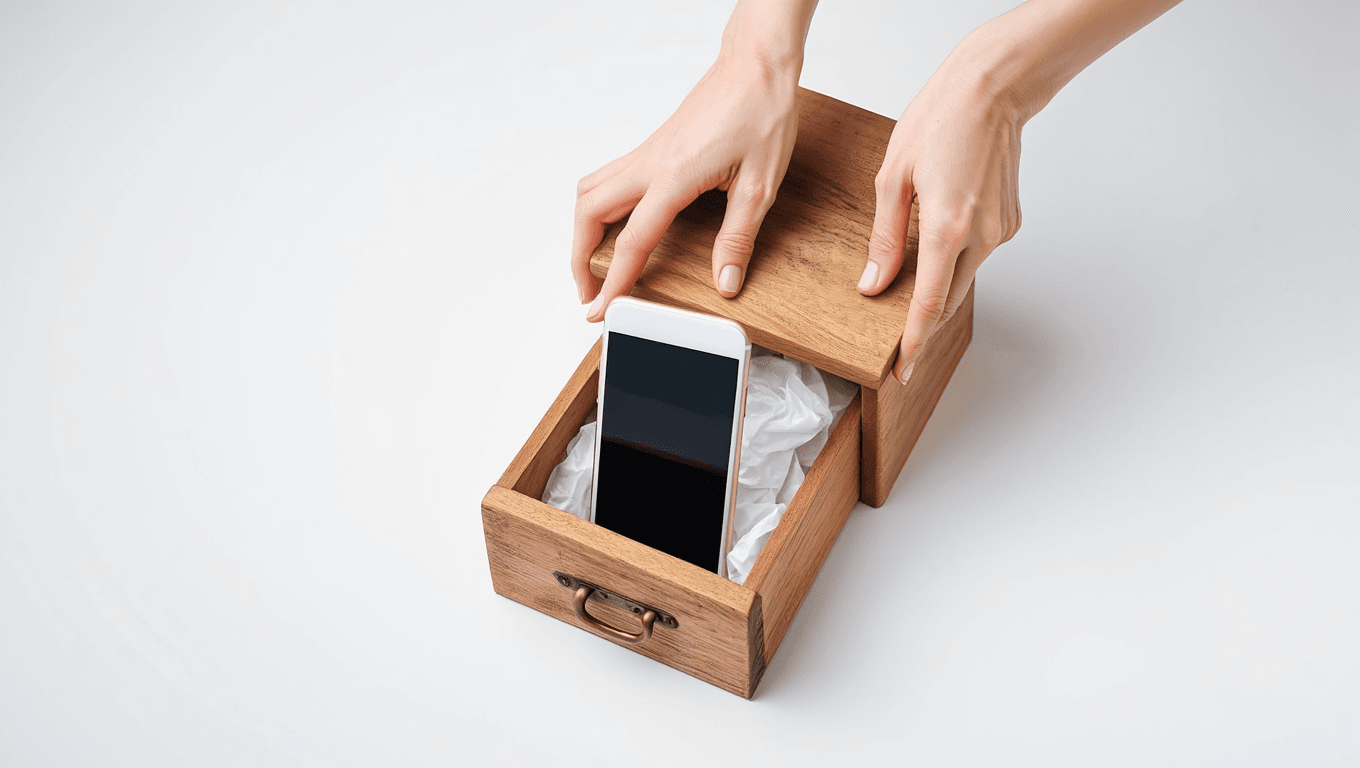
  5. Physically remove the phone from the bedroom at night. Charge it in another room. Buy a ten-dollar alarm clock if you're using your phone as one. This single change has the highest return on effort for sleep quality.

These aren't rules. They're design constraints. The goal is to make the phone slightly less convenient for low-value use, while keeping it fully functional for intentional use.

What You're Actually Resetting

Digital detox doesn't work because "phones are evil." It works because it reduces three specific types of cognitive strain: fragmentation, dopamine overload, and informational anxiety.

Fragmentation happens when your attention is interrupted every few minutes. Even if you don't fully engage with the notification, your brain has to decide whether to respond—and that decision costs cognitive energy. Over weeks and months, those micro-interruptions erode your ability to sustain focus on complex tasks.

Dopamine overload recalibrates your reward threshold. When your brain gets used to constant novelty and stimulation, activities that require patience—reading a book, having a slow conversation, working through a difficult problem—feel unbearably boring. You're not less disciplined. Your baseline has shifted.

Informational anxiety is the low-grade stress that comes from constant awareness of everything happening everywhere. Wars, climate reports, celebrity drama, friend updates, work emails—all compressed into a feed that never stops. Your nervous system wasn't built for this volume of input. It interprets the noise as threat, even when nothing in your immediate environment has changed.

When you reduce phone use strategically, your brain returns to a more natural attention regulation rhythm. Not because you've "purified" yourself, but because you've stopped feeding a system that was never designed for human neurology in the first place.

The result isn't perfection. It's recalibration. And recalibration is enough.
What is this about?

  • Explainer */
  • Cameron Ellis/
  • Health/
  • Mental
  • digital wellness/
  • neuroscience/
  • neuroplasticity/
  • sleep architecture/
  • dopamine regulation/
  • attention economy

Feed

    Button AI Assistant Debuts, Offering Screen‑Free Voice Help

    Button AI Assistant Debuts, Offering Screen‑Free Voice Help

    Nostalgic iPod Shuffle design meets privacy‑first press‑to‑talk AI

    about 23 hours ago
    Razer Hammerhead V3 HyperSpeed Debuts with Dual‑Mode Case

    Razer Hammerhead V3 HyperSpeed Debuts with Dual‑Mode Case

    The USB‑C case also serves as a 2.4 GHz receiver, cutting dongles for PS5 and phones

    about 24 hours ago
    Apple ships 6.2 million Macs Q1 2026, M5‑MacBook Pro leads

    Apple ships 6.2 million Macs Q1 2026, M5‑MacBook Pro leads

    Apple’s share rises to 9.5%, moving it into fourth place among global PC makers

    about 24 hours ago
    Galaxy S22 Ultra can be bricked after factory reset

    Galaxy S22 Ultra can be bricked after factory reset

    US owners report IMEI‑level lock that hands control to unknown administrator Numero LLC

    about 24 hours ago
    Mouse: P.I. for Hire arrives April 16 on PC, PS5, and Xbox

    Mouse: P.I. for Hire arrives April 16 on PC, PS5, and Xbox

    Modes: 4K 60 fps quality or 120 fps performance on PS5 and Xbox Series X

    about 24 hours ago
    YouTube Rolls Out Auto Speed for Premium Users

    YouTube Rolls Out Auto Speed for Premium Users

    The AI‑driven playback boost aims to cut dead air on long videos

    2 days ago
    Blackwell Set to Capture Majority of the 2026 GPU Market

    Blackwell Set to Capture Majority of the 2026 GPU Market

    GB300/B300 GPUs Push Blackwell to 71% of Shipments; Rubin Falls to 22%

    2 days ago
    Google launches AI avatar tool for Shorts on April 9, 2026

    Google launches AI avatar tool for Shorts on April 9, 2026

    Ages 18+ can create digital replicas, with Synth ID tags and a 3‑year auto‑delete

    2 days ago
    Mac OS X 10.0 Cheetah runs on Wii

    Mac OS X 10.0 Cheetah runs on Wii

    Ports Mac OS X 10.0 Cheetah to the Wii, showing the PowerPC 750CL can run an OS

    2 days ago
    DuoBell Beats ANC: Safer Cycling with Apple AirPods Max

    DuoBell Beats ANC: Safer Cycling with Apple AirPods Max

    A 750 Hz blind‑spot lets DuoBell cut through ANC on popular headphones

    2 days ago
    Škoda DuoBell prototype unveiled on April 5, 2026

    Škoda DuoBell prototype unveiled on April 5, 2026

    750 Hz pulse and 2,000 Hz chime cut through ANC, alerting riders faster at 15 mph

    2 days ago
    SteamGPT Leak Reveals Dual‑Role AI on Steam

    SteamGPT Leak Reveals Dual‑Role AI on Steam

    Leak shows AI handling support and cheat‑detection for millions on the platform

    2 days ago
    Oppo Pad mini challenges Apple with Snapdragon 8 Gen 5

    Oppo Pad mini challenges Apple with Snapdragon 8 Gen 5

    April 21: Oppo Pad mini 8.8‑inch, Snapdragon 8 Gen 5, 5.39 mm, 279 g, 144 Hz OLED

    2 days ago
    Apple to ship 3 million foldable iPhones by end‑2026

    Apple to ship 3 million foldable iPhones by end‑2026

    Limited rollout equals 12 % of iPhone volume and rivals Samsung’s 2.4 million Galaxy Z Fold 7 sales

    2 days ago
    Apple unveils iPhone 18 Pro, iPhone 18 Pro Max, and iPhone Ultra

    Apple unveils iPhone 18 Pro, iPhone 18 Pro Max, and iPhone Ultra

    Mockups match leaked renders; 20 million Samsung panels for iPhone Ultra

    3 days ago
    Sony launches Playerbase program for Gran Turismo 7

    Sony launches Playerbase program for Gran Turismo 7

    PlayStation gamers can win a flight, facial scan, and an avatar in Gran Turismo 7

    3 days ago
    Claude Mythos Preview Beats Opus 4.6 in Cybersecurity!

    Claude Mythos Preview Beats Opus 4.6 in Cybersecurity!

    Claude Mythos Preview for five partners—pricing after a 100 million token credit

    3 days ago
    ChatGPT and AI Tools Let Solo Founders Launch Fast

    ChatGPT and AI Tools Let Solo Founders Launch Fast

    With GitHub Copilot, a founder can code, design, and deliver an MVP in days

    4 days ago
    Android 17 beta adds Notification Rules

    Android 17 beta adds Notification Rules

    New rules let users silence, block, or highlight alerts; Samsung eyes One UI 9

    4 days ago
    Utah Starts 12‑Month AI Chatbot Pilot for Psychiatric Meds

    Utah Starts 12‑Month AI Chatbot Pilot for Psychiatric Meds

    Legion Health pilot offers refills for 15 meds, easing shortages in rural Utah

    4 days ago
    Loading...
Health/Mental

What Actually Happens to Your Brain During a Digital Detox?

The neuroscience behind dopamine recalibration, sleep quality, and why extreme phone fasts backfire

February 11, 2026, 1:15 pm

Your phone operates on the same reward mechanism as a slot machine, recalibrating your brain's dopamine sensitivity with every scroll. Research shows measurable cognitive shifts happen within days of strategic reduction—but only if you understand what you're actually resetting. Here's the science behind digital detox, who benefits most, and why small friction beats cold turkey every time.

image-230

Summary

  • Apps exploit variable reinforcement—unpredictable rewards like slot machines—triggering dopamine hits that recalibrate your brain's sensitivity threshold, making normal activities feel boring and fragmenting baseline concentration within days.
  • Strategic detox beats cold turkey: grayscale mode, notification removal, bedroom phone ban, and desktop-only social media add friction without requiring willpower, producing measurable improvements in sleep, focus, and anxiety within 10 days.
  • Studies show limiting use to ≤2 hours daily cuts depression 25%, anxiety 16%, and insomnia 15% in young adults—but detox fails if your phone is a necessary work tool or if life stress, not scrolling, drives the behavior.

You reach for your phone within three minutes of waking up. The first notification pulls you in. Then the second. Then a scroll. By the time you're dressed, you've burned through fifteen minutes of fragmented attention—and you haven't even started your day. This pattern repeats every few hours: unlock, scroll, dopamine hit, lock. Your brain is running on a slot machine schedule.

Digital detox has become the wellness buzzword of 2026, but the question isn't whether you should quit your phone—it's whether recalibrating your relationship with it actually changes anything measurable in your brain and behavior. The answer depends on understanding what's happening under the hood when you scroll.

Your Phone Is a Dopamine Slot Machine

The core issue isn't the device itself—it's the behavioral architecture apps are built on. Every notification, every pull-to-refresh, every autoplay video operates on variable reinforcement: the psychological mechanism that makes slot machines so addictive.

Here's how it works. When a reward is unpredictable—sometimes you get a like, sometimes you don't; sometimes there's a message, sometimes silence—your brain releases dopamine not just when you receive the reward, but in anticipation of it. That's why you compulsively check. You're chasing the possibility.

Over time, constant micro-stimulation from these dopamine hits reduces your brain's sensitivity to dopamine itself. The system recalibrates to expect higher stimulation just to feel normal. The result: your baseline concentration drops, irritability rises, and procrastination becomes your default mode. You're not weak-willed. You're neurologically adapted to a feedback loop designed to capture attention.

Brain imaging research demonstrates this recalibration happens fast. In a 2025 study, just 72 hours of smartphone restriction altered activity in reward, salience, and inhibitory control regions—patterns resembling reward system recalibration seen in other habit-change scenarios. PET imaging has also found that higher proportions of smartphone social app interactions correlate with lower dopamine synthesis capacity in bilateral putamen, providing direct neurochemical evidence linking smartphone social behavior to dopamine function.

The takeaway: detox works only if it reduces the frequency of these dopamine micro-hits long enough for your brain to reset its sensitivity threshold.

What Actually Shifts When You Pull Back

The changes aren't abstract—they show up in measurable cognitive and emotional outcomes within days, not months. In a U.S. cohort study published in November 2025 involving 295 young adults aged 18 to 24, a one-week social media detox produced measurable improvements: depression symptoms decreased by 24.8%, anxiety decreased by 16.1%, and insomnia decreased by 14.5%.

A randomized controlled trial in Austria involving 111 university students found that limiting smartphone use to two hours or less per day for three weeks produced statistically significant improvements in depression, sleep quality, and well-being, though effects attenuated when screen time increased again post-intervention.

Laboratory research has shown that just 45 minutes of smartphone use impaired vigilance and reduced inhibitory control compared to baseline—providing acute evidence that smartphone exposure fragments attention in the short term.

People report a stronger subjective sense of time—hours feel longer, days feel less blurred. Sleep quality improves significantly when screens are removed one to two hours before bed. The effects are most pronounced in specific groups: individuals with screen time exceeding four to five hours daily on their phones (not counting work computers), those experiencing disrupted sleep, people with high baseline anxiety, and teenagers whose dopamine systems are still developing.

But here's the nuance: not everyone benefits equally. If your stress source is work deadlines, relationship conflict, or financial pressure—not the phone itself—digital detox won't solve the underlying problem. It might even increase anxiety if the phone is your primary social connection or coping tool.

Why Extreme Fasts Backfire

A dramatic seven-day "digital fast" sounds appealing, but it often triggers a rebound effect. You white-knuckle through a week, feel temporarily clearheaded, then crash back into old patterns with even more intensity because the environment that shaped the behavior hasn't changed.

The brain adapts to absence the same way it adapts to presence. When you reintroduce the phone after total abstinence, the novelty and dopamine response can actually spike higher than before. It's the same mechanism that makes "cheat days" in diets so destabilizing.

A sustainable model isn't about deprivation—it's about friction and environment design. Small structural changes consistently applied outperform extreme resets every time.

Sleep Gets the Biggest Win

Of all the benefits tied to reducing phone use, sleep quality improvement is the most immediate and measurable. Blue light from screens suppresses melatonin production, the hormone that signals your body it's time to sleep. Late-night scrolling also spikes cortisol—the stress hormone—because your brain interprets the influx of information (news, messages, comparisons) as requiring a response.

Even if the content isn't objectively stressful, the volume and unpredictability create cognitive load. The combination fragments your sleep architecture. You might fall asleep, but your sleep cycles don't deepen properly. Heart rate variability (HRV)—a metric that reflects nervous system recovery—stays elevated, meaning your body never fully shifts into rest mode.

Studies show removing phones from bedrooms reduces sleep onset latency by an average of 14 minutes and increases REM sleep duration by 8 to 12 percent. For someone averaging six hours of sleep, that translates to an additional 29 to 43 minutes of restorative REM sleep per night—the phase critical for memory consolidation and emotional processing.

One intervention alone—"phone out of the bedroom"—improves sleep onset latency (how long it takes to fall asleep), sleep depth, and HRV. You don't need a full detox. You need physical distance during the hours your brain is trying to power down.

Who Benefits Most—and When Detox Doesn't Work

Digital detox isn't a universal solution, and pretending it is undermines trust in the intervention. The people who see the clearest benefits: individuals with anxiety disorders, particularly social anxiety amplified by comparison loops on Instagram or TikTok; teenagers, whose prefrontal cortex (the region managing impulse control and long-term planning) is still developing and more vulnerable to addictive design; people whose work demands sustained cognitive load—designers, writers, researchers, developers—who notice context-switching is fracturing their ability to hold deep focus; anyone showing signs of dopamine burnout—apathy, distractibility, inability to enjoy activities that used to feel rewarding.

Longitudinal neuroimaging data from approximately 8,324 children aged 9 to 11 found that higher screen time was associated with greater reward orientation and weaker fronto-striatal connectivity (inhibitory control network) over two years—suggesting high screen exposure influences development of reward-control circuits.

A composite example illustrates the pattern: a 32-year-old software engineer in Austin reduced her evening screen time from 4.5 hours to 90 minutes using only two interventions—grayscale mode and bedroom phone removal. Within 10 days, her sleep tracker showed REM sleep increased from 68 to 94 minutes per night. The measurable nature of these interventions also appeals to the growing number of people using wearables—HRV data, sleep scores, and activity tracking can validate whether the detox is working within days.

When detox doesn't work: if the phone is a necessary work tool with no viable alternative (you're on-call, managing remote teams, or coordinating care); if stress originates from life circumstances—job insecurity, health issues, relationship conflict—not from digital consumption; if you replace scrolling with another high-stimulation behavior (binge-watching, gaming, compulsive snacking) without addressing the underlying need for distraction.

The mechanism matters more than the tool. If you're using your phone to avoid something, removing the phone won't resolve what you're avoiding.

The Smart Detox Model: Restructure, Don't Restrict

Instead of abstinence, the goal is environment design—making the default behavior the healthier one without relying on willpower. Here's the practical framework:

  1. Turn off all push notifications except critical ones. Calls, texts from specific contacts, calendar alerts. Everything else—email, social media, news apps—switches to pull-only. You check them when you decide, not when they decide.
  2. Set your phone screen to grayscale. Color is a core part of what makes interfaces addictive. Instagram's gradient logo, YouTube's red play button, the green dot on messaging apps—all designed to trigger dopamine. Grayscale removes that hook. Most phones have this in accessibility settings.
  3. Access social media only from a desktop or laptop. Adding friction—having to sit down, open a browser, log in—reduces impulsive use. You'll still check it, but the frequency drops dramatically.
  4. Don't pick up your phone during the first 30 to 60 minutes after waking. Morning attention is your highest-quality cognitive window. Spending it on notifications fragments your focus before you've even started. Replace it with something that doesn't require a screen: coffee, movement, journaling, breakfast.
  5. Physically remove the phone from the bedroom at night. Charge it in another room. Buy a ten-dollar alarm clock if you're using your phone as one. This single change has the highest return on effort for sleep quality.

These aren't rules. They're design constraints. The goal is to make the phone slightly less convenient for low-value use, while keeping it fully functional for intentional use.

What You're Actually Resetting

Digital detox doesn't work because "phones are evil." It works because it reduces three specific types of cognitive strain: fragmentation, dopamine overload, and informational anxiety.

Fragmentation happens when your attention is interrupted every few minutes. Even if you don't fully engage with the notification, your brain has to decide whether to respond—and that decision costs cognitive energy. Over weeks and months, those micro-interruptions erode your ability to sustain focus on complex tasks.

Dopamine overload recalibrates your reward threshold. When your brain gets used to constant novelty and stimulation, activities that require patience—reading a book, having a slow conversation, working through a difficult problem—feel unbearably boring. You're not less disciplined. Your baseline has shifted.

Informational anxiety is the low-grade stress that comes from constant awareness of everything happening everywhere. Wars, climate reports, celebrity drama, friend updates, work emails—all compressed into a feed that never stops. Your nervous system wasn't built for this volume of input. It interprets the noise as threat, even when nothing in your immediate environment has changed.

When you reduce phone use strategically, your brain returns to a more natural attention regulation rhythm. Not because you've "purified" yourself, but because you've stopped feeding a system that was never designed for human neurology in the first place.

The result isn't perfection. It's recalibration. And recalibration is enough.

What is this about?

  • Explainer */
  • Cameron Ellis/
  • Health/
  • Mental
  • digital wellness/
  • neuroscience/
  • neuroplasticity/
  • sleep architecture/
  • dopamine regulation/
  • attention economy

Feed

    Button AI Assistant Debuts, Offering Screen‑Free Voice Help

    Button AI Assistant Debuts, Offering Screen‑Free Voice Help

    Nostalgic iPod Shuffle design meets privacy‑first press‑to‑talk AI

    about 23 hours ago
    Razer Hammerhead V3 HyperSpeed Debuts with Dual‑Mode Case

    Razer Hammerhead V3 HyperSpeed Debuts with Dual‑Mode Case

    The USB‑C case also serves as a 2.4 GHz receiver, cutting dongles for PS5 and phones

    about 24 hours ago
    Apple ships 6.2 million Macs Q1 2026, M5‑MacBook Pro leads

    Apple ships 6.2 million Macs Q1 2026, M5‑MacBook Pro leads

    Apple’s share rises to 9.5%, moving it into fourth place among global PC makers

    about 24 hours ago
    Galaxy S22 Ultra can be bricked after factory reset

    Galaxy S22 Ultra can be bricked after factory reset

    US owners report IMEI‑level lock that hands control to unknown administrator Numero LLC

    about 24 hours ago
    Mouse: P.I. for Hire arrives April 16 on PC, PS5, and Xbox

    Mouse: P.I. for Hire arrives April 16 on PC, PS5, and Xbox

    Modes: 4K 60 fps quality or 120 fps performance on PS5 and Xbox Series X

    about 24 hours ago
    YouTube Rolls Out Auto Speed for Premium Users

    YouTube Rolls Out Auto Speed for Premium Users

    The AI‑driven playback boost aims to cut dead air on long videos

    2 days ago
    Blackwell Set to Capture Majority of the 2026 GPU Market

    Blackwell Set to Capture Majority of the 2026 GPU Market

    GB300/B300 GPUs Push Blackwell to 71% of Shipments; Rubin Falls to 22%

    2 days ago
    Google launches AI avatar tool for Shorts on April 9, 2026

    Google launches AI avatar tool for Shorts on April 9, 2026

    Ages 18+ can create digital replicas, with Synth ID tags and a 3‑year auto‑delete

    2 days ago
    Mac OS X 10.0 Cheetah runs on Wii

    Mac OS X 10.0 Cheetah runs on Wii

    Ports Mac OS X 10.0 Cheetah to the Wii, showing the PowerPC 750CL can run an OS

    2 days ago
    DuoBell Beats ANC: Safer Cycling with Apple AirPods Max

    DuoBell Beats ANC: Safer Cycling with Apple AirPods Max

    A 750 Hz blind‑spot lets DuoBell cut through ANC on popular headphones

    2 days ago
    Škoda DuoBell prototype unveiled on April 5, 2026

    Škoda DuoBell prototype unveiled on April 5, 2026

    750 Hz pulse and 2,000 Hz chime cut through ANC, alerting riders faster at 15 mph

    2 days ago
    SteamGPT Leak Reveals Dual‑Role AI on Steam

    SteamGPT Leak Reveals Dual‑Role AI on Steam

    Leak shows AI handling support and cheat‑detection for millions on the platform

    2 days ago
    Oppo Pad mini challenges Apple with Snapdragon 8 Gen 5

    Oppo Pad mini challenges Apple with Snapdragon 8 Gen 5

    April 21: Oppo Pad mini 8.8‑inch, Snapdragon 8 Gen 5, 5.39 mm, 279 g, 144 Hz OLED

    2 days ago
    Apple to ship 3 million foldable iPhones by end‑2026

    Apple to ship 3 million foldable iPhones by end‑2026

    Limited rollout equals 12 % of iPhone volume and rivals Samsung’s 2.4 million Galaxy Z Fold 7 sales

    2 days ago
    Apple unveils iPhone 18 Pro, iPhone 18 Pro Max, and iPhone Ultra

    Apple unveils iPhone 18 Pro, iPhone 18 Pro Max, and iPhone Ultra

    Mockups match leaked renders; 20 million Samsung panels for iPhone Ultra

    3 days ago
    Sony launches Playerbase program for Gran Turismo 7

    Sony launches Playerbase program for Gran Turismo 7

    PlayStation gamers can win a flight, facial scan, and an avatar in Gran Turismo 7

    3 days ago
    Claude Mythos Preview Beats Opus 4.6 in Cybersecurity!

    Claude Mythos Preview Beats Opus 4.6 in Cybersecurity!

    Claude Mythos Preview for five partners—pricing after a 100 million token credit

    3 days ago
    ChatGPT and AI Tools Let Solo Founders Launch Fast

    ChatGPT and AI Tools Let Solo Founders Launch Fast

    With GitHub Copilot, a founder can code, design, and deliver an MVP in days

    4 days ago
    Android 17 beta adds Notification Rules

    Android 17 beta adds Notification Rules

    New rules let users silence, block, or highlight alerts; Samsung eyes One UI 9

    4 days ago
    Utah Starts 12‑Month AI Chatbot Pilot for Psychiatric Meds

    Utah Starts 12‑Month AI Chatbot Pilot for Psychiatric Meds

    Legion Health pilot offers refills for 15 meds, easing shortages in rural Utah

    4 days ago
    Loading...
banner