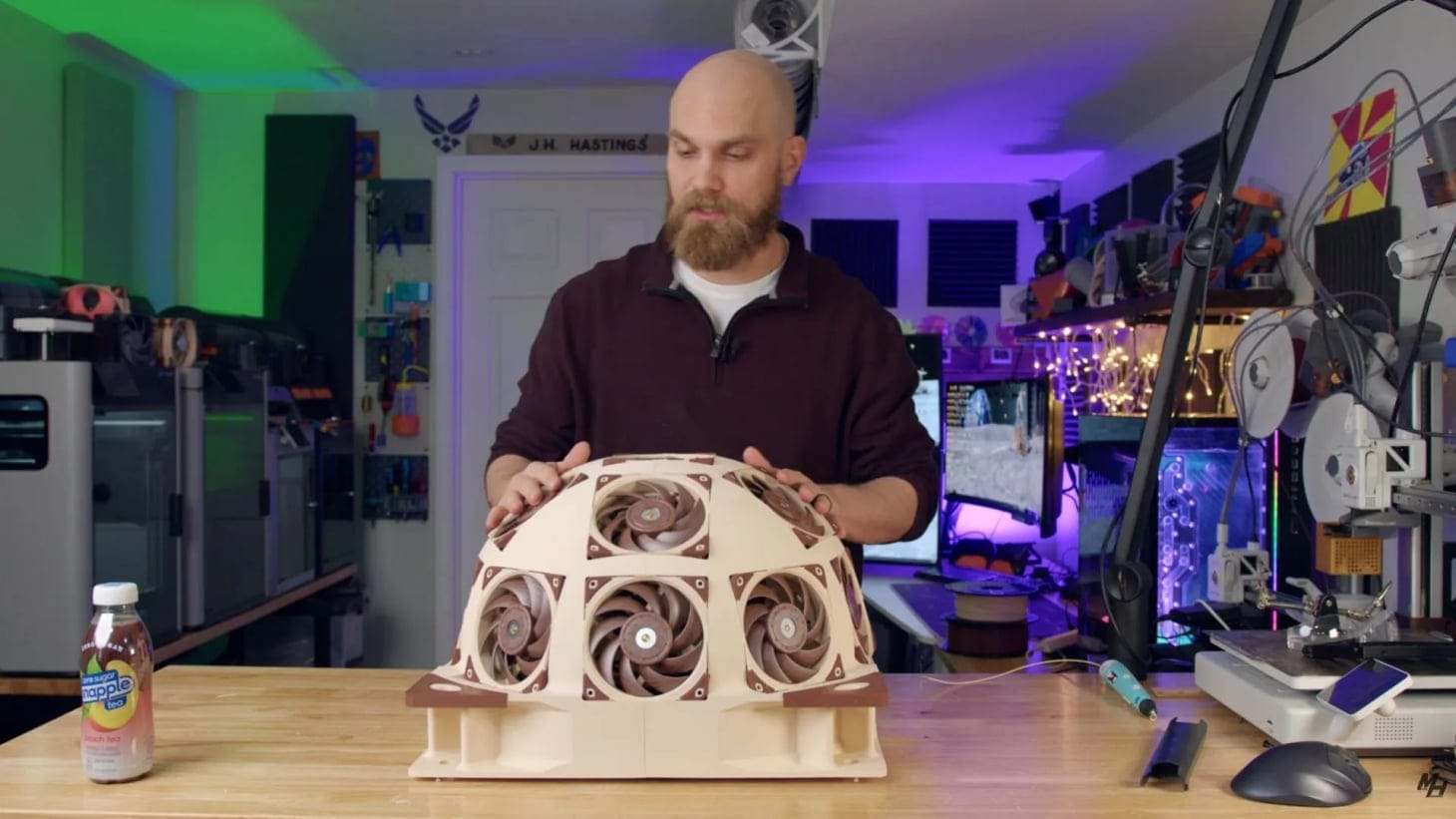

When Major Hardware, a well‑known PC‑experiment blogger, set out to test an unconventional airflow solution, the result was a dramatic temperature swing that reshaped his view of cooling high‑performance builds.
Lead: The fan‑dome concept
Major Hardware assembled a dome of fifteen Noctua NF‑A12 120‑mm fans and mounted it over the side panel of a custom case. The goal was simple: see whether massive, directed airflow could outperform his trusted water‑cooling loop.
Open: Building the prototype
The design started from an earlier 3‑D model that had only a single fan. Scaling up required a sturdy frame that could hold the fans in a circular array while still fitting inside a mid‑tower chassis. Noctua supplied all fifteen fans free of charge after a partnership request, turning a $480 bill of materials into a community‑backed experiment.
Each NF‑A12 fan was wired in parallel to a single 12 V supply, delivering a combined airflow of roughly 1,800 CFM. The dome was sealed against the case panel with foam gaskets to prevent recirculation of warm air. A critical detail, since even a small gap can let hot exhaust loop back into the intake stream and eliminate your temperature gains.
Middle: Testing conditions and results
To generate a realistic load, Major Hardware ran an extended gaming session, pushing a Ryzen 9 5950X to near‑stock frequencies. Under the traditional water‑cooled setup, the CPU settled at 86 °C after ten minutes of sustained gameplay.
After swapping in the fan‑dome, the same workload produced a steady 67 °C reading. A reduction of 19 degrees Celsius, approaching the 20 °C improvement threshold. The temperature drop was consistent across multiple runs, confirming that the dome's directed airflow removed heat faster than the liquid loop could transfer it to the radiator.
Close: Lessons for builders
From this experiment, several practical takeaways emerge for anyone seeking to squeeze extra performance from a desktop PC:
- Massive airflow can rival traditional liquid cooling when properly sealed. The fan‑dome proves that volume, not just velocity, matters when you're moving heat away from critical components.
- Using identical, high‑quality fans ensures predictable performance and noise levels. Mixing fan models introduces turbulence and acoustic hotspots that can sabotage an otherwise elegant solution.
- Community support can offset component costs for experimental builds. Major Hardware's partnership with Noctua turned a $480 parts list into a zero‑dollar prototype, demonstrating that makers who share their work often find willing sponsors.
- Testing under real‑world loads provides more trustworthy data than synthetic benchmarks. A gaming session stresses the CPU in ways that stress tests can't replicate, revealing thermal behavior you'll actually encounter day to day.
- Proper sealing prevents warm air recirculation, a common pitfall in DIY airflow solutions. Foam gaskets and careful panel alignment are the difference between a 19‑degree drop and a disappointing two‑degree nudge.
- Unconventional designs can unlock thermal headroom for overclocking without additional pump or radiator upgrades. If you've already maxed out your liquid‑cooling investment, a fan‑dome retrofit might be the cheapest path to another 200 MHz.
For builders who value individualism and hands‑on problem solving, the fan‑dome demonstrates that thinking beyond the standard cooling toolbox can yield tangible performance gains. Whether you're chasing higher frame rates or simply want better thermal management, exploring large‑scale airflow configurations is a worthwhile experiment. Creation starts where manuals end, and in this case, it starts with fifteen fans, a little foam, and the determination to try something genuinely new.