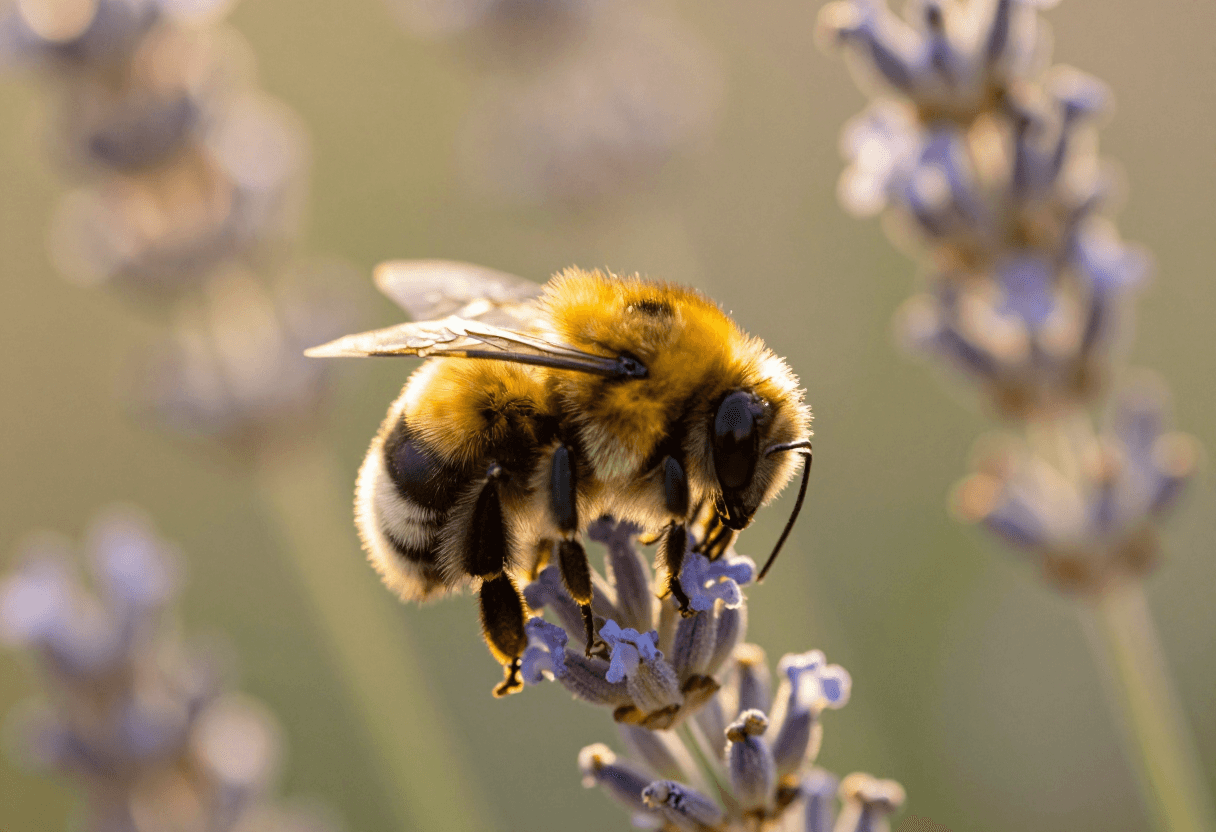

On June 4, 2026, a team at the University of Oulu published something no one expected: buff-tailed bumblebees solving a three-step problem they had never encountered before. More than 70% succeeded—not through trial and error, but spontaneously. That performance matches what Wolfgang Köhler observed in chimpanzees stacking boxes to reach bananas a century ago, except these problem-solvers have brains smaller than sesame seeds.
What the bees did
Akshaye Bhambore and Olli Loukola gave 22 bees a chamber with a low ceiling (too low to fly under) and a sugar feeder hanging out of reach. On the floor: a lightweight plastic ball. To access the reward, each bee had to roll the ball beneath the feeder, push it into a shallow hole to stabilize it, then climb onto the ball—using it as a platform.
Sixteen bees solved it. The researchers had never trained the insects to use a ball as a tool. The bees recombined two unrelated objects—ball and feeder—into a single, goal-directed sequence. That recombination is the signature of insight, the sudden appearance of a solution without incremental learning steps.
The apparatus—a ball-feeder system (a hopper that presents a ball to a feeding station)—was designed to prevent accidental success. The chamber's geometry forced a specific sequence: transport, stabilize, climb. Bees that succeeded moved the ball an average of 4.2 centimeters to the target zone and accessed the reward within 90 seconds. Naïve bees—those that had never seen the ball or the feeder—moved the ball randomly or ignored it; only one out of 22 succeeded.
How the team ruled out luck
To exclude trial-and-error, play behavior, and visual guidance, the Oulu group ran control experiments. In one condition, they hid the feeder during ball movement. Bees still transported the ball to the correct spot, then climbed once the feeder reappeared. That indicates the insects built an internal representation of the goal—they weren't simply following a visual cue or stumbling into success.
The gap between experimental and naïve groups was statistically robust: p < 0.001 for success comparisons. The data show bees that had prior exposure to the ball and feeder (but never in combination) generated the solution in one or two attempts. Naïve bees failed almost universally.
What insight means
In psychology, insight is the abrupt comprehension of a problem's structure—the moment a child realizes she can turn a doorknob instead of pushing the door 50 times. Insight differs from incremental learning (reinforcement trial by trial) and from instinct (hard-wired behavior triggered by a stimulus).
Köhler documented insight in chimpanzees between 1913 and 1920, publishing The Mentality of Apes in 1925. His subjects paused, then suddenly stacked boxes or joined sticks to reach fruit. For a century, skeptics argued that such "aha moments" required primate-sized brains, language, or abstract reasoning. The 2026 bumblebee data contradicts that assumption: a brain with fewer than one million neurons generated the same functional outcome.
This does not mean bees possess human-like consciousness or verbal thought. It means spontaneous, flexible problem-solving—once thought exclusive to vertebrates—is present in an insect. The finding suggests insight is not a high-level add-on but a fundamental cognitive mechanism shaped by natural selection across phyla.
What remains unknown
The study awaits independent replication. No other lab has published results from a comparable spontaneous ball-platform task. The Oulu team's data and code are archived on Dryad, enabling replication attempts.
Key open questions: Do wild-caught bees (not lab-reared colonies) show the same success rate? Does the behavior transfer to different apparatus designs—say, a lever instead of a ball? What neural circuits in the bee brain encode the recombination of tools? Sample size (22 bees per group) is modest; larger trials will clarify how robust and repeatable the effect is.
The paper does not report individual-level variation in latency or error rates beyond aggregate success percentages. Future work should track whether some bees solve faster or with fewer errors, and whether those differences correlate with age, foraging experience, or colony role.
What this shifts
If insight is present in bumblebees, it reshapes how we model the evolution of cognition. Rather than a ladder—simple to complex, invertebrate to primate—intelligence looks more like a toolkit: different species assemble different suites of problem-solving mechanisms depending on ecological pressure.
Bumblebees face multi-step foraging problems in the wild—learning flower cues, avoiding predators, optimizing routes. Spontaneous tool use may be an adaptive byproduct of that selective regime. The next experiment: can bees solve a different novel task with the same speed and success? If yes, the finding generalizes beyond one apparatus. If no, the ball result may be a lucky match between bee sensorimotor skills and task design. Either outcome tells us something new about how miniature brains carve problem-space. Read more: Claude Sonnet 3.5 Fails the Butter Test, Robots Lag Humans.